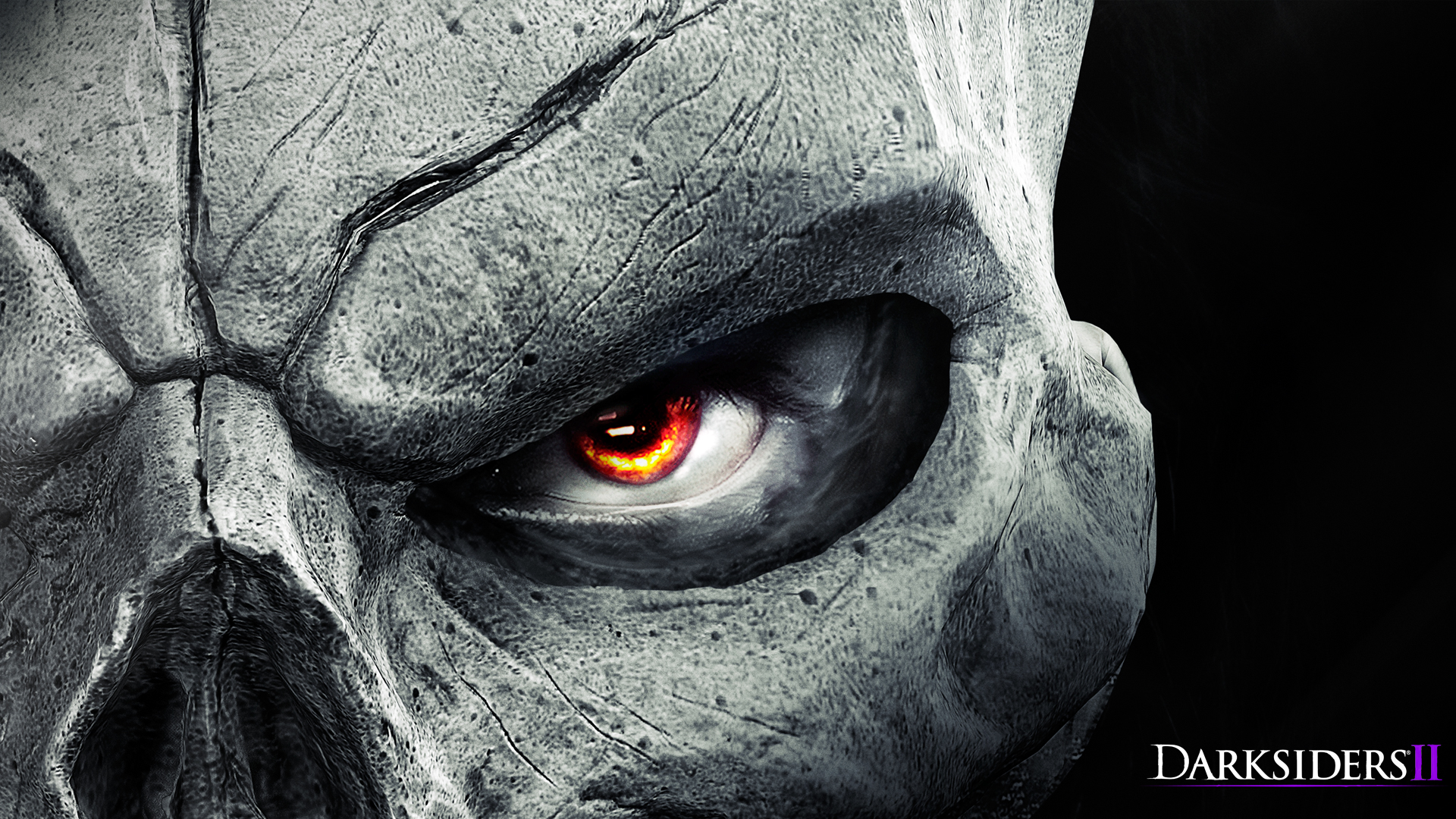
Darksiders II has arrived onto our consoles, bringing the Anti-hero Death and his cutting wit back to the Xbox One after a period away. This Darksiders presents a mirror image of the content which released on the Xbox 360, yet has all the DLC of the original already available. The Deathinitive Edition also includes a graphical tweak which sharpens up the details and cleans up the corners.
The Darksiders saga differs from the religious texts in a way which makes them seem more human and likeable. In this Universe, the Four Horsemen (War, Strife, Pestilence & Death) are a force operating under a group called ‘The Charred Council’ who are trying to keep the balance between Heaven and Hell. To do this, the aforementioned riders are tasked with keeping the Seven Seals complete, as to break these would herald the End Times

In this story, the Red Rider, War mistakenly starts the apocalypse. In the ensuing chaos, accusations are thrown about, and the mythical Charred Council throw him back into finding his redemption as he hunts down the real culprits. Leading War into combat with a multitude of different foes. Darksiders 2 runs in a parallel story arc, with Death trying to find out what has happened to his brother. This puts him at odds with plenty in his way, yet the Pale Rider constantly finds himself beating the challenges which come across his path.
The game opens with an interesting sequence, which you have to sign in again, despite being already signed into Xbox Live. Whilst irritating, this is a slight problem which has little after-effect, it is still troubling for this to be in so early. The game starts with the introduction of Death, and his purpose and his backstory are revealed. Following the opening cut scene, you are introduced to Despair and Dust. These two are a Horse and Crow respectively, and assist you on your journey, Despair acts as a mount for Death, allowing him to travel across large distances quickly, despair even has access to a sprint button with RB providing a short yet rechargeable boost. Dust acts as a guide making sure you are heading in the right direction, and can be activating by pressing the LS. Each are a key part of the experience and can be a valuable aid when you’re stuck.
Death himself is shown to be a scrawny character, with emphasis on agility and precision rather than the brute force which was so prevalent early in the genre’s history. This perception of the character Death, is interesting as it is a direct contrast to the portrayal of his brother War, whose is the personification of brute force. Death has access to a variety of weapons, with the Scythe being his primary weapon (as fits his moniker of The Reaper.) Death has access to a wide range of secondary weapons, from monstrous Two-handed Axes and Maces, to lightning quick fist weapons. It is the same with his gear pieces (Chest, Shoulders, hands etc.) Each piece of gear has its own individual statistics, with each stat being marked green, white or red depending on how the weapon matches up to your equipped one. Equipment is marked by quality, from white at the low end of the scale, to yellow at the high end of the scale. Generally, the better quality, the better of you will be. Special weapons and gear are available, these typically drop from bosses, and have a mixture of high range stats with along with a description of the item.
Death has access to two different talent trees. Harbinger and Necromancer, each talent has its own benefit to Death’s playstyle, with some abilities that have to be actively triggered whilst some others add a passive benefit onto an ‘active’ skill. The talents work in a three-stage structure, the player can put one point in to get as far down the talent tree as soon as possible, or they can put three points in the skill to gain maximum benefit from it. The Harbinger specialisation concentrates on dealing high damage on a short period of time. The Skill ‘Teleport Slash gives you a 15% heal at max rank, yet the passive skills can be utilised to set the target on fire, cause them to explode and increase Death’s Wrath generation. Other skills in the tree give a damage skill, and the others increase the effectiveness of said skill. The Necromancy skill tree brings a range of support abilities for Death to take advantage off. Using Exhume, Death summons Ghouls who with the passive Death’s Allure can attract enemies, effectively acting as a tank so that Death can beat on enemies.

The story opens with Death on a glacier before tracking down a character called The Crowfather, and trying to figure out what is going on with War. The Crowfather is enigmatic, yet insists that Death will find answers elsewhere. Following from an inconsequential QuickTime element. Death travels to the Forge Lands, a place of wonder and inhabited by the Makers – Tall Humanoids with the task of being the architects of creation. Upon Completing the Forge Lands, Death Travels to the Lands of the dead and beyond in search of a solution and to battle the corruption which has appeared everywhere.
The story is very well written, with excellent characters which give the player a feeling of being involved with how the story progresses, each character that death encounters brings a different level of tension and embodies different aspects of the human spirit. The Makers, as an example, focus on the good. Karn, the youngest of the makers, is this to a flaw, as his willingness to prove himself to his colleagues gets him in all sorts of trouble, despite his best efforts. There are other Characters which show off the other side, by reflecting the bad in humanity, with Absalom constantly looking for retribution against the Riders for perceived misdeeds in the past. Each location brings new information to the fore, giving the player the inclination to keep on going.

The art style has a style which is uniquely its own, and each location has a unique style. The Forge Lands focus on promoting that fantasy aspect, with the wide open plains and dense forests falling away to the lava-filled forge, to the water-logged and the frozen shadow gap. The Lands of the dead echo their theme with barren areas being populated by either towering citadels or plunging crypts, giving a sense of scale which is rarely seen in a game of this style. Each little piece has been crafted and upgraded from the Xbox 360 version, to give a greater sense of clarity. But there are places where this falls over. When dealing with the Makers, at their town of Tri-Stone, the shadows on the NPC’s don’t fit smoothly onto their frames. These shadows blur and are pixelated to a degree where it is irritating just to be near them. The Maps give a sense of the scale in these games and are navigated by using the right stick.
The Music compliments the art and gameplay perfectly with every zone having a distinct sound. The Drenchfort, is a great example, the music flows around you, with a very oriental feeling to it, perfectly complimenting the reason you’re there. Every location has its own distinct feel, and the music helps create that. Combat is fast paced and frantic, with a musical beat to accompany it. In truth, because of the swirl of the melee combat, and the variety of enemies which you face, the music goes unnoticed. It is a credit the folks at Nordic Games and Gunfire Games that the surroundings and the music tie in so well with the overall feel of the game.

Using Death’s agility, the game forces you to beat puzzles to progress. These can be simple traversal challenges, which force you to take an alternative path should the gate be blocked. Any climbable path is normally marked out by noticeable wear due to use, and thankfully many of the objects you can use are marked out in a yellow outline. Vines and broken pillars are also used to traverse areas which would not be accessible by other means. Every single puzzle has been well crafted to keep the player entertained. Later on the progress of the game, Death gains access to a ranged grip, allowing him to swing across gaps that are wider than anything else. The addition of constructs which aid Death in his crusade through the environment, creating more ways through, around and over blockages in our heroes’ path.
Combat is swift and fluid, with the lock-on feature being both a boon and a curse. The boon is because it singles out your target causing your focus to be on him alone. The curse comes from being unable to view your immediate environment due the letterboxing of the lock-on, causing you to miss out on attacks directed at you. In a swirling mass melee filled with claws, swords and all sorts of melee weaponry, this can be quite irritating. Coming up against a variety of monsters, from small skeletons, to giant winged fire birds, the ability to view your environment is quite crucial. Combat controls are simple, using X and Y as your primary and secondary attack buttons in a different order create a wealth of different combinations. Filling in with A to jump gives a group of mid-air attack moves which can cause plenty of damage when used right. RB acts as a dodge whilst locked on. The Player has a modifier LB, which allows them to program abilities from the talent tree to buttons for use in combat.

Darksiders II has gameplay which flows and bends around the objectives which are offered to you. Plenty of time is spent travelling or solving puzzles in comparison to the tiny amount of time spent in combat. The puzzles make this game alongside the idiosyncrasies of characters and locations. The Character of Death is the perfect Anti-hero, as his jibes, and conversation with characters grant an insight into what the developers were aiming for. His willingness to go into danger for his brother echoes at the very heart of what means to be human. This is a game that I really enjoyed and whilst there are slight discrepancies, which take away from the overall majesty of the Darksiders saga. It is still a game which should be worth playing and is worth every penny of its price. Buy this game, play it, and enjoy it.
^Ben (@Benwatson90)

Ben was a regular ICXM contributor between 2014–2017, publishing 45 articles across game reviews, Windows and PC, and Xbox news. Their work focused on hands-on reviews, platform commentary, and breaking-news reporting during the Xbox One X launch year and Microsoft’s wider Play Anywhere / UWP gaming initiative.