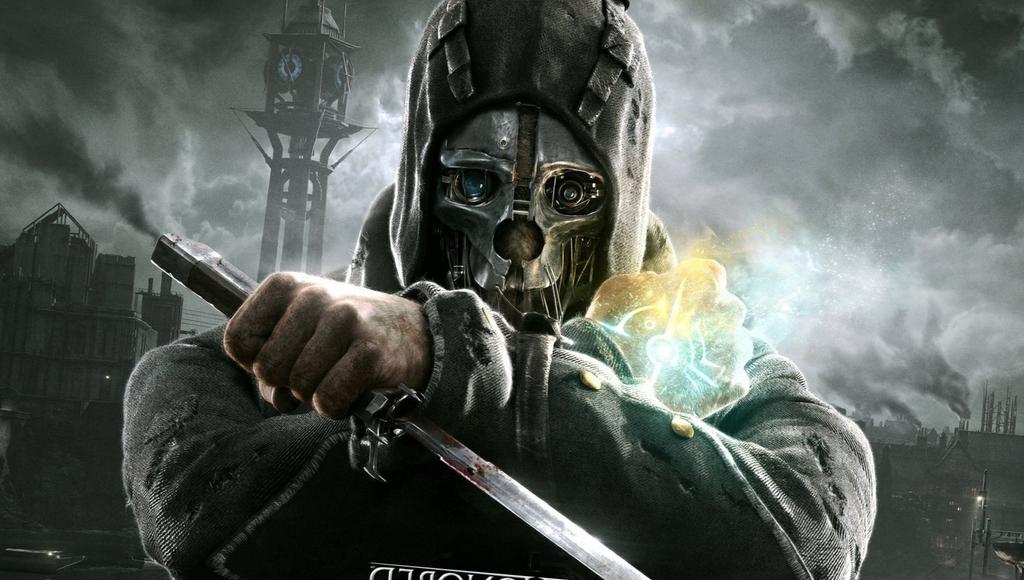
Stealth mechanics are one of the most common types of gameplay in videogames, but ironically, not something that is usually done particularly well. Whenever a game proudly states that it has stealth sections – or is even based entirely on stealth – most gamers tend to shudder as all the bad experiences they’ve had flash through their minds like they’re suffering from PTSD; Post Traumatic Stealth Disorder. It’s a common ailment amongst our kind.
But once in a while a game sneaks up on us and actually nails the gameplay we’ve been desperately seeking all these years. Dishonored, in this case the “Definitive Edition” for Xbox One, is one of those games. It wowed us on its original release for the 360, and everything that made it good still holds up today, which shouldn’t be a massive surprise considering the relatively short time between releases. This is certainly a spit and polish remaster, rather than a big upgrade; bringing slightly improved visuals and all the extra content, which goes some way to padding out the original’s somewhat short length.

If you’ve already played the original version of Dishonored, I can tell you straight away that there’s no real reason to buy this version again. There are no significant enhancements on either a technical or creative level, unlike some other ports such as Tomb Raider, which got big boosts to framerate and resolution along with completely overhauled graphics for Lara especially. Graphics are marginally better, but controls are unchanged and the animations – particularly facial expressions – are distinctly last gen. Even the DLC that’s thrown in is quite missable. Unless you’re addicted to this world, in which case you probably already bought the DLC, there’s not a ton of new stuff to enjoy, but it is a bonus if you’re completely new to the game.
So, if this is your first ride, you’ll need to know what to expect. Firstly, the game is like a weird mix between The Elder Scrolls, Bioshock, Assassin’s Creed, Half Life and various steampunk ideas you’ve probably never heard of because you aren’t a hipster. If that sounds like a great mix on paper, you’ll be pleased to know that it is even better in practice.
Firstly, the world is beautiful in a strange, Victorian-Dystopia kind of way. You’re chucked into it head first, fighting through sewers and prisons, then out onto the streets where it’s surprisingly almost as grim. Disease and poverty is everywhere, and speakers constantly read out propaganda, often about the supposedly evil deeds of the protagonist. It’s all very dark stuff but it the best possible way, and sucks you into the world immediately. The only distracting thing is the weird character art style, with some characters looking quite normal and others having stylised features like massive hands that are bigger than their bloody head. It’s laughable and could’ve been done a hell of a lot better.

What’s also laughable but in a good way, is the deep, exciting and sometimes brutal gameplay, which is primarily focused around stealth as you are an assassin and killing guys is your speciality. But there’s so much more to Dishonored than just sneaking around in the shadows. You can handle yourself in a fight no problem if you know what you’re doing. You’re able to carry an item in each hand right from the start of the game, so you can quickly transition from pinning a guy against a wall from 50 yards with your trusty crossbow, to jumping into the fray with your sword in your other hand. This is not only satisfying and flows really well, but can occasionally be quite violent, with heads flying off in slow motion. This is a good thing.
The gun and swordplay is great, but Dishonored isn’t only limited to that; as you also quickly develop supernatural abilities, such as being able to blink (teleport) to anywhere within your line of sight. There’s a lot more abilities than that too, some of which help in the sneaking around parts – like being able to kind of see through walls – and others help in the fighting baddies parts – like being able to summon a swarm of rats to devour your opponents. You also have bonus items, called bone charms, that buff abilities like being able to hold your breath longer and fight better. The magical abilities are unlocked by finding runes and charms around levels. Don’t worry about missing out on them too much though, you have help finding this stuff. Early on you’re given a magic heart that beats when you’re close to hidden items, making the search much less annoying than it could’ve been.

Despite the ability to kick ass and take names though, the game does push you towards being sneaky rather than Ramboing it up. It does this not by making you weak in combat, but by using a rather nifty morality system. Every bad deed you commit, like murder, makes the town worse for the populace you’re trying to save. Killing creates more famine and disease and despair, but showing mercy brings balance to the force, creating hope where before there was none. This can affect your playthrough, but in ways that should not be spoiled. All this moralising might sound like yet another clunky good & evil system, but it’s smarter and far more subtle than that. It’s so much more nuanced and insidious than something like Mass Effect’s paragon-renegade system, which was great in that game but wouldn’t work at all here. This is darker, greyer, and more real.
Even if you decide that the dark side is for you, there’s still fun to be had when you’re not directly getting your hands dirty, or when you want to want to add a bit more spice to an encounter than simply killing someone. Again, spoilers are hard to avoid in this aspect, but listening to characters and reading journals can be a huge boost to your enjoyment of the game. Angry mobs certainly can be handy. You won’t be bored just looking around either, as the levels are extremely detailed, with tons of hidden items and multiple ways to complete them. There’s almost always a different path to take, something else to see, or a different method to use. It’s very open despite not being an open-world game, and despite the graphics not being enhanced much since last time, it’s still a fantastically richly designed world.

In conjunction with the excellent level design, the meat of the game is of course the flow from stealth to combat. Getting around with the Blink ability is both a joy and a vital tool, allowing you to move from hiding place to hiding place without being seen, or getting you into places you otherwise couldn’t reach. As you sneak around and start taking out guards, the bodies start to stack up and attract attention. Thankfully you can move them as well as loot them. If that sounds like a pain, one of the many abilities you can get turns dead guards to ash when you kill them, so you can nip round doing that and saying a badass action-hero line like “dust to dust mother f*****r” after each kill, instead of worrying about getting detected.
The level design and inventive combination of abilities & sword-play are the two pillars on which Dishonored stands tall against all competitors. It’s more than satisfying to infiltrate a building, blink around the rooms, either slipping by or taking out guards, and reaching your target to give them a highly-deserved and highly ironic death. Again, the port could’ve made the controls a bit tighter but they’re more than acceptable and allow for smooth movement and skilful play once you’re accustomed to the mechanics. Despite any flaws the gameplay may have though, the inventiveness and creativity on display is still outstanding, even compared to newer releases.
Summary
Overall Dishonored is still a superb game, and one that stealth fans must pick up this time round if they avoided it before. There’s nothing at all new for people who’ve already played the original version, and a disappointing lack of enhancements in general, but the core gameplay and world design continues to be one of the strongest in the genre. It falls short as a definitive edition, but still excels on its own terms.

Dean was a regular ICXM contributor between 2015–2017, publishing 39 articles across game reviews, Windows and PC, and Xbox news. Their work focused on hands-on reviews, platform commentary, and breaking-news reporting during the Xbox One X launch year and Microsoft’s wider Play Anywhere / UWP gaming initiative. They post on X as @SpookyWomble.