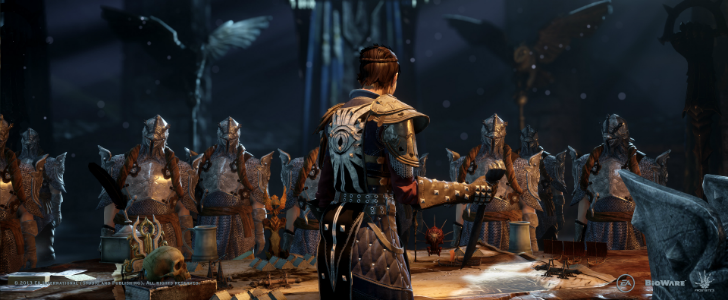
BioWare is a company with an almost unparalleled history in gaming, certainly in terms of quality. Knights of the Old Republic is still considered not just an incredible RPG but the best Star Wars game ever released. The Eastern-themed follow-up, Jade Empire, was more of a kitsch title but was still massively well received by gamers.
The Company moved on to the Baldur’s Gate series before bringing us two of the most iconic franchises of all time; Mass Effect and Dragon Age. These series are, in my opinion at least, some of the most spell-binding and engaging stories ever committed to game. Dragon Age: Origins and Awakening together provided a depth of role playing mechanics that were so rich and detailed I didn’t even fully utilise them until my second playthrough.
However, Dragon Age 2 (which incidentally coincided with their purchase by EA) while still providing a gripping and immersive story, was a huge disappointment on the gameplay level. Little in the way of customisation, massively simplified combat and constantly repeated dungeons left many fans wondering if BioWare had lost the touch.

This is the background to my tentative approach to Dragon Age Inquisition. There can be fewer bigger fans of the developer or the series, but at the same time I was stung by the previous title and so my expectations were suitably tempered.
With all that in mind, the sheer scope of Inquisition makes this a particularly difficult review to write. If I tried to break the game down and cover everything you wouldn’t be reading a review, it’d be a dissertation. The best approach I’ve managed to come up with is to provide some of the highlights (or lowlights) and give you an understanding of how the game works and feels.
The best place to start, however, is the Dragon Age Keep site. This isn’t just a suggestion, this is a public service announcement: Go to DragonAgeKeep.com BEFORE you play. This site lets you log in and import your Save games from Dragon Age: Origins, Awakening and 2 which have a massive impact on the world of Inquisition. Everything from major plotlines to minor character appearances are shaped by the decisions you made in previous games. If you haven’t played these earlier titles (or you just want to amend some of the actions in your past) the site also offers the chance to write your own history from scratch or edit an existing one.
You start the main game having just been saved and subsequently expelled from a fade rift (a portal to the fade, the Spirit Realm) by a mysterious female figure. Was it a demon, a benevolent spirit, a mage or even Andraste herself? This is the question that pervades much of the game. Regardless, you are clamped in irons the moment you awake from your ordeal and it quickly becomes apparent that your traversal through the rift and subsequent survival have brought suspicion upon you. After all, you are the sole survivor of a fade-based attack on a meeting of high level religious and political representatives, known as The Conclave. It doesn’t help that one of your hands is aglow with green fade energy, and seems to react every time you encounter one of the many smaller rifts that have been appearing across the land.
Once it becomes apparent that your newfound power can be used to close these rifts (and that you are prepared to use it to that end) you are grudgingly accepted by the Seekers who captured you, and taken into their newly founded order; the eponymous Inquisition.

With the barrier between the mortal world and the Fade collapsing (allowing daemons to pour fourth) and a devastating, widespread war being waged between Mages and their previous slave-masters, the Templars, the ancient order of the Inquisition has been reformed to try to restore peace to the land. Having been given the title of ‘Herald of Andraste’ (whether you like it or not) by many of those caught in the troubles, you are asked to help head the Order. In practice this means your role sees you expanding the influence and power of the the Inquisition (through both direct and political means), while also helping the refugees and inhabitants, returning political and religious stability, dealing with the mage-Templar war and of course restoring the barrier to the Fade and expelling all the unwelcome visitors.
Sound like a lot to take on? Well it is. Luckily you have the chance to recruit a huge team to support you, ranging from familiar faces like the head Seeker herself and the wise-cracking city Dwarf Varric though to Quinari mercenaries, sociopathic Elven rogues and smart-mouthed Tevinter mages.
Of course the first decision you have to answer before any of this is what character you want to be. Male or Female; Human, Elf, Dwarf or Quinari; Mage, Warrior or Rogue. Even among these choices there are sub selections (such as warriors specialising in 2-handed or sword and shield, Rogues being archers or hit-and-run melee etc). You also have a huge range of options for your character’s appearance.
The customisation doesn’t end when you make decisions about your race and face, in fact far from it. As you play you gain experience points used to unlock skills in any of 5-6 skill trees, which vary depending on your class and type. Some of the trees will provide direct attacks or offensive magic etc, while others will be defensive, and some will provide temporary buffs across the various attributes for yourself or the whole group. Beyond that there is the insane crafting system, but more on that later.

Once you get past the tutorial you are dropped into the huge, beautiful and totally alive open world. Nothing you have played from BioWare previously will prepare you for the size of the areas you are presented with. Starting in the Hinterlands, you are given the opportunity to explore hundreds of square miles of fields, valleys, hills and rivers.
As you wander with your party of 4, you will come across caves, forts, farms, villages and more. They may be populated by friendly (or at least neutral) characters, or hostiles such as Templars, mercenaries, or even feral animals. The next hill or house could provide loot, or (very often) a new lead or subquest. It can actually be daunting to see your subquest menu fill up so much in one area alone. However, it also means that as you wander, despite the size of each area, there is always something to do nearby and you constantly feel like you are making progress rather than just wandering or grinding.

To understand the scope, scale and style of the play in these areas, forget Ferelden and Kirkwall just for a moment, and think Cyrodiil and Skyrim. Crucially for a game of this length and scale, the main and side missions all interact well, and provide a lot of variety. Fetch quests, NPC assists, assaults and defences, area clearances, set collecting and (of course) closing Fade Rifts are all present and available. There are also random events and incidents that you will come across as you wander around, and often you will note a situation that seems irrelevant at the time only for it to become important later on as the result of a conversation or interaction.
I spent over 20 hours in the first area alone. And that is only the first of very many.

As is a staple for BioWare games, when interacting with party members, main characters and even random NPCs you will be presented with multiple dialogue options for every response. These range from simple questions and statements to insightful questions, quest-unlocked options and the classic ‘good/evil’ style options that will evoke an emotional response (not only from the person to whom they are directed, but often from your party members too). The evolution of the series pervades this aspect, too. Although there are ‘emotional’ options that provoke a reaction, they are not clearly marked with symbols, or written in red or blue, as they have been in previous games. Instead you have to consider who they are directed to, who is with you, and how all may react to each option. Keeping people happy is certainly more of a challenge than previously, and it makes the game feel far more natural and real as a result.
The subquests you undertake, people you interact with and choices you make on your travels all shape the world you are trying to save. This can be obvious and direct or far more subtle and hidden. They can also gain your Inquisition more ‘Influence’ as well as additional perks. These are used in the War Room of your base keep, and can be used to provide your party both direct and indirect benefits, as well as used to allocate the resources and forces of the Inquisition around the many areas to help keep the peace and support the people.
The combat is an interesting combination of RTS and turn-based.
If you want to keep it simple, you can just stick to your primary character and keep the action flowing as you run around in third-person, unleashing regular attacks and special moves as the rest of your party does their own thing, controlled by the computer (somewhat intelligently) unless you choose to switch character and take control.

At a mid-level there is the inclusion of ‘tactics’. Those familiar with Origins and Awakening will be familiar with these (and like me will probably welcome their return). They are macros that allow you to set up 20 or so pre-set, context-dependant actions for each character. Therefore your tank may always be set to attack the largest sod on the battlefield, your shield-barer might be set up to run to the aid of the main character whenever his health drops below 40%. Your caster might be told to use offensive Area of Effect magic any time a group of 3 or more enemies are gathered together – and ALL of your characters should be primed to use a health potion any time their health drops below 20%. Each character has standard tactics preset but those who want to have a little more control will want to set up their own.

However, the advanced (and in my opinion the proper) way to take on the combat is through the return of the strategic, freeze-time view. At any time in the game (so as soon as enemies are sighted, for example) you have the option to pause the action and switch to party combat mode through a simple press of the ‘squares’ button (yeah, I still don’t know what that button is called, it’s the one where Back used to be – Editor’s note: It’s officially called the View button, alongside the Menu button). In this mode, you can the survey the battlefield, weigh up your enemies and the terrain available, and issue each of your party members an order. Time will only move forward when the right trigger is held, so you can pause and resume on a whim. It brings the best aspects of the combat from Origins and even KotOR but with an added polish that makes it both fun and user-friendly.
Despite the time-freezing, it’s not a strictly turn-based system. The commands you issue are not taken sequentially or in order. The action is happening ad hoc, all over the battlefield, you may pause to issue your rogue an order to take a long shot, but your mage might be half way through casting a ward as you do it. It makes it feel less artificial than simply issuing 4 orders and then watching them play out before doing it again. The only downside is the lack of an option to ‘stack’ actions. It would be nice to give each character a number of actions to undertake and then let them play out over a longer period before pausing again to issue more or reconsider tactics.
On to the customisation. Oh the customisation. The sheer number of options for customising your weapons and gear is mind-boggling. You obviously find loot as you move around the world, and each type of weapon and armour comes in a variety of forms and rarities, from common through to unique. The range of every type is impressive, and then they vary further by carrying different stats and buffs. You can then augment them with runes and extra parts (such as hilts and pommels for swords, grips and arms for bows, hafts and blades for staves, arms and legs for armour etc) to provide greater stats and so greater variety.

But more than that, as you travel you will find crafting plans and materials; and there are hundreds of each. You might find the plan to build a weapon, so off you toddle to the blacksmith to craft it. The ‘tier’ of the plan will dictate the number of ‘slots’ available – so tier 1 schematics have 2 slots while Tier 3 have 4 slots. Lets assume it’s a tier 2 plan and has 3 slots. These will come in different forms, so you may have a ‘Primary’ slot, an ‘Offence’ slot and a ‘Utility’ slot. The Primary Slot will require a type of material relevant to the weapon, so for example, a hammer would need metal or stone. This slot dictates the base attack value and level of the weapon, and choosing each of the 10 or so material options form the selection you have collected will provide different stats. However, if that same material is applied to, say, the Offense slot, it may instead imbue one of a number of bonuses or buffs such as fire damage, bleeding or even healing per hit.
Then of course all the items have the potential to be upgraded – even the potions and grenades.
I could talk about the crafting and customisation for hours. There is so much variety in ways to put items and weapons together that you could probably play through 20 times and have a completely unique setup for your entire party every time. All you need to know is that it is optional, but it is INCREDIBLE. I have never seen an RPG come anywhere close to this level of variety in customisation and crafting.

I am already bordering on dissertation so I will wind up with a quick word or two about the multiplayer. It is not totally different to that seen in Mass Effect 3. You have a 4 man party and a large number of character builds to choose from (3 to start with, many more unlocked as you play). You can level up the characters and choose how to spend XP on a cut down version of the Single player Skill Trees. You also get new armour and weapons for your characters, either found on each mission or more often from chests bought between games using in-game gold or alternatively with real world currency (I do have to say that the disparity in value of the two currency options to push you towards the microtransactions is a little more heavy-handed here than in Mass Effect).
Where this differs from its future-themed sibling is two-fold:
The first is in the style of gameplay. Instead of holding a specific area over 10 hoard waves and then an extraction, you are given a large but relatively linear level to try to work through, coming across increasingly difficult (and numerous) enemies as you progress. You will also be given random sub-missions (such as collect X number of items or guard an NPC) as you move through the rooms, which provide bonus gold if completed. These actually help it feel a lot more of a co-op story rather than a simple hoard mode.
The second difference is that the crafting I just salivated over from the single player is available in the multiplayer too. Although it is in a cut-down form its still comprehensive, and lets you tool up your characters in a way that you like and which complements your team.

So is Dragon Age Inquisition any good?
I do NOT say this lightly, but Inquisition is one of the most comprehensive, engaging and well-designed games I have ever played. It genuinely feels like BioWare have taken every positive aspect and every lesson learned from every single game they have ever made, and put them together in an open world on next-gen hardware, thus creating what I can only describe as the nearest thing I can imagine getting to a perfect Role Playing Game.
My only warning is that this is an amazing role playing game, rather than just a perfect game. If you like RPGs then this is going to ruin all the others for you. BUT, if you don’t like stats, crafting and menus, this game has so much depth and detail it may prove a little too in-depth and slow paced to keep your attention for the 90-plus hours of gameplay.
As for me, I imagine this won’t be far from my console until well into next year.
^HooksaN (@HooksaN)

David Hook (HooksaN) contributed 26 articles to ICXM between 2014–2015, covering game reviews, and Xbox news with a focus on hands-on impressions and verified-source reporting. Their bylines on the site span the Xbox One’s first full year of post-launch coverage, including the early days of Backwards Compatibility and Windows 10 gaming. They post on X as @Hooksan.