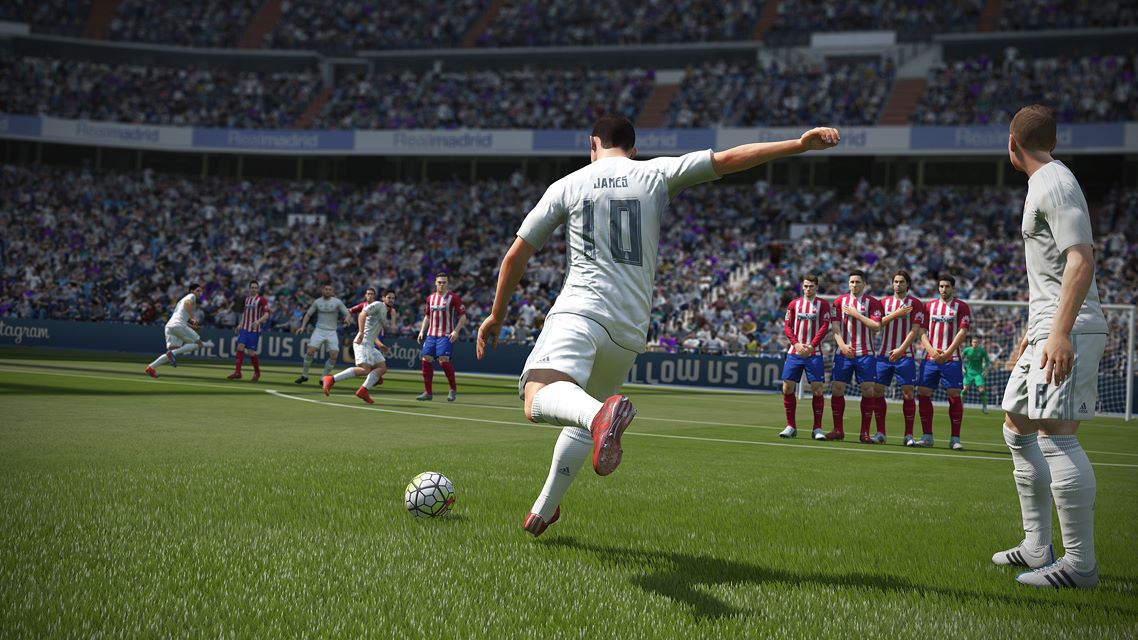
Annual football games are not particularly easy to review. Most games simply require you to detail the major features, but in these, the differences between the new and old versions are numerous and tiny, yet have a massive impact on experienced players. It’s a “death by a thousand updates” kind of review process. What you need to know though, is that FIFA 16 is really good, but with a ton of flaws. The other thing you need to know, is that I’m going to try really hard to not fill this review with dumb football puns like every other writer in the world, because I actually respect my audience’s intelligence.
Before we get into FIFA itself, you might be wondering how this entry compares to perpetual rival, PES. I won’t be reviewing PES 16 in full, as I didn’t think to touch it until after other reviews for that game came out. Now though, I can say in brief, that this year’s PES is – at least in terms of the on-pitch action – more or less as good as FIFA. Both have pros and cons, but PES is responsive, lively and has pretty much nailed the passing this time round. It’s not really an arcade-like experience, but it’s definitely designed to be more about feeling great than being an accurate simulation, so which one is better depends on that preference. Pro Evo’s presentation – user-interface, commentary, licenses, etc. – are all as terrible as they have ever been, but the core gameplay is decent. So I’ll say that it’s absolutely worth looking at if FIFA’s not doing it for you.

Presentation
In contrast to PES, the presentation in FIFA 16 is utterly fantastic. The menus have a bright new look to them, which at first seemed garish and weirdly reminiscent of the default shapes in PowerPoint, but they quickly grew on me. The match graphics (the scorecards and replays, not the players and stuff) are all as authentic as it gets. Matches flow really well between gameplay and cut-aways or set-pieces, with every single moment of the match designed to be as much like watching the real thing as possible.
These efforts extend to the authentic recreations of real-life details, like the way replays cut to players on the bench or show their goals when they’re substituted. Other small additions include referees using “vanishing spray” for set-pieces, more angles of stadiums including external views, players reacting to things happening around them like pointing for teammates to mark opponents or freaking out over a decision, plus a hundred other little things. Another nice touch is being able to run to the camera or the bench for your goal celebration.
The sound design is also superb, with the soundtrack being a remarkable success story once again. FIFA really needs to be praised for the effort it puts into choosing the right kind of music, which for the last few years has been a consistent joy for many players. While it obviously won’t suit everyone, they’ve again done a great job of selecting occasionally great and otherwise inoffensive tracks, whereas in the past they’d chosen a few too many that were a bit too intensely genre-specific.

The audio department’s efforts can also be heard in-game, with new additions to what is already a remarkably good attempt at creating realistic sounding commentary, such as talking about major transfers and giving specific analysis on certain players with more regularity and believability than last year’s version. The commentators also feel a bit faster to react to on-pitch actions. In previous games they’d shout something like “and he goes for goal!” several seconds after you’d already shot, but now they keep up with the action a bit more often, although they still mess up more than you’d like.
The match atmosphere is great too, with the crowd reacting more to events on the field, such as ramping up the noise when you’re on the break or jeering when they don’t agree with a decision. Again, it still needs work but it’s more than serviceable. As a Spurs fan, I got genuine chills down my spine when I was totally bossing the game (unrealistic, I know) and the crowd began cheering “come on you Spurs” incredibly loudly and clearly. FIFA 15 did this too but for one reason or another, it felt so much more alive this time. All the effort that went into creating a real-feeling match made that moment more special than simply hearing a sound-clip.

Gameplay
The key to a great football game for most people is of course the actual gameplay. All the licenses and fancy modes in the world won’t make a game good if the “kicking it around” bit sucks. Thankfully, even though PES might have a bit of an edge this year, FIFA is still really good on the pitch. The game supports a huge variety of tactics and types of players, while older games generally favoured one or two cheap tactics and only certain kinds of players – like pacey little buggers.
There doesn’t appear to be any of those imbalances so far, but football games are notorious for exploitable tricks coming to the surface a few weeks after release, so consider this a warning that there’s always a chance of something being dodgy that isn’t obvious, even after the dozens of matches I played. For the record, that applies to other modes too and not just gameplay, with weird but generally unnoticeable bugs really common in previous career modes. I’ve not seen anything major so far, but if that stuff worries you then be sure to keep an eye open for it.
As it stands though, FIFA 16 builds upon its predecessor’s foundations with tweaks rather than overhauls and iterations rather than innovations. It just plays like a slightly more defensively solid FIFA 15, so I didn’t have any real acclimatisation period, whereas I did in almost every previous game. From a tactics perspective, everything is still set up to allow for whatever style you can imagine. I generally prefer high-line, pressing football, but playing as Chelsea and hitting teams on the counter-attack is incredibly satisfying and effective. No matter what your style is, passing, sprinting and heading are all equally valid ways of getting things done and fit together perfectly in the complex jigsaw of modern football.

But FIFA 15 did all that pretty well too, so the details are what matters here. First up, there’s passing, which is mostly the same as last year but can still be less effective if you’re sloppy. This is because defending players are now much more alert to interception opportunities. If you know anything about football, you’ll know that the key to victory is commonly believed to be in mastering the transition between defence and attack, so these new interception mechanics make that concept much more important this year.
To counter the interception system, you can now drill ground passes much harder by holding a special button. This lets you fire a ball into someone’s feet, past players that might otherwise have intercepted it. The cost is of course a higher chance of miscontrolling it, but it’s worth that risk most of the time. This is a revelation, as previously you’d often pass to the wrong player by holding down the button too long, when all you wanted to do was hit it harder rather than further away. I have noticed that the computer sometimes misuses this ability though, often firing the ball back at their keeper with predictably bad results.
The ball itself seems to behave more like it does in real life too. In last year’s game, when players miscontrolled the ball it seemed more like they were just clumsy rather than unlucky with their touch or trying to do something difficult. Now though, instead of getting annoyed that your world class player is a bumbling buffoon, you can see what the player is trying to do even when it doesn’t come off. For instance, firing the ball into someone occasionally causes it bounce up off their foot and they quickly adjust their body to compensate. Also when dribbling down the wing under pressure, even if the player is unable to do what you want, they are more likely to try and keep the ball in play with a poor but calculated touch, rather than completely fumbling it over the line.

This new-found ability to make the best of a bad situation applies to defenders to. Tackles are far more deliberate now, instead of the clumsy pokes and barges common in the last game. Slides tackles are the most improved, with infinitely more intelligent and professional-looking slides that vary greatly depending on the context. Sometimes they’ll be a desperate, last-ditch toe poke, or a knee slide that’s halfway between standing and sliding, or a fantastic curling slide that not only gets the ball off the opponent but retains it or directs it toward a teammate. Players will even try to get the ball while laying on the floor, sticking out a leg as the opponent tries to goes past, even if you missed with the original slide.
Defenders also have better AI, working more effectively as a team to fill space. Players even point and direct teammates to cover gaps or mark runners. Your team now tracks back more intelligently, following opponents and working in tandem with teammates to break up moves. They also react much faster to danger too, than in 15, when they’d often charge up the pitch and leave gaps behind before taking a while to notice. Thankfully players are now both smarter and quicker about this kind of positioning. This is particularly evident when parking the bus. Your team seems to have much more understanding of what you’re trying to do and positions themselves more appropriately, most notably if you’re trying to draw the opposition in for a counter-attack.
When you are on the attack, there’s plenty to look forward to as well. The aforementioned ping passes make a world of difference in getting through tightly-packed midfields. Long passing around the box seems like it needs to be tweaked a bit, as the game usually thinks you’re trying to cross the ball rather than switch the play and swings your pass into the box. This is annoying if you didn’t mean it but very effective if you did. Crosses lead the player a bit more this time, so strikers have something to run onto. If your cross does reach a teammate, you can expect a better header than the likes of which we saw previously. Headers are much more common and a lot more accurate, but nowhere near as ridiculously overpowered as they were in the demo.

If you manage to make a shooting chance from outside the box, you’ll be pleased to find that long shots are a bit punchier and more likely to test the keeper. They can also be a little bit unpredictable, but in a good way; curling round a player or spinning off your boot into the top corner, just like you’d see in real matches. Shooting overall is much more varied, with a much greater number of animations and possible shots. Players now try to quickly shift their feet to get around the ball or flick it with the outside of the boot in ways that simply never happened before. This not only looks much better but makes things a lot smoother in difficult shooting chances, with much more variety in the kinds of goals that are scored.
Keepers are generally convincing when dealing with ranged shots, trying to shift their momentum when they realise a ball is curving or deflecting away from them. Thanks to this, they seem less prone to making impossible saves from perfect free kicks. They aren’t so good when the action is closer to them though, sometimes getting confused if they’re surrounded by players. However it’s not been a big problem and keepers are mostly pretty realistic.
Other than the keepers, the computer opponent AI is also quite solid. Teams play much like you’d expect, with Barcelona passing it around and taking you apart piece by piece, while lower-table teams are more likely to park the bus and try to hit you on the break. The AI is able to play a range of passes and make a variety of dribbles, although it does still occasionally shift between absolutely impossible feats of genius and amateur-league level stupidity. It’s also competent in defence but still able to be fooled by intelligent passing chains or clever movement, just as a real player would, at least to a point.

Another addition to the game is the new Messi-inspired “no-touch” dribbling skill. What this means, is that the player will move their body rather than the ball in order to fool the defender. It’s a bit more complex and devious than the usual feint-shots, plus it’s available for any player to use, unlike skill moves – although better players will use it more convincingly. It’s more than just dropping the shoulder, as it not only helps to beat players, but also shield the ball, buy time, make space for a shot, or position your body for a better pass. It seems pointless or defunct-on-arrival at first, but if you take a few minutes to watch EA’s videos about it and do a quick bit of research on how players like Messi use this technique in real life, it won’t be long before it becomes not only handy but second-nature.
That’s more or less it for noticeable gameplay changes. The only other things to say on that front are that players feel a bit different to control than they did in 15. It’s not really better or worse, or even describable, just slightly different. Something that is very strange is the controller vibration, which gives you a little buzz when players clash or do something physical. There doesn’t seem to be a way to turn this off, which I’d like to do, but it’s not as annoying as it seemed in my first couple of matches. All in all then, gameplay is just a tuned version of last year’s very good effort, which is absolutely fine as long as more significant improvements are made next year so the series doesn’t start to stagnate.
Career Mode
This year career mode has got a bit more attention with a few minor tweaks and a few major additions. EA Sports says that the transfer market has been tweaked to make the frequency and values of transfers – especially major ones – more reflective of reality. To be honest, I didn’t even see many examples of completely ridiculous transfers in 15, so I can’t say for sure if it’s any better here. However I can say I haven’t seen any crazy ones, unlike those I saw in PES, with world-class players going for just a couple of million to lower-league teams. The closest FIFA got to this madness was my Tottenham scouts telling me to sign Lionel Messi.
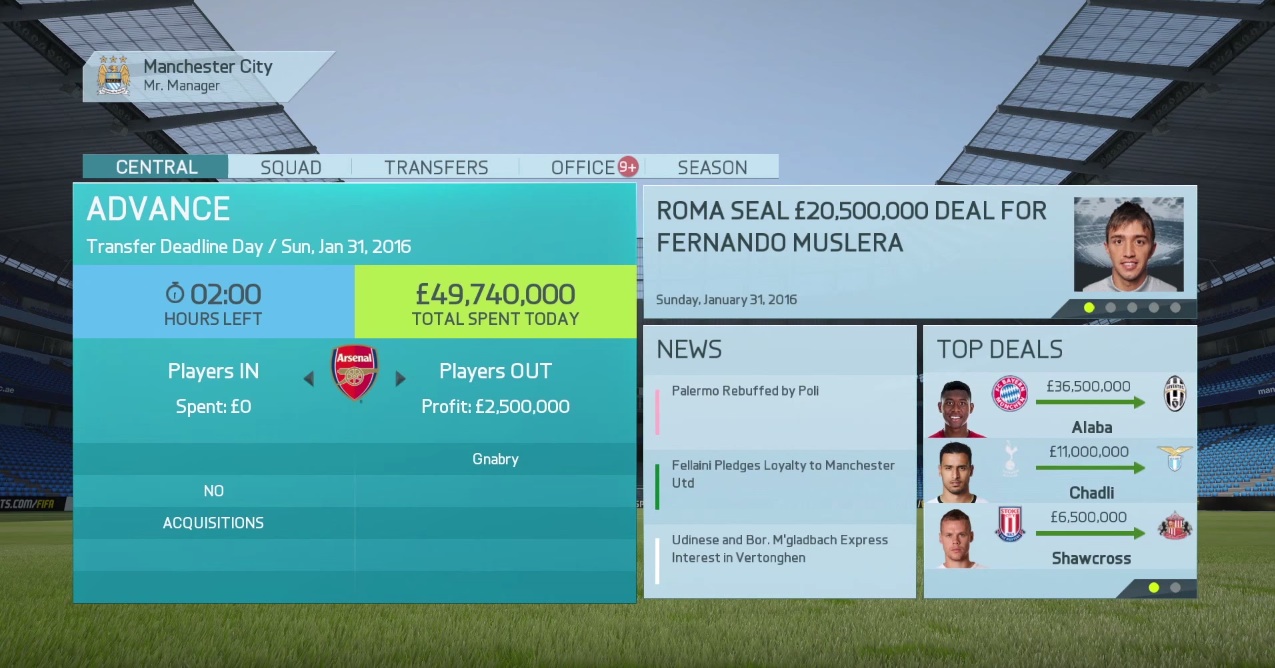
As for player values, they definitely aren’t right yet. Some players are closer to their proper values, but a lot really aren’t at all. Just in my own team, Harry Kane and Son Heung-Min are both worth less than £10m when they’re easily £15m plus players, while Christian Eriksen is a more reasonable £22m. This probably has to do with player ratings still being way off for a number of players. Again with Spurs, players like Son have looked the real deal in real life, but are rated below obviously worse teammates; Kane is a 78 versus Adebayor’s 79 and Son’s 77 compared to Chadli (who’s a subpar player in reality) at 79. So overall, the new transfer values are still occasionally laughable, with bizarre player ratings being part of the problem.
Some things that are good about FIFA’s transfers, are the new abilities to sign free players outside transfer windows and loan players for two years rather than just one. Clubs also now have transfer budgets that are closer to reality. Manchester City has the largest in the Premier League at over £70m and the scale goes all the way down to about £10-20m. It seems a bit odd though that many Spanish La Liga teams have comparable or greater budgets than Premier League teams when it’s well known that English teams are flooded with TV money, while Spain hands out a rather petty amount to anyone not named Barcelona or Real Madrid.

Career mode also features pre-season tournaments that replace the old friendlies. This is reflective of reality where not many big teams even play friendlies any more, favouring lucrative overseas, sponsored tournaments that both generate cash and enhance the club’s worldwide reputation to win foreign fans. These mini cup competitions are quite well done, with unique commentary additions and trophies to be won. You earn a few million for winning the cup, but unfortunately there’s no international fan-base or reputation system, which would’ve made long careers much more interesting as you build a global brand and unlock sponsors. Despite the missed opportunity though, you can finally use pre-season to try out more ideas, as there’s more games and the new ability to make unlimited substitutions. This allowed me to experiment with building a team around Tom “the English Xavi” Carroll, who should honestly be rated 99 if there was any justice in this world.

The other major feature in Career is a new training mode. This allows you to train six players a week on specific attributes, by completing some new skill-games like the ones seen on loading screens. This is perhaps the biggest missed opportunity, as the training mode is awful. Firstly, you can only train a limited number of players rather than setting up regimes for your whole squad. The abilities you’ve chosen to improve gradually increase over several weeks. This means that’ll you’ll be playing the same – sometimes lengthy – mini-games over and over again. You can sim them, but players get much lower grades when you do this, causing their stats to go up at a snail’s pace.
Even when taking the reigns yourself, some of the challenges are almost impossible for various reasons. In most of them, you’re forced to trust that the automatic control assists won’t screw you over, which they often do. While the computer is laughably dumb in some of these mini-games, it seems like it’s just mocking you in others; running back and forth doing skills moves that have no answer, just to waste your time. You also don’t get rewarded points for doing things that seem like they should get something, like winning a penalty in a chance creation session or blocking a shot in a defending session. It can prove to be very frustrating, as you’re doing the right thing that would win you a proper game, but being told you suck anyway.

Much better than the training is the “story of the season” feature, which highlights things like big transfers and references major victories over a campaign. This is the kind of thing that really makes each season feel unique in real life, so it’s a much welcome move. Unfortunately this feature is also undercooked, with only a few things really being called out by commentators and no real record of this sort of stuff down the line. A season-ending highlights video and a few team photographs would be a nice touch, but there’s nothing of the sort.
Taking everything into account, the new additions to career mode are clumsy and underwhelming, with the training modes and weird player ratings more likely to cause more frustration than enjoyment. The rest of the mode is still woefully underdeveloped and the lack of innovation is beginning to get annoying. Press conferences, if you can even call them that, are exactly the same. All you do is “motivate” or “praise” your team with nothing coming of it. Player interactions are the same too, with a few requests to play and notifications of retirement. There’s nothing like PES’s neat animated press conferences or create-a-manager feature, nor is there anything like Football Manager’s deep systems. Overall, career mode isn’t a bad experience, but it’s far from what we’ve deserved for years now.

Ultimate Team
While career mode has been stagnating, Ultimate Team has become a massive part of FIFA. Ironically, this year there’s not a huge amount to say about it. On the Xbox One version, you can now play Legends alongside regular players and still get maximum Chemistry if they share a nationality. Thankfully there’s also eight new legends like George Best and Ryan Giggs to go with the existing 56. It’s still missing a ton of great players, which will hopefully come in a future version along with a dedicated legends mode.
Much like career’s “story of the season” feature, Ultimate Team now does a much better job representing your club’s achievements, with commentators referencing signings, matches and records. It’s very much welcome but also a bit lacking like its Career mode cousin. There’s still not enough here to make your club feel unique or important, but in fairness, doing that would mean a host of changes rather than one new system.
Perhaps the most welcome improvements are those to the interface, with massively improved search features and a host of other community-recommended changes. Some examples include being able to find a player’s buyout amount much easier, selecting multiple cards at once, swapping entire teams with the new swap function, chemistry previews and automatic consumable recommendations. One of the best if most useless improvements is the new pack animations, with much more tension surrounding the card reveals. It’s small but really neat, even if it does feed that gambling addiction even more.

The big addition though is the new Draft mode. This new mini-mode allows you to spend points to play a few games with a semi-randomly selected team, being rewarded with prizes if you win those games. Basically, you get to pick one of five randomly selected players for each position in your team. This means that you don’t have any control over who’s in your squad and have to improvise to get a great balance between talent and chemistry. This mode could have been a masterpiece, but unfortunately it’s stuck in Ultimate Team rather than being its own separate thing. If that had been the case, players like me, who don’t like UT as a whole but like the idea of the systems, would’ve gotten a great new mode to enjoy. Alas, it’s locked away in microtransaction hell because the mode costs a large amount of points to play and the prizes you win are mostly worth less than what you’d get if you just spent the entry cost on packs.
Women’s Teams
The one major new addition to FIFA 16 is of course the Women’s national teams. It’s fantastic to finally see them represented, as the women’s game is taking off all around the world at a tremendous rate. The huge success of the recent World Cup is a real statement about where this sport is going, especially in the United States, who were the winners.
The difficult question regarding their inclusion was how they should be rated. The answer was quite simple in the end. In FIFA 16, the women are rated on their own scale and are not compared to the men. So, while Messi is far better than even his male rivals, he’s only three points higher than Carli Lloyd – on 94 and 91 respectively.

In terms of how they play, however, there are some differences. It’s not completely obvious why or how, but it feels like there’s more space in women’s games. Players don’t seem to close you down as quickly or aggressively as they do in the men’s matches I’ve played, but the random nature of football might just mean the ten or so women’s games I played were all flukes. It’s very satisfying to play and even though I admittedly don’t know that much about the players, I found myself getting really attached to them during my World Cup run with England. I completely changed the system they played and picked my own favourite players with pace and skill so I could hit teams on the counter-attack, rather than play my usual high-pressing game.
What helps in this is that the women themselves are absolutely authentic looking and feeling. They look incredibly realistic, with long hair flowing as they run and what I could be mistaken for thinking is breast physics, but it might just have been their shirts moving about. They move just like the real thing, with a slightly different skeletal structure and running animations making it feel just as you’d expect. The women definitely aren’t some marketing ploy or a half-baked palette-swap job. They are absolutely legitimate teams and players and it’s fantastic.
The only thing letting it down is the really lackluster mode they’re stuck in. The Women’s World Cup mode is the only thing they get, which itself is barebones. The hope is that next year they’ll be able to break out into something else too, or maybe be able to play against the men’s teams, which currently isn’t allowed. For now though, women are a great addition in an average mode.

FIFA Trainer
Quite possibly the best feature behind the Women’s teams, is the new FIFA trainer. Learning to play FIFA has been a problem for years, with new players struggling to master the game and dad’s around the world pretending not to care that their son is beating them 25-0. FIFA innovated brilliantly with two-button mode a few years ago, but this new feature is what’s going to get beginners into using the advanced features.
Rather than just forcing players through tutorials, FIFA trainer gives players an optional graphical-overlay that gives advice and button prompts in any match, so people can learn as they play. This is especially good for impromptu two-player sessions with your dad or your partner, as you can play and advice them at the same time they’re learning the ropes.
It’s amazing that it took this long for this to be a thing, but it’s brilliant now that’s it’s finally here. In addition to the in-game trainer and tutorials, there’s new skill games to play. These include a new “basic” level of skill game for all the core gameplay elements, designed to encourage these new players to try new things.

Summary
All things considered, FIFA 16 is as good as a football game has ever been, but it doesn’t really feel like that. Many of the new additions – with the exception of FIFA trainer and Women’s teams – either fall flat or just fix flaws rather than move the series forward. As great as the game is on its own terms, it doesn’t seem like EA are pushing as hard to improve things as they did over the last few games.
Maybe that’s a symptom of their success, after all it is hard to improve on near-perfection. Or perhaps it’s because adding women was a bigger effort than it seems and drained development time from traditional modes, although that’s not to say adding women was a waste of any kind. Either of those could be true, but there’s also a whiff of complacency and stagnation.
If FIFA feels a bit samey to you, this year might be a good time to check out PES if you don’t care about authentic presentation and don’t completely hate Konami as a company yet. But if you want the absolute most convincing football experience, both on and off the pitch, then FIFA 16 might be a worthy upgrade on whatever you’ve got now – including PES 16.

Still, FIFA 16 is playing the hare in this race to innovate; either reluctant or unable to keep moving forward in a significant way. As a standalone football game, it’s near-perfect. But as a yearly franchise, it’s only a marginal improvement. Because of this, dropping another £50 on it if you already own FIFA 15 doesn’t seem like a great deal. It’s like adding sprinkles to your ice cream for the same price as the ice cream itself.
Of course if you’re reading this then you can make your own value judgment, but I can’t personally grade FIFA 16 as if it and PES 16 were the only two football games to have ever existed. Let’s just assume that for whatever reason, these two games were literally the same next year, with just roster updates. They’d still be the best football games you can buy, despite them not actually improving anything. In FIFA’s case, that’s not far from what’s going on this year, so I don’t think it deserves the arbitrary near-perfect score it’d get if this was the first in the series. Like a joke that gets less funny the more you hear it, repetition tends to have diminishing returns. Progress is important and FIFA 16 doesn’t make much.

Dean was a regular ICXM contributor between 2015–2017, publishing 39 articles across game reviews, Windows and PC, and Xbox news. Their work focused on hands-on reviews, platform commentary, and breaking-news reporting during the Xbox One X launch year and Microsoft’s wider Play Anywhere / UWP gaming initiative. They post on X as @SpookyWomble.