Generally, video games are used as a means to escape the stressful life that we manage to survive each day. They offer experiences in alternate worlds and let us have skills that we could only imagine to possess. They offer a break from social life, a calming shrine of solitude and mindlessness. However, The Jackbox Party Pack 2 maintains a different approach, quite the opposite one in fact. Jackbox seeks to facilitate social gathering through a collection of five party games, revolving heavily around large groups and laughter in order to maintain its charm, but suffers from slow pacing and tediousness, and never seems fully certain what audience it wants to appeal towards.
Jackbox can be played two ways. One can either play locally with three to eight players total (although, to say it is playable with three people is an overstatement) or by streaming through Twitch and playing with anyone who happens to be watching the stream. There are issues with both scenarios.
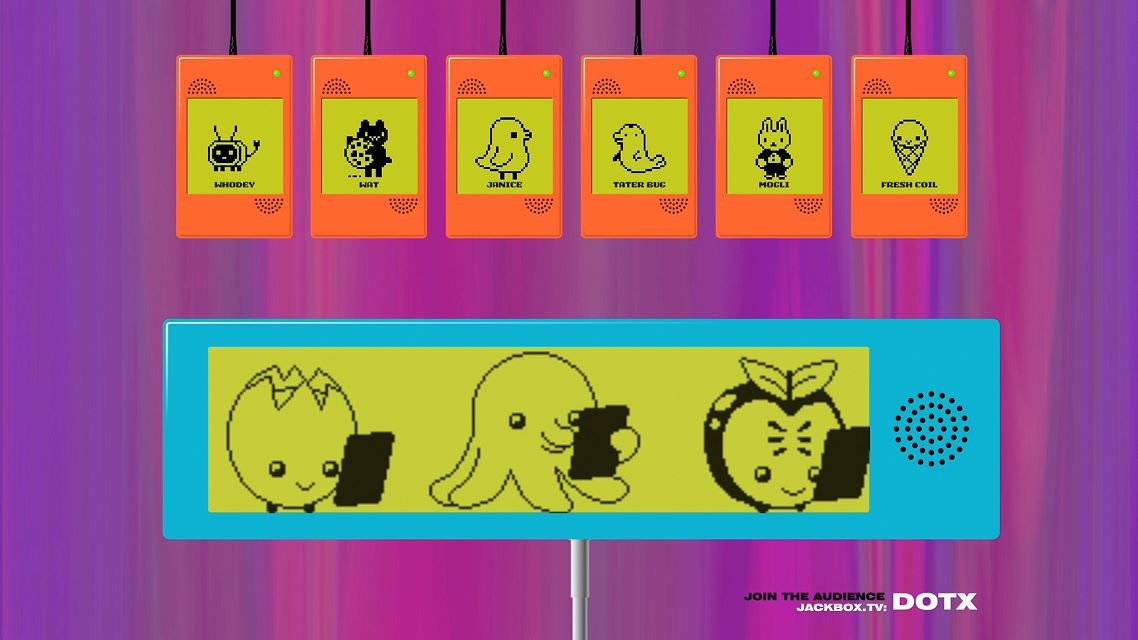
For the local play, as with any party game, you have to gather a large group of people together in order to get anything out of the games. This means that although the games may be fun, there are so rarely occasions when there are enough people available to play. However, let’s say that you do manage to come across the optimal situation: eight players. “But wait!” you might say, “I don’t have eight Xbox One controllers!” Fear not! Jackbox has got you covered. Xbox One controllers are not required to play. In fact, they are not usable at all. The only controllers are your own smartphones, tablets, or computers with internet connection, one for each player. Upon launching one of the five party games, the TV screen displays a four-digit room code. Each player must go to jackbox.tv on their electronic device and type in the room code and a nickname to join. For a casual game, this is more setup than seems necessary, but seeing as the other option would have been $480 worth of controllers, I think this is fine. What is not fine, however, is the execution of these “rooms”. After every game is completed all players get kicked from the room until a new game is started. Then a new code will be generated and everyone will have to join again. The process only takes a minute or two, but it slows the pacing of the game and creates a time period long enough for one to feel inclined to log onto Twitter or Facebook and start scrolling, which only lengthens the time between games and causes players to lose interest quickly. This brings me to a major issue with Jackbox. The purpose of Jackbox should be to bring a group of people together, to create social interaction, conversation. However, being a video game, Jackbox rebukes that. I myself prefer to play board games or card games at a large table with my friends or family surrounding me on all sides. The game in the middle of the table has one purpose, which is to unite us together, starting a basis on which discussion formulates. Once that has been done, its role is complete. It serves no other purpose. The attention is on my family or my friends and the stories that they tell. Perhaps the words “Go Fish” are mumbled every few minutes, but the real conversation originates from us, not from the game. By sitting a group in front of a TV, all eyeballs pointed forward, all eyelids unmoving, Jackbox does not create that same intimate experience that unites a group together. The corny jokes and the cutesy acorn or duck character icons all seem to screech “Look at me! Look at me!” as if the game is the focus more so than the people surrounding you. Each player is bent down over his or her own phone, sneaking a look up at the TV screen every few seconds, focusing. It doesn’t bring people together like it should.
Now, the other way to play Jackbox is by streaming what is displayed on your TV screen to Twitch TV for other people from all over the world to see. Basically, you have to download a Twitch app from the Xbox Store, (of course you have to download an app. How else would your day be complete?) then you have to create a Twitch account and log in, and finally you have to maneuver your way through settings until you determine the privacy setting that will allow you to stream your game online. Simple really. Then, someone watching you on Twitch can see the Room code to input in order to play. This is a nice solution for the amount of players issue, as long as you don’t mind playing with strangers. However, the fact that Jackbox, a casual game, takes so long to set up and finally to play, really frustrates me. I felt like I could’ve played through an entire Halo mission in the time that it took to set up a stream and to find people to play with online. Nonethless, Twitch audiences of course get to play free of charge, and thus Jackbox has really hit it off among popular streamers, who can finally play a game with their fans fairly easily. The problem is that only eight people can really “play” at a time. Anyone who joins after the eight spots have been filled will be put into an “audience”. In the audience you can do things like vote on your favorite lies in Fibbage 2 or for the funniest phrases in Quiplash XL, but you are not actually playing with anyone else. You don’t actually get to participate in any games. In fact, no one will even know that you’re voting in favor of a player except for yourself, and your vote will barely if not at all influence the outcome of the game.
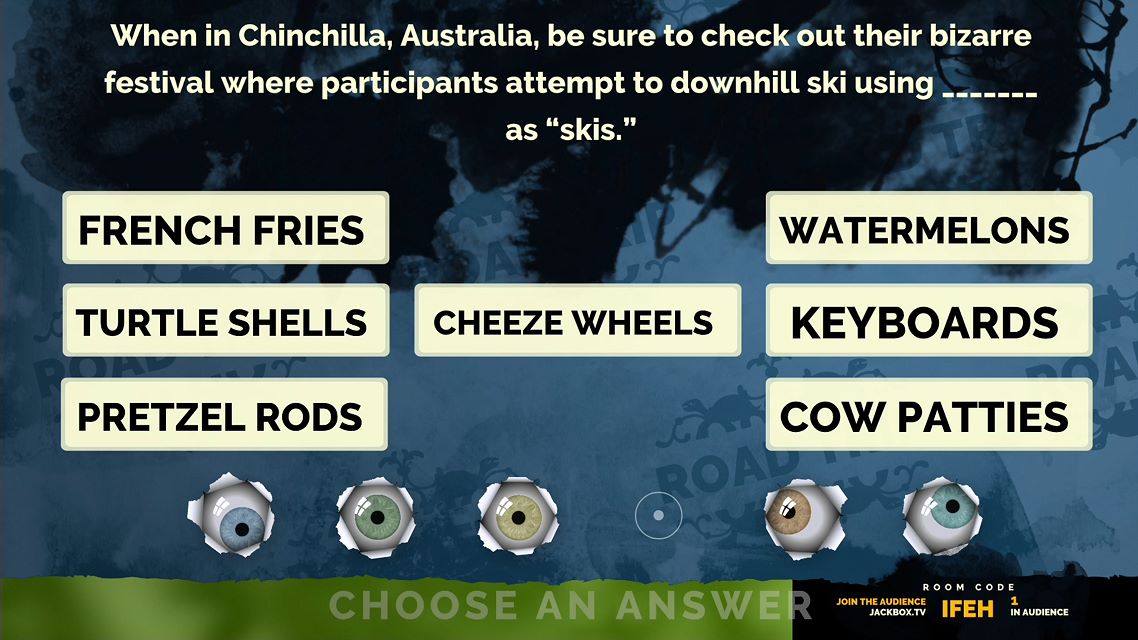
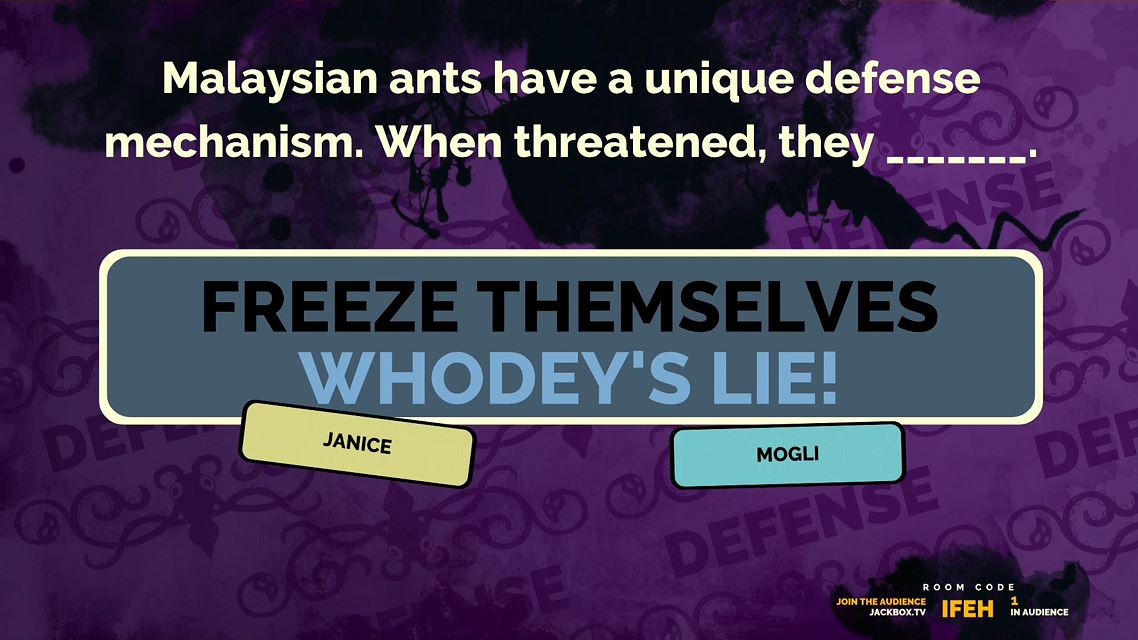
As for the games themselves, first comes Fibbage 2. In this game a fact appears on the TV screen based on a category chosen by the players. However, the fact is missing a key word. For example, “Coca-Cola was originally green” might be replaced by “____ was originally green.” You have limited time to type a fake phrase or word to try to fool the other players while attempting to guess the real phrase or word that fits the fact. It’s fun, but requires a lot of people in order to function correctly, since it is often easy to guess the mindset of someone you know closely, especially when there are limited choices to guess from. In one round of my three-player game, for example, “men with small penises” was clearly the correct phrase because it was so much more extreme than our more conventional “dogs”, “artists”, and “serial killers” input phrases.
Earwax is pretty atrocious. A phrase is given, such as “What you might hear in a trash can behind a club.” All players except for one, the judge, pick two choices from five or six options, and the judge then chooses the pair of sounds that fit best. However, the sounds are crude, and do not sound as they are anticipated via text, and because you are choosing from a predetermined list, there is no creative or logical thinking involved.
Bidiots requires a lot more critical thinking and is much more complex than the other games in The Jackbox Party Pack 2. Each player draws two paintings on his or her phone and then bids on those paintings, which are randomly assigned values, in order to acquire the most cash. Each player also has exclusive access to information regarding the value of certain paintings. Bidiots is enjoyable but overly complicated, and it does feature some bugs, like in our game when one player was given information which allowed her to easily gain profit on one of her own paintings.
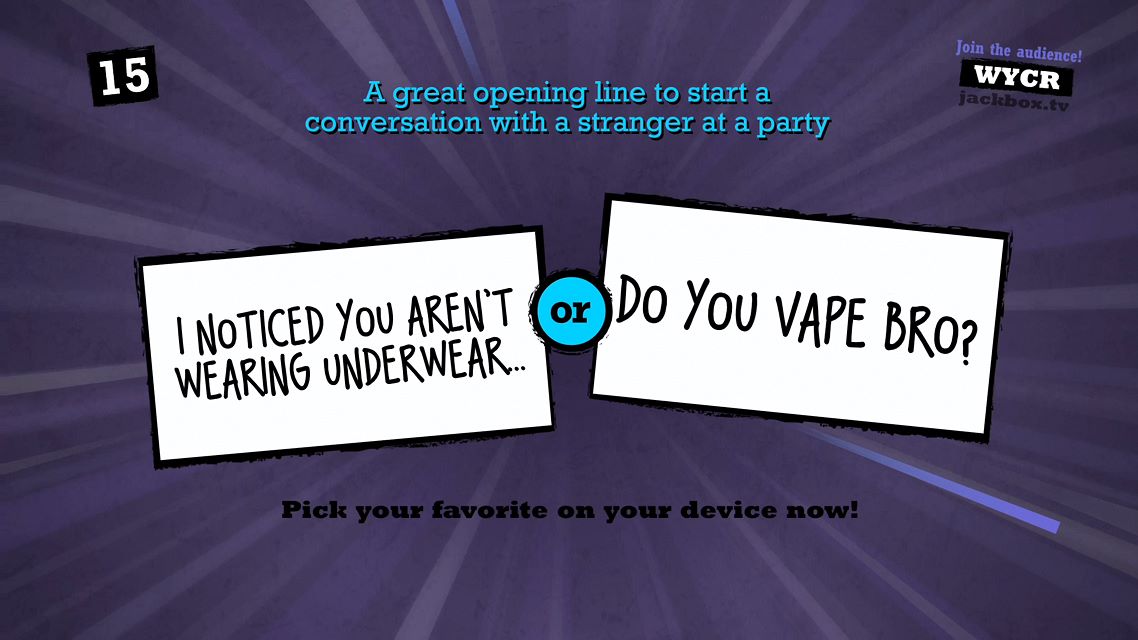
Quiplash XL has players inserting a word or phrase into a blank in order to make a sentence funny. It is virtually unplayable without at least four people, but it can be a lot of fun with enough people. Some sentences we were given suffered from syntax issues; one sentence was so unclear that we didn’t know what part of speech to fill in the blank with. This was rare, and overall Quiplash worked properly.
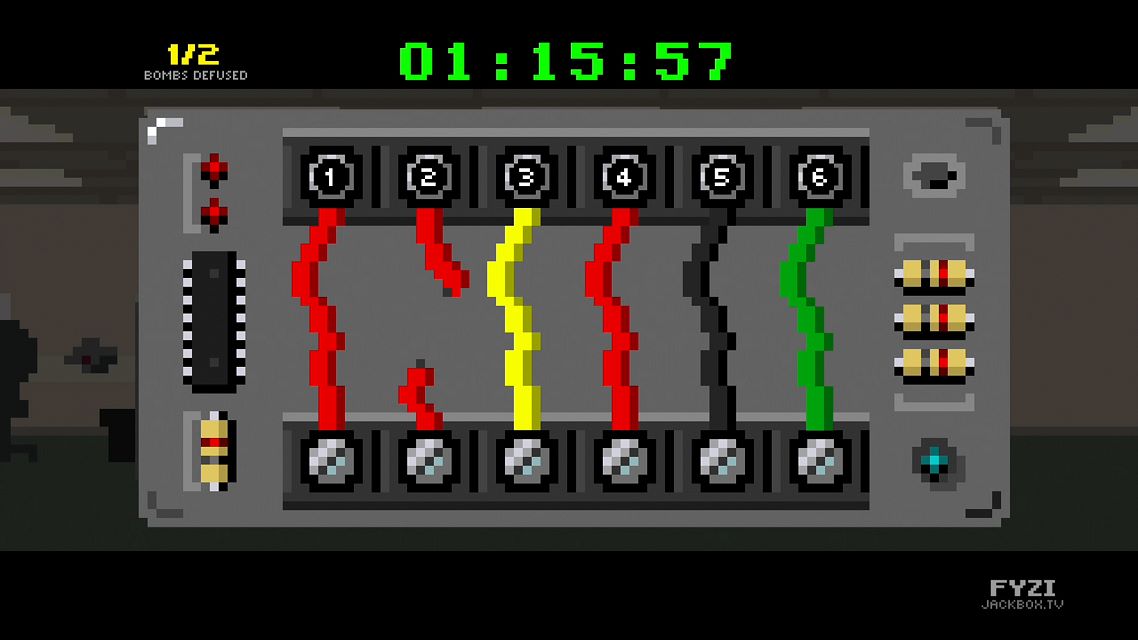
Finally, Bomb Corp. is reminiscent of the mobile game Spaceteam, which has one player shouting at another player to flip a certain switch or lever because of a prompt coming from the original player’s phone. Bomb Corp. is similar in that multiple people shout instructions at one person who must cut the wires displayed on his or her phone in the correct order in order to defuse a bomb. However Bomb Corp. is different in that only one person at a time has access to the virtual bomb. This excludes the rest of the players and makes them lose interest quickly. Bomb Corp. also incorporates absurd, unlikable pixel characters that tell horrible jokes. It tries to be comical in between rounds, but this only adds to the horrible pacing, and allows boredom to flourish.

Overall, Jackbox Party Pack 2 is an okay game. It has the potential to kickstart a social gathering once or twice with plenty of laughter, as long as you have a large enough group, and it is a good way for Twitch streamers to connect better with their audiences. It can be frustrating to reconnect with a new room code after every game, and it is easy to lose interest in it after a couple tries due to mediocre gameplay and slow pacing. The $25 price tag certainly stands out, but Fibbage 2 and Quiplash XL justify the price for those truly interested in constantly returning to casual party games.

Tristan was a regular ICXM contributor between 2015–2017, publishing 51 articles across opinion pieces, game reviews, Windows and PC, and Xbox news. Their work focused on hands-on reviews, platform commentary, and breaking-news reporting during the Xbox One X launch year and Microsoft’s wider Play Anywhere / UWP gaming initiative. They post on X as @tbogost.