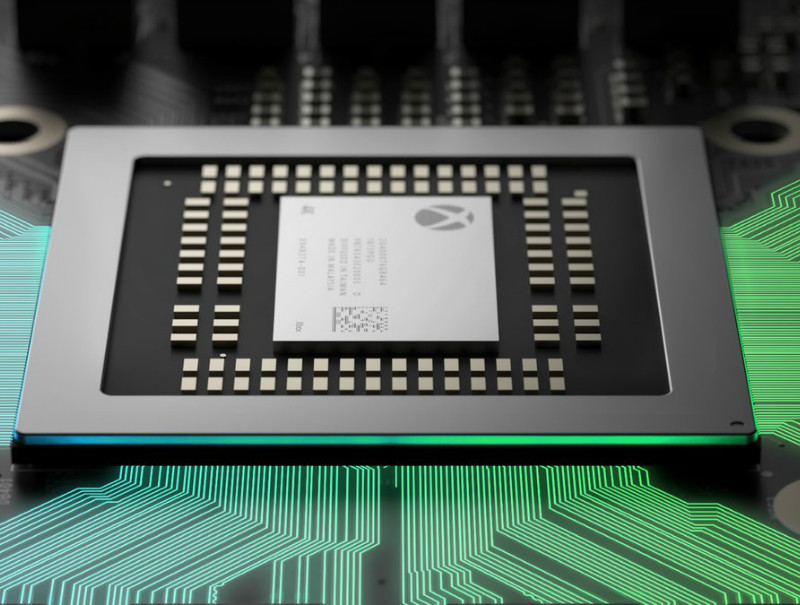
It’s been 24 hours since Microsoft in partnership with Eurogamer revealed the amazing specifications for the upcoming Project Scorpio. I have had time to digest the information after being blown away by the sheer engineering prowess shown off by Microsoft. Even though we haven’t seen the last of Project Scorpio, with more info sure to release as we get closer to E3, I believe we will most likely look on in awe at the marvel that this machine is when we finally get to see it.
The entire system was designed and engineered for one purpose, to get the most power out of components we already have, and to push them to their limits. Microsoft took what they learned from the Xbox One launch and dialed that up to eleven. Project Scorpio features a fully custom CPU/GPU system, which is loosely based on the same layout of the Jaguar, and the GPU which is wholly unknown to us at this moment should feature a mixture of Polaris technology and Vega according to tech analysts over at RedGamingTech.
Although the system would seem to be just an overclocked version of what we already have, that would be an assumption that would be entirely incorrect. Microsoft took what they know about DirectX 12 and baked it directly into the system. Project Scorpio can take thousands of draw call instructions and parse them down to just 11. On top of that, the system is so highly optimized that the GPU/CPU and memory have all been designed to make sure that there are no bottlenecks for DirectX 12 games, meaning that we should see games like Forza Horizon 3 and Battlefield 1 run at 4K 60FPS at PC equivalent settings with room to spare.
Beyond that, the system was designed to make sure that games that do not utilize all of the 12GB GDDR5 memory that is onboard, will use the spare memory overhead to cache frequently used assets to ensure that they remain easy and quickly accessible.
So what does this mean for the average gamer? Well for a start, Project Scorpio will bring the 4K 60FPS dream to every gamer. No longer will it be relegated to the fringe who can afford to spend thousands on systems that are as inefficient as they are expensive. Microsoft practically killed off the PC at the lower end of the spectrum, giving those gamers an affordable 4K system, that just works.
High-end enthusiasts will still stick with their overburdened PC systems trying to squeeze out every last bit of power to get that 60FPS lock. On Project Scorpio, these things will be a given. An example of Forza 6 Apex—the PC equivalent to Forza Motorsport 6—was seen running on prototype hardware at Microsoft and achieved 4K 60FPS with 4K textures and Ultra settings enabled with 66% maximum GPU utilization. This means that not only can developers on efficient development engines achieve 4K 60FPS, but they have enough room to spare to think about making the game look even better, much better than that available on PC.
Eurogamer stressed that what they saw was pre-release hardware when looking at games running at it, and Microsoft noted that their drivers/system should achieve full power this July with it currently hovering at 80%. Eurogamer also noted that Project Scorpio will achieve similar power to that of the GTX1070, with further optimizations pushing it into the realm of the GTX1080. This is mind blowing considering that the system will be aimed at the general consumer with a retail price of between $400 and $500, pretty much the price of a single GPU for a PC. Instead of forcing gamers to tinker and shop around to get the best deals for the most powerful system, they can buy Project Scorpio and have all that done for them. The comparisons to the PlayStation 4 Pro is misguided, as the two systems are disparate and the system from Sony can never be successfully compared or even compete with the system Microsoft revealed.
Microsoft has over-engineered Project Scorpio to the point where they created one of the single most powerful console systems, reminiscent of the days of Xbox 360 and the original Xbox. Microsoft preemptively captured the console market away from Sony and in so doing, grabbed a massive chunk of the consumer PC gaming market with it. Microsoft however, will not abandon their Play Anywhere model, so the few on PC should still get their fix of Microsoft exclusive games, but their stranglehold on the power narrative was just wholly diluted by Microsoft.

Dreyer was a regular ICXM contributor between 2016–2017, publishing 139 articles across opinion pieces, game reviews, Windows and PC, and Xbox news. Their work focused on hands-on reviews, platform commentary, and breaking-news reporting during the Xbox One X launch year and Microsoft’s wider Play Anywhere / UWP gaming initiative. They post on X as @dreyer_smit.