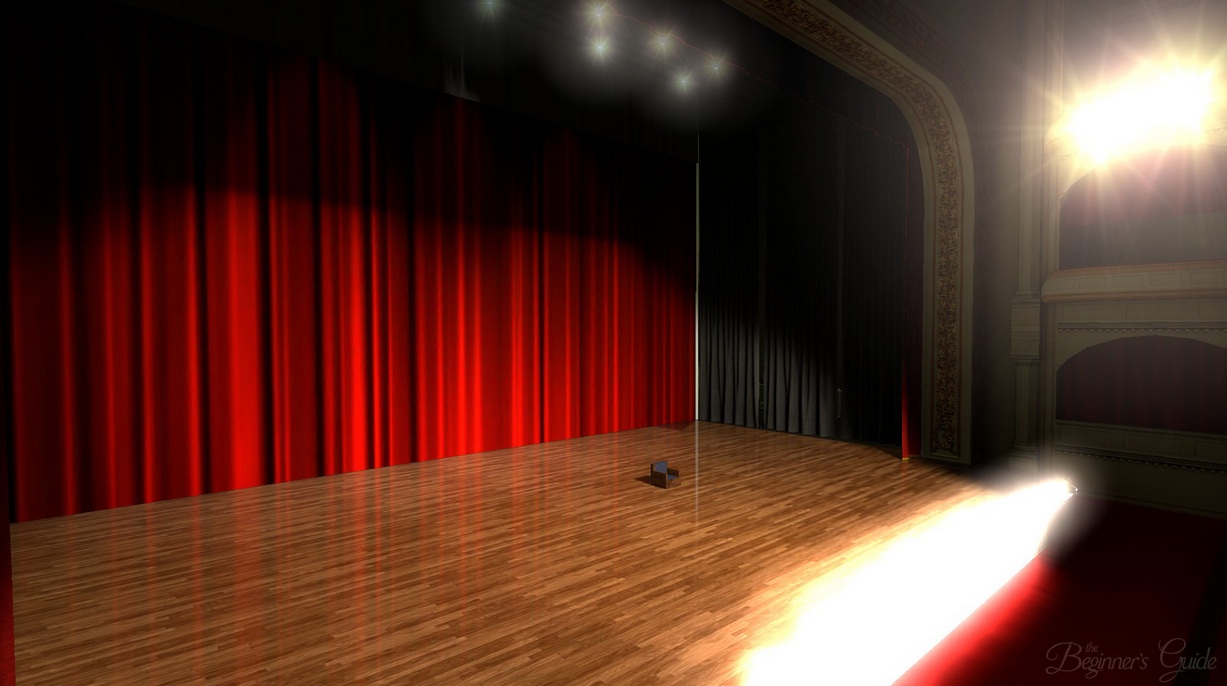
Only now and then does a piece of work come along – in any type of media – that makes you reassess everything about yourself. The Beginner’s Guide is one of those and needs to be experienced, if you have any interest at all in questioning your own or general human behaviour. Of course, this is not going to be for everyone, but it is about everyone.
It’s very likely that reading this review before playing the game will negatively impact your experience it. There are no specific spoilers here, but the less you know about this game going in, the better. It’s probably best you just buy the game right now, play it, then read this afterwards. Seriously, you need to trust that assertion this one time or risk utterly ruining the experience for yourself. If you’re willing to risk that, read on.
Some people might call this game pretentious, after all it is what certain reductionist consumers would dismiss as a non-game. Of course any work attempting to be philosophical certainly can end up being a pompous mess, but in this particular case, not only is it a genuine masterpiece, but being pretentious is actually the entire point of the experience – as in, the central narrative is about how people view work, art and each other. If that still sounds like a load of college art student nonsense, the game itself will definitely surprise you.

There honestly isn’t much more that can be said about the content of the game itself without spoiling it. Indeed, there’s little that can even be said about the game’s existence as a product that will make any sense if you haven’t played it. In fact, merely writing about the game and attempting to analyse it, kind of proves its point.
Still, some attempt must be made to talk about it. What can be said, is that it’s very short for a game. In total it lasts about an hour and a half, but that’s absolutely fine, as it has more to say and provokes more thought than most two-hour movies – not to even mention the intellectual banality of most video games. The product itself lasts only a short time, but the impact it delivers will quite possibly stay with you forever. Now that’s real value for money.
If you hadn’t guessed by now, it’s also devoid of traditional gameplay mechanics. Again, that’s fine as it engages players in different ways while still justifying the need to be an interactive experience, unlike far more tedious entries in this pseudo-genre, such as Dear Esther. It has more in common with The Stanley Parable, which is by the same developer, although this game expands its scope beyond games in even more poignant ways.

The narrative of the game though, is what really makes it special. As already stated, to talk about it in any detail would be to the detriment of the experience. In vague terms, it is a game that will make you think about yourself and your motivations. It will make you rethink how you see other people and judge what they do. It will also make you feel deeply uncomfortable, perhaps even angry, as the true nature of the game becomes apparent.
Some of the story-telling tricks are somewhat gauche on reflection, but necessary for a compelling visual experience. There are many liberties taken with the subject matter and a lot of red herrings throw players off. It’s hard to criticise though, as it all fits into the narrative of the game. Everything serves the ultimate purpose of what this story is trying to achieve, which is truly affecting on both a psychological and emotional level.
There are real thoughts and real feelings to be had from this experience, rather than vague half-answers most stories attempt to give to difficult questions, or the usual “fun” hate you’d have for an evil character in a story. The beauty in this game is that it makes you ask your own questions and come up with your own answers. Again, not in a mystery-box-style “Lost” way, where the questions are contrived and meaningless, but in a natural way.

The game does give you all the answers it can, but they lead to different, deeper, unanswerable and most importantly, very personal questions for you to ask yourself. It’s an extremely introspective experience, which is admittedly going to be hard for some people to deal with. It might also be a very liberating experience in time, but not before a dark sea of doubts washes over you.
Much of what the game is about can certainly be labelled as quite obvious when you think about it. That’s easy to say in retrospect, but regardless, that’s what makes it so disturbing; that it is so prevalent in human nature to the point of being seen as unworthy of discussion.
As was also mentioned, talking about the game’s mere existence as a product is interesting. Whether or not it is legal, ethical, or even real is all up for debate. That’s all just another point in its favour though, as the context of its existence is a disturbing continuation of its narrative, regardless of any concerns.
Despite the product’s excellence as a work of art, your opinion on the creator, Davey Wreden, will be very interesting to hear about after you’ve played it. This statement will itself become very ironic, once you understand the point of the game.

Summary
The Beginner’s Guide is a complex game that almost defies the concept of a review entirely, not least because even talking about it in such a way is validating its meta-narrative. It is a game that demands discussion while pouring scorn over the very idea of it.
It not only raises the bar for social commentary in videogames, but expands such discussions beyond content and into the realms of creation and critique, as well as delivering a wider perspective of human nature. There is simply no other game in this genre that achieves the potential of games as a method of examining humanity, quite like this one does. Intellectually, it’s a cut above anything else like it.
Giving a score to this game, or merely recommending it, feels wrong for various reasons. It seems arbitrary or even distasteful to talk about it. But our culture would not be what it is without works like this and the critiques they demand, such is the power of pretension.

Dean was a regular ICXM contributor between 2015–2017, publishing 39 articles across game reviews, Windows and PC, and Xbox news. Their work focused on hands-on reviews, platform commentary, and breaking-news reporting during the Xbox One X launch year and Microsoft’s wider Play Anywhere / UWP gaming initiative. They post on X as @SpookyWomble.