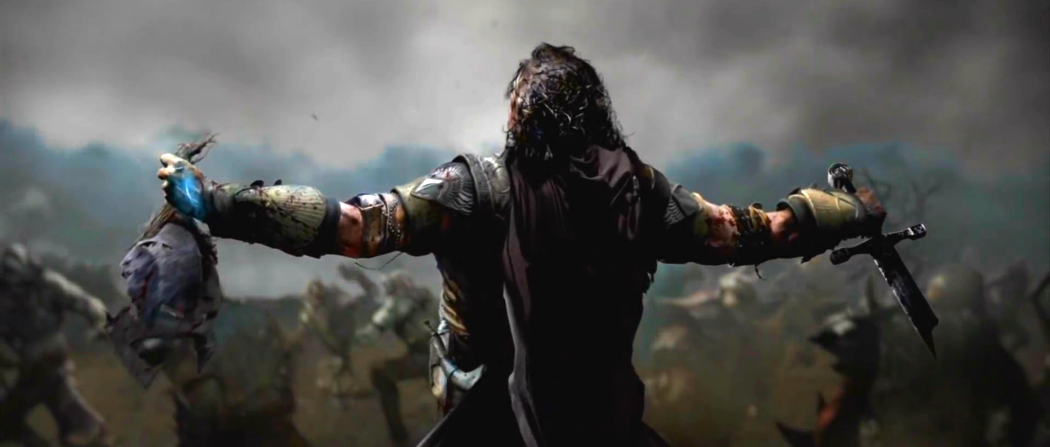
I have to start this review with 2 confessions. The first is that I am an unrepentant Tolkien geek. The second is that when I originally heard about Shadow of Mordor, I was NOT happy.
The first information I heard was that ”…you play an undead ranger who has magical powers and leads an Orc army.” My inner geek was outraged. For starters, necromancy and magic are scarce and carefully employed commodities in Middle Earth. To abuse them for the sake of a quick-cash game licence was sacrilege.
It was at the hands of lead designer, Bob Roberts, that I was taken to school. I was lucky enough to interview the Monolith penman at EGX (HERE) and it became apparent that, compared to the team who worked on Shadow of Mordor, I had as much knowledge as Jon Snow (no… not the weather man).
More than that, this isn’t a game that takes cheap advantage of a licence. This is a game that actually brings something of great value to the cannon it represents.

You see, this is a game that has been crafted by two equally talented groups; a great development team who have been able to craft an incredible game, and a brilliant writing team who’s love of the source material and the Tolkiensian Lore shines through in every cut scene and side quest.
I am incredibly lucky to say that it was Bob Roberts himself who convinced me to play this title, and I hope I can do him justice by imparting that same impulse in the rest of you.
Our story begins with an unassuming Gondorian Ranger, stationed with his family at the Black Gate of Mordor and helping keep vigilant watch for a threat that people ceased to take seriously 200 years ago. In terms of the stories with which most fans are familiar, it is planted firmly between the adventures of Bilbo and Frodo. There, but not yet back again you might say.
For those familiar with the tales, it’s no spoiler to tell you that it is in this period that the forces of Mordor (and others) start to gather their strength in earnest at the behest of the Dark Lord Sauron. The first stop on the road to the domination of Middle Earth is to take back Mordor and the Black Gate, and this means taking it from our protagonist, Tallion.
So it is that our story begins where Talion’s mortal life ends. However the manner in which he meets his untimely demise sees him denied death and instead fused with an Elven wraith. More than that, the Elf’s immortal form provides Talion with powerful abilities, but has left him without memory of his former life or the reasons for his fate.

And so it is that our immortal, wraith-infused Ranger sets to his task of confronting the growing threat of Mordor while seeking to lift the curse that has bound him to his Eldar guest.
That is the set-up and it paints the opening picture beautifully. You assume the controls wondering the same questions as our hero: Why is he still alive? Who is this Elven wraith? What has awoken in Mordor? – and these are all questions that the various story threads will answer. However, if you want to fully answer all these and more you need to not only take on the main quest, but also tackle the sub-quests and collect all of the scattered items (each of which carries its own story).
At its most basic, this is a hack’n’slash with combat that falls in style somewhere between Assassin’s Creed and Dynasty Warriors, however that comparison barely dips a toe on what this game has to offer. In practice it’s far more an open world sandbox, with incredibly nuanced combat, and both character and weapon levelling. In fact the game has so much to offer it’s difficult to choose where to start.
The combat in this game is just incredible, both in terms of the feel and the implementation.
You have three weapons at your disposal: a sword, a knife and a bow. The sword is your primary weapon for open combat, your knife is your stealth choice and the bow (shockingly) is your ranged option. However, you can (and will) be switching and employing all three seamlessly during battle.
Each of the weapons can be enhanced. As you play, you gain runes which can be etched into your bow or blades. The runes cover a range of enhancements from upping damage during combos to causing fear in your enemies. Each weapon can have up to 5 slots and you can switch the selection on the fly.

Each also comes with a set of ‘legend’ missions, which let you undertake great feats to help forge the reputation and story of that weapon. These are not only great fun but add an extra level of Tolkiensian mythos to your story.
Weapon play is augmented by upgradable ‘ranger skills’ and ‘wraith powers’ – both bought with hard-earned XP. The skills are enhancements to your combat style, allowing you to execute, stun and or throw knives.
Rather than being over-the-top magic tricks, the wraith powers are enhancements to your play, letting you run faster, slow time and at high levels even dominate minds.
You quickly find your own style as you gradually upgrade your own character, and this is where the real beauty of the next gen engine comes into play. The action is as smooth as silk. Combat will regularly involve at least 15 to 20 enemies and require you to string together both combos and powers with a mixture of rhythm and quick reaction.
The sheer number of enemies that can attack at any one time is (in every sense) overwhelming. But the way the combat works allows you to turn taking them down into poetry. You can interrupt your regular strikes at any time in the combo to react to changing circumstances. Execution moves, area blasts, parries and dodges can all be instantly and seamlessly incorporated into chain attacks, with a flow that makes Ezio Auditore look like Thomas the Tank Engine.
The combat itself can also change on a moment’s notice. The horde of 20 Orcs may be falling to your every stroke and offering little resistance – until a captain or warchief makes himself known by stepping out from the throng and issuing you a challenge. Whether your battle against him is a desperate pitched attempt to identify his ‘Achilles heel’ or a matter of exploiting a known weakness is down to the intel you’ve gathered during the course of your travels.

Likewise, you could be getting overwhelmed by a band of Uruks and their hero, when a giant Graug (a huge monster) wades in and turns the tide of battle – or offers you the chance to escape.
It should be noted that stealth is always an alternative to open combat. Often sneaking through a camp, poisoning grog and silently taking out guards will be the easier option to achieve your goal.
The Role-Playing elements stretch well beyond just upgrading your character and weapons. There is a great level of unrest among these warchiefs and captains, which you are able to turn to your benefit. Initially this is a matter of investigating, hunting and killing those in key positions to keep the army weak and disorganised.
However as the game progresses and your powers are honed, the opportunities to take advantage of the weak minded become far greater…
On the other hand, woe betide he who finds himself unprepared for the skills of the enemy. Falling in battle will have little effect on your hero beyond an unceremonious respawn at a nearby Elven tower. However, the Orc or Uruk that managed to take you down will get respect, and maybe even a promotion. In game terms that means next time you face him he’ll be better armed, more powerful and tougher.
The game looks gorgeous, plays beautifully and captures the heart and soul of the source material perfectly. In terms of what I want from a game, this title is as close to faultless as I have seen since Knights of the Old Republic.
I thought this game would be a burden, that it would not survive in the wild of the gaming landscape and that it would have no place amongst Tolkien’s works. I’ve never been so wrong in all my life.
^HooksaN (@Hooksan)

David Hook (HooksaN) contributed 26 articles to ICXM between 2014–2015, covering game reviews, and Xbox news with a focus on hands-on impressions and verified-source reporting. Their bylines on the site span the Xbox One’s first full year of post-launch coverage, including the early days of Backwards Compatibility and Windows 10 gaming. They post on X as @Hooksan.