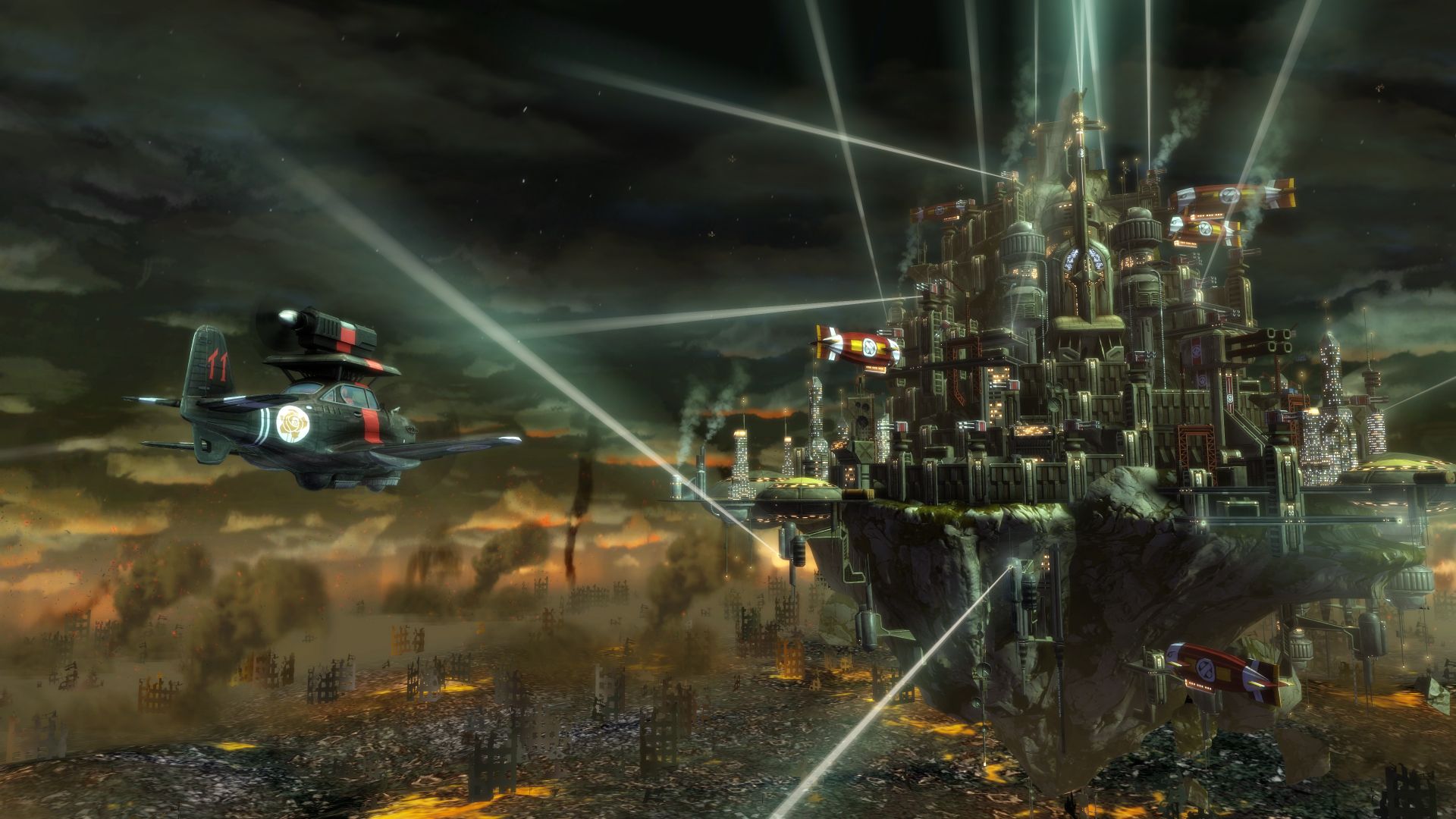
Sine Mora EX is hard, and I mean throw-your-controller-at-the-TV hard. Sometimes it could even be considered unfair. But most of all, Sine Mora EX is utterly exhilarating. At its core, the game is an old-school 2.5D shooter–you fly around the screen and shoot enemies whilst avoiding a copious number of bullets and collecting various powerups. However, Sine Mora EX has an extra trick up its sleeve: the ability to control time.
At the press of a button, you can slow time to a crawl to help navigate through the rain of bullets or to kill some of the faster enemies. In addition, a timer replaces the traditional health bar or one-hit kill mechanics of other bullet hell games. For every enemy killed, the timer increases, but every hit you take knocks precious seconds off. Once the timer reaches zero, it’s game over. These features help Sine Mora EX stand out as more beginner-friendly than other bullet hell games, but only very slightly. It’s certainly not an easy game–the opposite has never been truer–but something about it makes you more eager to master it with each playthrough. Once you become comfortable with the controls, you’ll find yourself blasting away at ships, desperate for weapon upgrades, and weaving seamlessly through seemingly impassable walls of orange and blue bullets.

There are four modes: Story, Arcade, Score Attack, and Challenge Mode. The campaign is the most accessible (especially as the other modes are touted as being “for experienced players only” in the main menu) and serves as a good introduction to the different characters and vehicles, their unique abilities, and the various stages. Unfortunately, the story itself is just countless paragraphs of jargon and exposition without any real payoff, which is a shame as the lore clearly had a lot of thought put behind it; in fact, there’s a whole encyclopaedia to be unlocked upon completion of the story. The characters are also a wasted opportunity. They could have easily been a more mature version of the Star Fox crew, and the fact that most of them had been blackmailed into joining the team could have presented an interesting dynamic, but the dialogue is too forced, and the limited interactions between characters is uninteresting. As I said, a shame.
Arcade mode is very similar to the game’s story mode, but without the, well, story. You can choose your vehicle–each of which have varying weapon upgrades–and your character, who all have different special attacks. Gameplay is largely the same, except the stages are now more linear (without the constant perspective-switching of story mode) and there’s now a ranking meter underneath your score, which can vary from C to A based on how many enemies you kill without being hit. At the end of the stage, the amount of time you spent in each rank is added to your overall score, so you’ll get a larger score for staying at an A rank.

Score Attack is largely the same as arcade mode, but you can freely select the stage and you seem to have a lot less time, therefore minimising the room for error. Challenge mode is the most unique of all the modes. You are tasked with completing a set of various challenges, such as trying to shoot a series of green mines without shooting or coming into contact with any red mines, all while under a strict time limit. I’m ashamed to say I didn’t get very far on either of these modes due to not being the experienced player the game specifically asked me to be, but they’re fun nonetheless.
I haven’t even mentioned how pretty this game is yet. It really is beautiful to look at, especially with its smooth, mostly-consistent framerate (there’s a slight bit of slowdown in certain areas, but barely noticeable). The stage designs are very distinct and diverse–each area feels unique, from a robotics factory smothered in an unfriendly orange glow, to the neon lights glistening from a city brimming with colour. No two stages look alike, except for the underwater stages. Sometimes the 2.5D perspective can be slightly distracting, but it becomes less of an issue the more you play. On the flip side, the score isn’t at all memorable and is little more than background noise. It serves its purpose, but you could easily play your own music instead and it wouldn’t detract from the experience.

The most memorable parts of Sine Mora, though, are the bosses–metal monoliths so large they have to be split into several parts to defeat entirely. At first, you’ll face smaller bosses such as a metal squid, which only takes up half the screen, but you’ll soon encounter titans such as a towering mining vehicle equipped with a wrecking ball, a bucket wheel and a whole lot of turrets. Suitably, each boss gets their own grandiose introduction, in which you get to admire the entirety of it before taking down each section individually.
Summary
Sine Mora EX is a must-have for bullet hell enthusiasts, but more importantly it beckons newcomers to the genre to have a go. Sure, it’ll beat you down with its brutal difficulty, but somehow you’ll always come back for more.

Jacob was a community contributor to ICXM, writing 1 article in 2017 covering game reviews. ICXM operated as an independent Xbox and Windows gaming outlet through the Xbox One X launch year and Microsoft’s wider Play Anywhere / UWP gaming initiative, drawing from a rotating bench of editorial volunteers. They post on X as @tyrantleon.