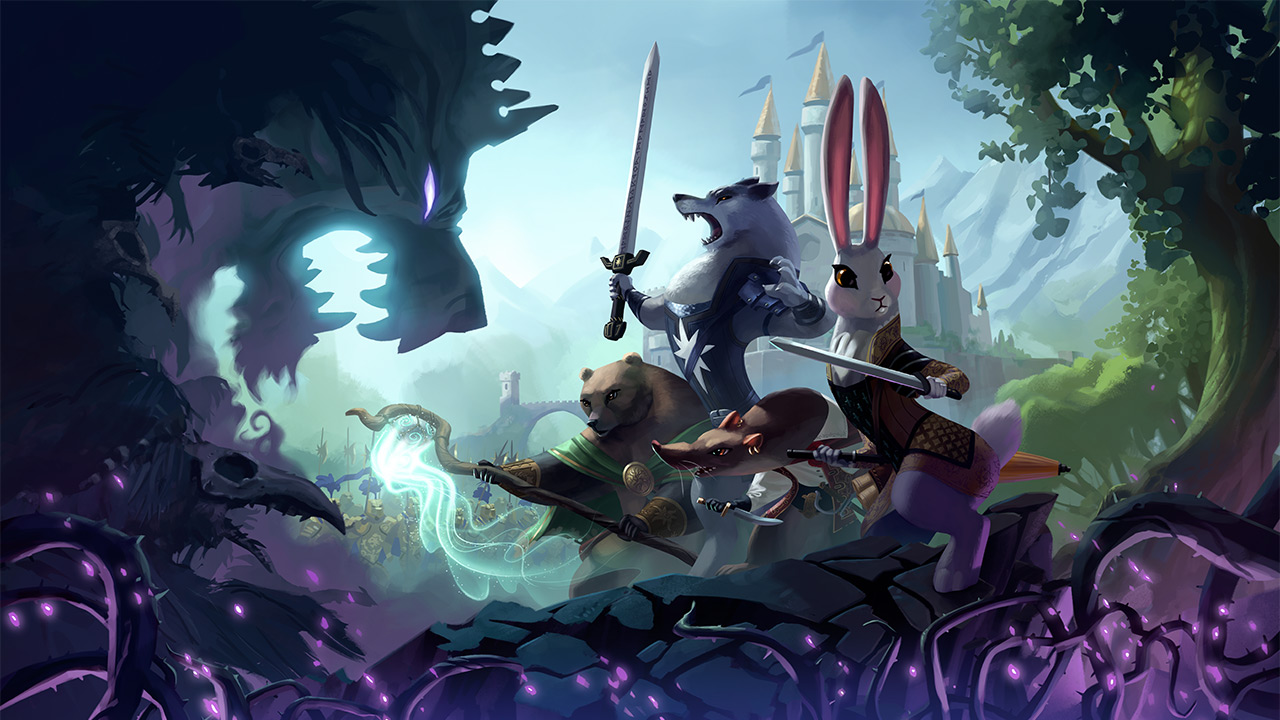
Armello can be described in one sentence: anthropomorphic creatures vie for the ability to control a kingdom. While simple in premise, this table-top strategy game is complex and original in application. But, is this board game one that can hold up when playing it alone?
Armello tells the story of a lion king that has been afflicted with rot. The rot is corrupting the king’s judgement and encouraging him to issue royal decrees that hurt and hinder the land. The player assumes the role of a hero that tries to either save the king, or defeat him and rule the nation.
There are eight heroes in total, two from each of four clans–the bears, the rabbits, the rats, and the wolves. However, on the battlefield, members of the same clan are not allies. Each player begins their turn at dawn of the first day. The hero chosen has a set of skills that are distinguished by a number system. A number from one to five is placed in four categories that equate to movements per turn, dice per roll, health points available, and activity cards allowed in hand.
The number of movements per turn is self-explanatory. At the beginning of each turn, the player can use as many of the points available as needed to move around the map and complete objectives. Objectives involve recruiting villages to your cause (which brings gold and prestige every turn) raiding caverns (that offer gold, magic or banes) or completing quests. Sometimes, failing these quests or entering the wrong town can cause the player damage and eat away the health points.
When exploring the game map, it is possible for one player to attack the other player. The battle system is done with dice rolls. The higher a heroes dice total, the more dice that hero can roll. This gives a huge advantage in taking out the other hero, which can also bring prestige rewards. Losing the battle can cause death if all health points are removed, sending the hero back to their starting town. But rival players are not the only opponent. There are also king’s guards and banes that patrol the map and seek to defeat the heroes.
There are four win scenarios in Armello. The first is a win by combat. If the hero attacks the king and survives, that hero becomes the new king and wins the game. The second is a win by prestige. The rot is slowly killing the king, and after too many rounds, the king will die. The hero with the most prestige points wins in that scenario. The third is a win by saving the king. Randomly on the map, magic eggs will spawn. If a hero collects four eggs and approaches the king, that hero will cleanse the king of rot and win the scenario. The final is a rot win. It is possible to have a hero become corrupted like the king. In fighting the king with rot, the world falls to chaos and the corrupt player wins.
Now that I have thoroughly explained what Armello is all about, I think I should explain why it is one of the best games I have played in a really long time.
Armello is an absolutely stunning game to look at. The colors and animations used for this board game that has come to life are stunning. Everything about the characters, the environment, and the playing cards struck me as a labor of love by the developers. Each playing card has a small animation that reminds me of the paintings in Harry Potter. For example, a bear is bursting through a wall in one card. The bear and the wall were frozen in place, but the wall shards were perpetually tumbling and spinning, adding depth and artistry to the cards.
The audio score used is quite beautiful as well. The music is perfect for the Game of Thrones meets Disney’s Robin Hood that Armello mixes so seamlessly. Each movement is met by the sound of walking over grass in a plain, or squishing through a dense swamp. The battle scenes have the metallic clank of metal on metal as the heroes battle to the death. All of this while a perfectly balanced soundtrack plays on in the background.
The main selling point of Armello is that it is fun. While the game can be played in multiplayer, I spent all of my time for this review playing against bots. The bots sometimes played aggressively, defensively, or a mixture of both. I had to employ strategy and foresight to even attempt to defeat the very talented bots. I found them to be fair and well balanced. While I only won about half of the games I played, I never felt that a bot spiraled out of control. I usually lost due to a few missed plays that another hero took advantage of.
One issue that I did have with Armello is that the pace is incredibly slow. I had to play a few rounds, including the entire tutorial, before a faster speed option became available. Games usually took about an hour to complete before the AI speed option was unlocked, cutting game time by more than twenty minutes. Even then, I felt the AI should complete their turns quicker, as watching each move around the board and decide how to proceed was odd during solo play.
The other thing that bothered me was the lack of multiple maps. The specific placements of town, caves, mountains, and swamps changes with every game; but the assets used are always the same. The big advantage of taking games off of a table and putting them into the digital space is the availability of variety. Monopoly has taken advantage of this to make hundreds of variants at little to no extra cost. I would have enjoyed maybe a desert kingdom, winter kingdom, or jungle kingdom for example.
Summary
Even with these small complaints, I feel Armello is an amazing game. I have already found several hours of enjoyment as it really has no end. Every time I played it was a new game with a new outcome. Even as I write this review I am excited about jumping in and playing a few more rounds before bed. Armello truly captured the fun of the table-top genre and offered a worthwhile package on Xbox One.

Joshua was a regular ICXM contributor between 2016–2017, publishing 42 articles across game reviews, and Xbox news. Their work focused on hands-on reviews, platform commentary, and breaking-news reporting during the Xbox One X launch year and Microsoft’s wider Play Anywhere / UWP gaming initiative.