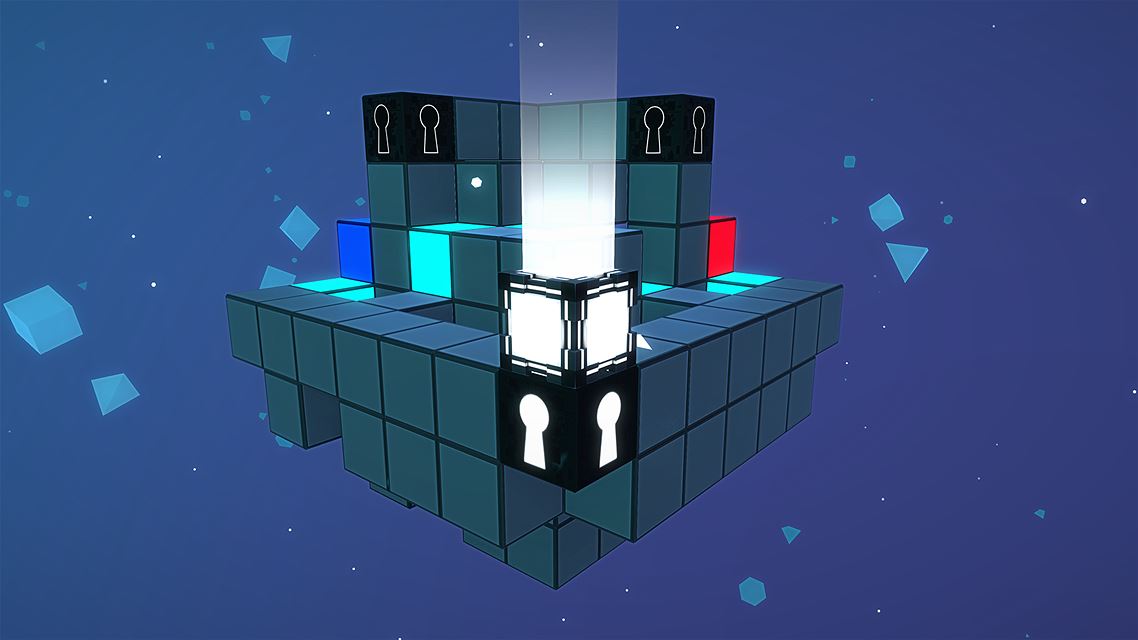
Cubikolor is an intense puzzle game not designed for those who lack any sort of patience. In fact, I pride myself on having patience in puzzle games, and even I found myself a few milliseconds away from my Xbox One controller ending up in numerous pieces against my wall.
In the game, you control a multi-colored cube (six sides) with each side having a different color. You maneuver the cube around a 3D environment, similar to a Q-bert level setup, and must land on blocks emblazoned with a keyhole symbol in order to “unlock” the next level. Most levels have multiple blocks which need to be unlocked along with different colored blocks. Each of these blocks responds to your cube when you land on it. If you land on the cube with the matching color, you go up one level. If you land with a different color, you go down one level. There are booby-trapped cubes, multi-colored cubes and more.
There are a few different features as well in Cubikolor. You can press the B button to go back several moves if you misstep. Pressing Y brings up an onscreen help menu and holding X restarts the level. You will need this more times than you will care to admit, because at many points you simply can’t progress any further. This is one of the more frustrating parts of Cubikolor as you won’t know you are stuck until it’s too late. Some parts require you to land on a red cube for example. This is easy, but there are two ways of doing it. While on the red cube, you can have blue on the left and yellow on the right. You can also have yellow on the left and blue on the right. Deciding which one you need is key, because you will be stuck on the next part if you choose wrong. Many of the levels have only one way of completing them. As a result, you need to try and plan out moves ahead of time which takes the fun out of the game.
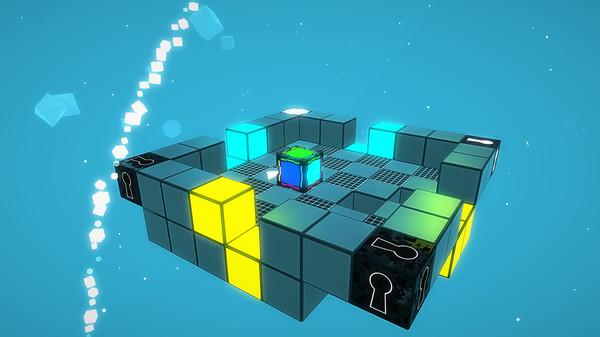
Puzzle games should be about experimentation, and too often in Cubikolor I found myself stuck with no way to go. Not only is planning out your moves in Cubikolor a drastic waste of time, but it is also completely unrealistic as some puzzles change as you go. In these puzzles you are only left with luck that you chose the right path. After all, puzzles are supposed to be solved with experimentation. Imagine putting together a jigsaw puzzle only to have to rip it all apart every time you tried an incorrect piece. Although I enjoyed the premise of Cubikolor, too often I found myself in these predicaments to enjoy the game the way it was meant to be.
There are 150 levels in Cubikolor situated over fifteen stages with ten levels each. Each stage uses letters of the alphabet from A to O, and of course the levels get progressively harder as you move on. Certain levels require you string together chains of moves while others require multiple keyholes to be unlocked. Cubikolor succeeds on many levels, including using logic to think out your progress. Unfortunately, some levels get you stuck as if you are going through a maze. For example, certain levels I started going to unlock the keyhole on the right and then to the one above it. Of course, I became stuck as it was impossible for me to progress. This caused me to start all over and try the left keyhole first and then go up. This also caused me to be stuck. Only after realizing that I had to go to the left and up, around in a circle before coming back down with a different color cube, was I able to progress. This isn’t an issue with single keyholes to be unlocked. On the other hand, when a decision you make on part one of a puzzle halts your progress on part four, it becomes a nuisance because everything you’ve done now becomes reset and you don’t know until it’s too late.
Another issue with the setup is that some levels also require completion within a set time period or by using a limited number of moves. Unless you are a cyborg capable of completing multiple equations within a nanosecond in your head, these puzzles are impossible to complete within the first dozen tries or so. You may beat one part and then get stuck on the second to run out of time. Once you beat the second part, you’ll run out of time when you get stuck on the third and so on. The timed puzzles are slightly fun, but much more frustrating because you finish the level with barely any time left even when you do everything perfectly. In fact, each time you think you have figured out how to move forward in Cubikolor, the game throws a new twist at you to ensure you stay stuck. Rewinding time, for example, doesn’t make the amount of moves you use go down. If you get stuck after fifteen moves and go backward two spots, you are now at seventeen moves instead of thirteen. For a game that touts itself as “armed with only your logic”, Cubikolor sure uses the opposite of it at many points.
Every time you beat a level in Cubikolor you earn a medal based on your time and amount of moves used. These range between gold, silver, bronze and clear white (earned just for completing it). You need to beat all ten levels in each stage before you can move on, and there is no way to skip forward. This was my favorite part of Cubikolor as it ensures one of two fates for every player: 1. Keep trying to figure it out or 2. Quit. That’s it. There is no way to beat this game unless you keep pushing yourself, and I wish more games would be formatted this way.
It does feature an incredibly original setup as well. Most games when you go around in a circle you start back where you are. Not Cubikolor. If you have your cube facing the red square up, you can go around a pattern by going left, down, right and back up again to land in the same spot you started in. Of course, you have four different color possibilities to land on with your six-sided cube. This 25% chance of accuracy is not only infuriating at times, but it’s addicting as well. It’s that “Ok, just one more time” mentality that really stands out in Cubikolor. You know, when every time you die you say to yourself “Ok, just one more time” and keep trying. Before you know it you’ll have about 25 “Just one more times” before you either quit or beat the level.
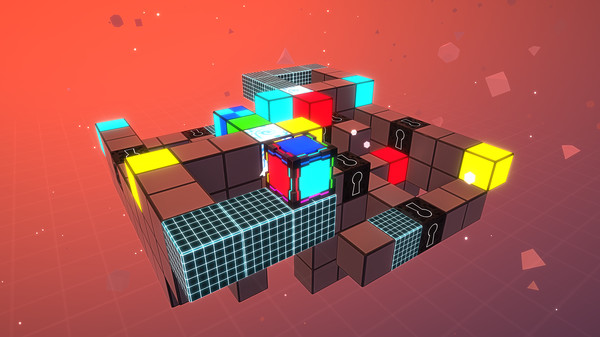
You’ll notice that both the colors and soundtrack stand out in Cubikolor, as they really try to keep you focused on the game. If you were fortunate to pre-order the game you’ll receive the OST as a free gift as well. Perhaps the best thing that the developers thought of in Cubikolor was the camera integration. Since the game is situated around a cube, at many points you can only see two of its six sides. Manipulating the right stick lets you move around the cube, as well as up or down levels in order to see where you need to go next. This is absolutely essential in Cubikolor and fortunately its incorporation into gameplay is both smooth and seamless.
Puzzle games are always incredibly difficult to get “right” when it comes to gameplay. The game becomes more of a point-and-click title if it’s too easy. If it’s too hard, then the thrill of experimentation goes away. Although there were more instances of luck and becoming stuck than I would have liked to see in Cubikolor, the game still managed to strike a feasible balance between difficulty, experimentation and luck. The experimentation aspect could have been better, as too often your ability to do so was blocked by bad luck and convoluted maneuvers.
Summary
Overall, Cubikolor is a very original puzzle game that is enjoyable for fans of the genre, but difficult for anyone else because of the game’s difficult setup and frustrating maneuverability. Cubikolor succeeds where it should in the area of puzzle game genre by appealing to its fans, but lacks in appealing to other gamers with the fun and experimentation factor.

Michael is a games journalist, contributor at 1080Players. They contributed 22 articles to ICXM in 2016, focused on game reviews, Windows and PC, and Xbox news: wrote for 1080Players, whose content also appeared on ICXM.