
Of the many things Deus Ex does well, its mechanical adaptability is the glue that holds it all together. Despite its incredibly well-written narrative and superbly designed world, Deus Ex’s designers could make the game about anything and set it anywhere and it’d still be incredibly fun to play, with those fundamental pillars of its mechanics in place. As if the core experience didn’t demonstrate this point enough, further proof comes in the form of the game’s fantastic third piece of DLC, A Criminal Past.
The expansion puts Adam Jensen into a separate but connected story about an undercover operation he went on between the events of Human Revolution and Mankind Divided, via the framing device of him retelling the events to Taskforce 29 psychologist, Delara Auzenne, at some point after the end of MD. For hardcore fans of the narrative, this framing device plays a pivotal role in potentially confirming some plot points that were hinted at during the main story and could play a big part in future games.

Jensen’s mission is to be incarcerated in a prison for augmented criminals and make contact with another undercover agent, who has been gathering intelligence on potential terrorist attacks by gangs. The mission immediately becomes more difficult than he thought, however, when the guards deactivate his augmentations.
This is a pivotal part of what makes the expansion such a joy and a wonderful example of the strength of the game’s design, as it doesn’t even need all the bells and whistles to be engaging. While there are numerous ways to re-enable Jensen’s abilities, the story is completely playable without any of them. Turning off the HUD (the minimap, health bars etc) and exploring the environment here is even more possible than in the base game, thanks to these deliberate design choices.

Despite his powers being disabled, Jensen is able to explore the prison and interact with multiple characters, although he quickly discovers things aren’t as straightforward as they seem. There are mysterious deaths to solve, a strange inmate offering drugs that supposedly reactivate augmentations and talk of discontent amongst the prisoners, with rumors of mistreatment to say the least.
It’s a vibrant cast of characters, several of whom have multiple possible motivations, which makes choosing allegiances a constantly invigorating challenge. Even the most righteous or innocent characters could be pulling a Keyser Söze and deceiving Jensen for nefarious reasons. This includes the man Jensen is supposed to meet; the deep undercover agent, Hector Guerrero aka “Oscar Mejia”. Nobody here can be completely trusted.
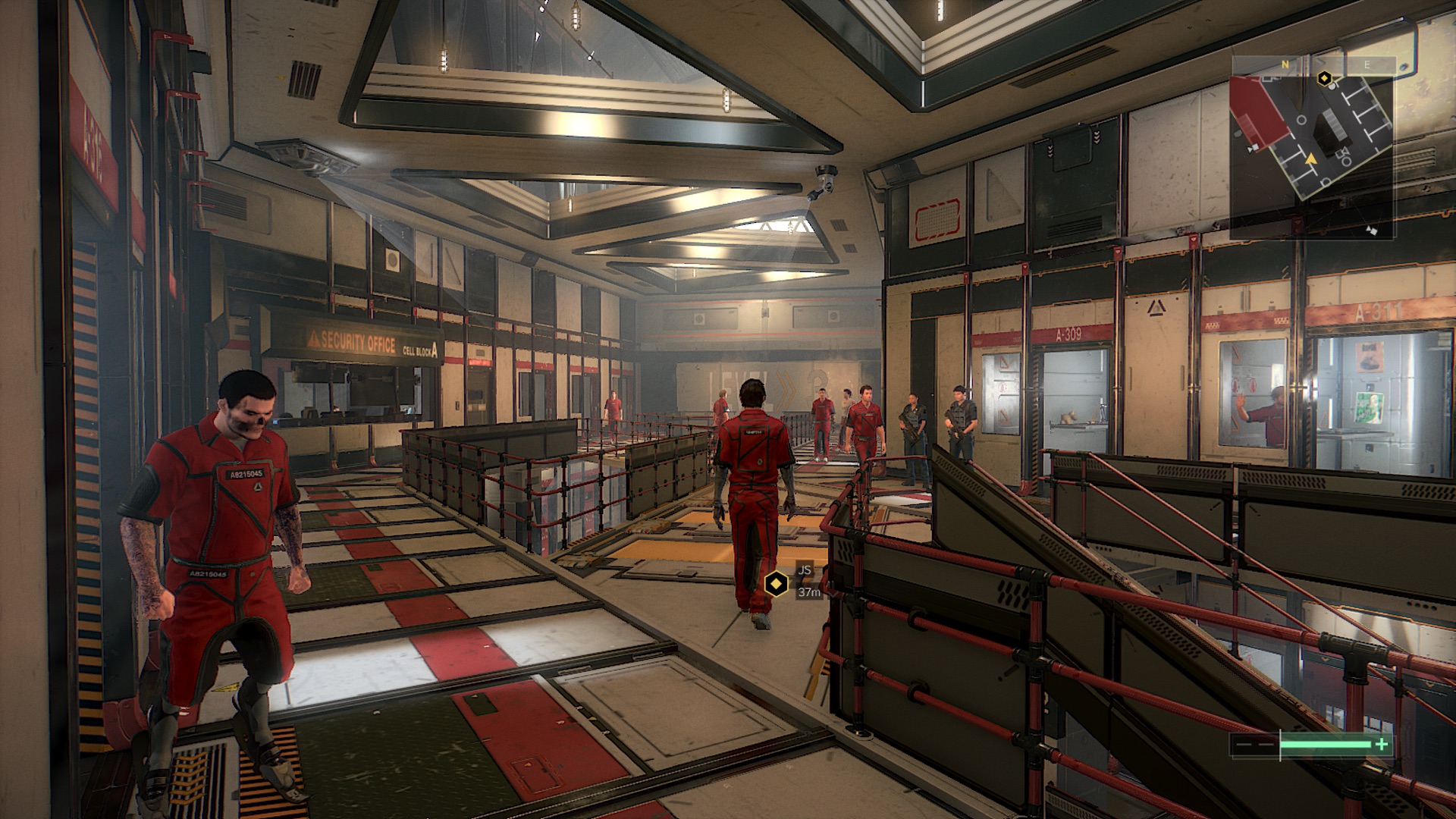
The prison itself is as perfectly designed — from a player’s perspective — as one could possibly hope for. There’s tons of potential ways to achieve goals, explore the various areas and defeat enemies. All the classic Deus Ex level-design charm shines through. It takes real talent to make a prison as interesting to explore as this. There are so many hidden paths and things to interact with, and a perfectly-paced progression of item discovery, with all manner of gadgets and weapons available should Jensen find them.
The potential for problem solving is a strength of Deus Ex and part of why all the sci-fi, gadgety fluff is surprisingly not really that vital for the game to be fun. Simple design choices that let the player use their brain are often overlooked in other games, but this series embraces them, with this expansion being no exception.
A particularly humorous example is an office that has a very high security lock on the door that needs advanced hacking skills to open, so its hard to get into. The door could be blown open to gain access, if the player lacks such skills. Alternatively, they could just step round the corner and smash the enormous, fragile glass panel that is the office’s sidewall. It was clearly a deliberate design choice rather than an oversight, to reward players using a little bit of common sense instead of relying of gadgets and other videogamey things.

As Jensen explores and advances the mission, things continue to escalate and everything starts to unravel. The story and action are perfectly paced and intertwined, with opportunities for exciting combat, intense stealth and masterful hacking, including lots of chance to puppet-master robots. The variety of activities rivals any mission in the main game. It’s definitely one of the best samples of what makes Deus Ex great that anyone could experience
The story crescendos with a number of shocking reveals and a classic verbal boss battle, including some mind-bending moral choices and tests of character. The final cutscene of the expansion is subtle in its genius. Hardcore fans of the series’ lore will probably understand what’s really being said behind the machiavellian doublespeak, but most will simply enjoy it for what it is on the surface, which is perfectly good as it is.

For the faithful though, the ending confirms some theories surrounding Jensen and the Illuminati, which might play a role in the next game, but also open previous events to new interpretations. Under more careful examination, the entire expansion could potentially not be what it seems, both canonically and in the meta (in this case meaning what the player is told). Some aspects are potentially reminiscent of Hideo Kojima fourth-wall breaking moments, although that may or may not be reading too much into it.
Regardless, the expansion is extremely enjoyable as a hardcore fan or as a more casual player. The added depth to the context is welcome, as previous expansions were much lighter in this aspect despite being pretty entertaining in their own right. This one however, is a far better standalone experience than either of the others and much longer at around six hours or more depending on the playstyle. It also offers good replayability, with many different choices to be made and ways to complete it.
Summary
A Criminal Past is a masterpiece of game design. The expansion can be played in multiple ways, offering compelling choices, exciting action and engaging storytelling for both casual and hardcore fans of the series. It proves that the core of what Deus Ex is can be put in almost scenario and remain extremely entertaining. This is everything a standalone expansion should be and its only flaw is not moving the story forward in a more substantial way.

Dean was a regular ICXM contributor between 2015–2017, publishing 39 articles across game reviews, Windows and PC, and Xbox news. Their work focused on hands-on reviews, platform commentary, and breaking-news reporting during the Xbox One X launch year and Microsoft’s wider Play Anywhere / UWP gaming initiative. They post on X as @SpookyWomble.