I wouldn’t blame anyone for not knowing what Inside is about before they play it. This is a game that needs to be played from start to finish in order to even remotely understand it, and short, minute-long trailers just aren’t enough to convey its message. Going in without prior knowledge may be what is best, though, as that is how the discoveries that you will make should be experienced; no expectations, just witnessed in the moment.
For a game with no dialogue, Inside’s story is successfully told entirely through its visuals. Some may prefer voiced characters for a more direct storytelling approach, but the subtlety in the way that Inside is told is outstanding. Starting out in a forest, you don’t know who you are or why you are there, but you are immediately compelled to move forward. On the run while being hunted by unknown people, you will make your way inside of a facility where human experiments are being conducted.

It’s difficult to talk about Inside’s story without spoiling any of it. The ending will leave players with more questions than answers, but that is part of what makes Inside so fantastic. All of its interpretations will raise discussions for years to come. I didn’t want it to end, and I was almost surprised when it did as the ending could be considered abrupt, however, it felt fitting. Inside is the type of game that leaves you staring at the screen contemplating what you have seen. It doesn’t give you the answers. Instead, it allows everyone to think for themselves. I look forward to reading how everyone interprets it.
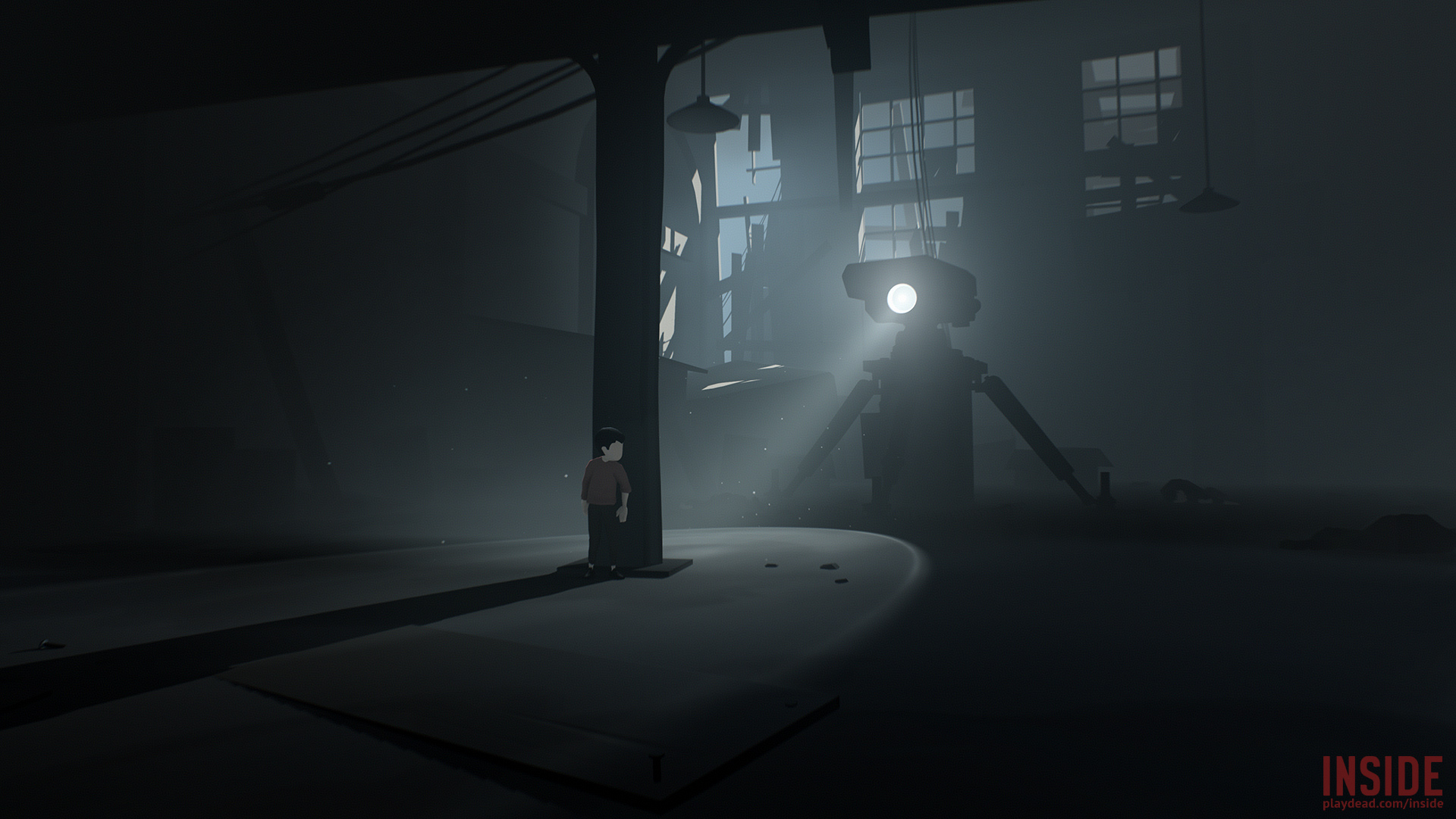
While the art style in Limbo was fairly flat, Inside’s environments have much more depth to them. Most sections are shades of black and white, but splashes of color help bring the oppressive atmosphere to life. The tension in the air is palpable. Whether it takes place in the future or the past, or an entirely different world to begin with, Playdead nailed Inside’s dystopian setting. You don’t know what happened to the world yet it is strangely foreboding.

The gameplay itself is very simplistic. Although the landscapes are presented as 2.5D environments, the movement is linear and consists of just walking and jumping while occasionally interacting with an object to solve a puzzle. On paper, that sounds rather boring, but actually playing it is incredibly engaging. Every section begs to be explored, and if you can find every hidden room, you will unlock an alternate ending.
Each puzzle cleverly uses the surroundings in ways that made me stop and appreciate the effort that must have went into designing them. None are overly complicated yet all of them do require a level of skill to complete. There are puzzles that rely on both your physical reflexes and your intelligence. There is a sense of urgency to solve specific puzzles that is perfectly executed. Don’t react fast enough in certain cases and you will certainly die, but if you are smart enough to realize what you need to do on the first try, completing a section makes you feel triumphant.

I never encountered any technical issues while playing. The controls are responsive and everything in-game moves like a well-oiled machine. Even the ways that each environment transitions into the next are seamless. You can play the entire game without seeing a single loading screen, assuming you don’t die.
Playing through Inside filled me with a sense of dread yet wonder. Everything about its presentation is haunting, and the end sequence of events is notably unsettling. Inside doesn’t scare you in the same way a typical horror game would, rather it focuses on being deeply disturbing. Playdead pulled off a gorgeously surreal title that is masterfully crafted.
The six-year gap between Limbo and Inside seems like a long time, especially for a game that can be beaten in just a few hours, but believe me, it was worth the wait. As a follow-up to Playdead’s Limbo, Inside is better in almost every way. From its art style, its gameplay, its story and themes, all of it creates such a unique universe that it’s almost indescribable. On the surface, it could be mistaken for a simple platforming title, but Inside is so much more.

Summary
Inside is a masterpiece waiting to be played and a worthy successor to Limbo that is just as thought-provoking, if not more. Playing through even one section of the game, the amount of polish and attention to detail is apparent. Not many games stick with me after the credits roll, but Inside is one of those rare few. I can’t wait to see what Playdead makes next.

Jennifer is a games journalist, former games journalist and PR Manager at Gearbox. They contributed 234 articles to ICXM between 2015–2017, focused on opinion pieces, game reviews, Windows and PC, and Xbox news: went on to write for Windows Central and later managed PR for Gearbox Software.