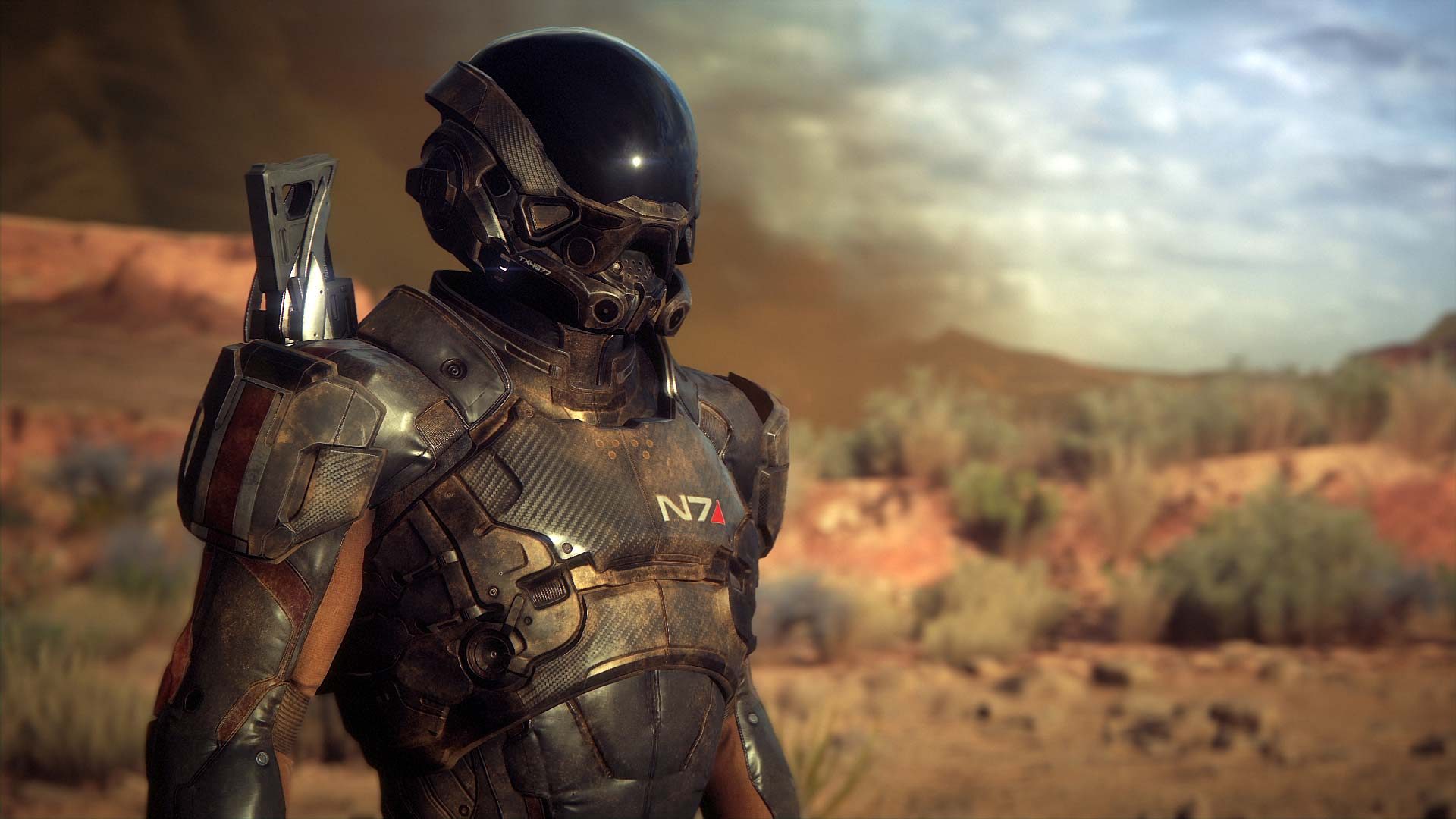
Following a trilogy of games widely regarded as some of the greatest ever created is no small feat, and Mass Effect: Andromeda had a lot to prove. Distancing themselves from the controversial ending of Mass Effect 3, the developers chose to take players to the Andromeda galaxy for a fresh start. In 2012, this is exactly how you’d imagine a new Mass Effect game would be, and that’s as much an insult as a compliment. It feels like Mass Effect, it has new features, new worlds, on a technical sense it is larger, but it doesn’t do enough. It plays it safe and doesn’t take too many risks. In 2017, I expect so much more.
Setting
While Andromeda is a completely different setting, everything about it feels surprisingly familiar. A couple of the planets are distinct enough, such as the jungle planet of Havarl, however two of the worlds are eerily similar desert planets and another is merely covered in ice. With the meager offering of explorable worlds, I would have liked more variety. The handful of planets you can land on all have their own hazards and are beautiful with stunning vistas, but they’re so barren and almost lifeless that nothing makes them special.
Characters
Assuming the mantle of Pathfinder, Ryder is a far cry from Commander Shepard. No matter what background players chose for their Shepard, they were always an N7 Marine, part of the Systems Alliance at the beginning of Mass Effect. In Andromeda, Ryder, while also a member of the Systems Alliance, is vastly less equipped to deal with conflict, primarily being an explorer who is thrust into a roll ill-prepared for. Ryder isn’t a battle-hardened soldier. In a way, that makes the character–whether you play as Scott or Sara–more relatable. Ryder is filled with an incredible sense of wonder, hoping to discover a new frontier and home for humanity.

The entire Tempest crew are worthy successors to those on the Normandy. From the pilot, Kallo, to the ship’s doctor, Lexi, everyone has diverse personalities, quirks, and traits that make them interesting. It’s easy to dislike a few members of Ryder’s squad near the beginning, but sticking with them and completing their loyalty missions is worthwhile. Peebee specifically was irritating when she was introduced but grew on me immensely as time went on. I ended up romancing Peebee in my first playthrough and was pleasantly surprised by how much she matured towards the end of the game. SAM, the resident AI, is another wonderful addition to the crew, helping Ryder solve the secrets of vaults across Andromeda. Ryder’s squadmates–Cora, Liam, Vetra, Peebee, Drack, and Jaal–all had a small piece of my heart by the end, and taking them out on missions is worth it for their banter alone.
This time around, no matter which character you choose to play as, the other exists within the universe as your twin. They aren’t just a throwaway character either, they play an important role in the narrative. Having a family member already gives Ryder ample motivation to settle the new galaxy and find a home. Though much of your twin’s time is spent in a coma, I look forward to seeing how they will be utilized in future installments.
Story and Missions
Mass Effect is at its best when it is character-focused, and Andromeda hasn’t changed that. Some of the strongest aspects of the game are its characters and their stories. The larger, overarching narrative is still intriguing, but each squadmate’s loyalty mission gives them a chance to shine and offers satisfying character development. Without spoiling too much, there is a specific mission that offers a better understanding of Ryder’s father and the creation of SAM that ties together some loose story threads while developing his character a great deal.
Ark Hyperion arrives in Andromeda in 2819, 634 years after it began its voyage across dark space, conveniently setting off before the Reapers arrived in the Milky Way. Encountering an energy phenomenon known as the Scourge, which has made the so-called golden worlds inhabitable, Ryder is tasked with finding a way to ensure humanity’s future. Many of the main story beats are reminiscent of Mass Effect. A formidable villain standing in your way, ancient alien technology at the center of it all, and chilling mysteries on the horizon. For fans of the series, there are callbacks to the original trilogy and its characters sprinkled throughout that people will enjoy.

The Archon, introduced early in the campaign as the main antagonist, is a small piece of a larger puzzle, like Saren. His motivations may be murky, but he is determined to control ancient Remnant technology to his advantage. He was a decent villain, but felt a bit one-dimensional. The Archon acts as though even talking to humans is beneath him as he is far more intelligent and cannot grace them with his time. He constantly tells his adversaries to “surrender or burn,” acting like he has all authority when it is made clear at one point that there are higher ranking kett above him in command. There is a lot more to the kett and their society that is still secret, likely being planned out for eventual sequels. Completing certain side missions gives further insight into their society, though nothing too substantial.
There’s a lot to love in Andromeda’s main missions which have depth, difficult choices, and presumably lasting consequences, but there is a ton of trivial filler as well. For as large as the environments are, they’re surprisingly desolate, and you may find yourself traveling across star systems and deserts only to have a brief conversation with one person that wasn’t at all worth the trouble or effort. Traveling so far and being forced to sit through scene after scene of the Tempest flying around the galaxy map just for three lines of dialogue seems like a glaring design flaw when the ship is outfitted with a vidcon communications channel. Missions requiring me to visit a planet, go back to the Tempest, read an email, and then land back on that same planet are an immense waste of time.
I wish that I could say the Andromeda galaxy is teeming with life, but unfortunately it isn’t. The only new sapient alien species that you encounter are the kett–who aren’t even native to that galaxy–and angara. I find it odd that somehow our own galaxy is filled with intelligent life but a galaxy millions of lightyears away isn’t. BioWare even made sure that those same familiar species made the trek to Andromeda in Arks specifically designed for them. I understand wanting to bring back parts of the original games that people love, and that includes races like the asari, salarians, and turians, but without adding enough new races, it’s a letdown. BioWare missed a massive opportunity in that regard.

Gameplay
Gone are the Paragon and Renegade decisions in exchange for a more nuanced approach to dialogue. With the binary morality system eliminated, players are presented emotional, logical, casual, and professional dialogue choices. This gives players more freedom than ever to craft the personality of Ryder as they see fit, but it makes it harder to discern how some decisions affect the world, if at all. The writing and dialogue itself is hit or miss, with cringe-worthy lines here and there, but the vocal performances from the main cast are all solid.
Exploration is a huge pillar in Mass Effect: Andromeda made easier with the addition of the Nomad, a more advanced equivalent of the Mako that oddly doesn’t have any weapons. The planets that can be visited are empty, with vast wastelands of nothing save for a few enemy hideouts, vaults, and mineral deposits to scan. Thanks to the jump-jet, locations have more verticality than ever before, and it is a powerful tool during combat.
The combat in Andromeda is as fluid and fun as ever. Even with contextual cover, I always enjoyed stumbling upon groups of kett or Remnant because the gunplay is so good. Players are no longer tied down to one class and have all abilities at their disposal should they choose to unlock them with skill points earned. Smooth controls combined with impeccable sound design make for fantastic firefights. Mass Effect: Andromeda is possibly one of the best third-person shooters on the market.
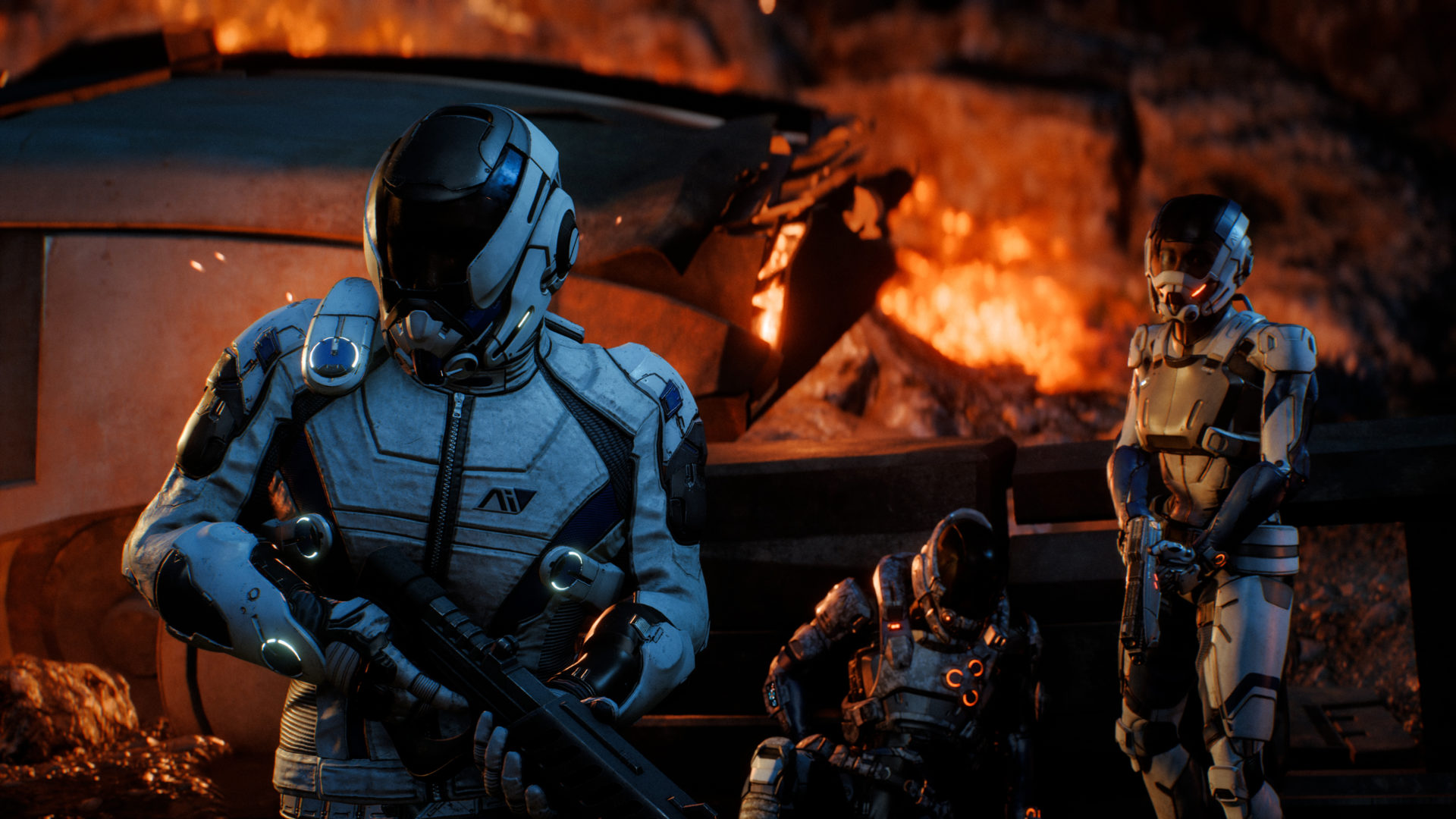
On the Tempest, you can access a Research and Development center that allows you to craft different weapons and armor, usually unlocked by acquiring blueprints. These items can then be augmented with buffs to stats, creating a unique arsenal. As tedious as scanning for anomalies may be, it does yield valuable resources that are needed in the R&D system. For as long as I played, none of the R&D items truly impressed me. I had better luck scavenging for weapons scattered in containers across the map or buying them outright from vendors. The only aspect that made it worthwhile for me to use my resources were the augments.
Multiplayer is back from Mass Effect 3 and features many of the same mechanics. You’ll encounter waves of enemies in a horde-like mode as you and your team push them back before extraction. A great progression system and combat are still at the mercy of its peer-to-peer matchmaking. Mass Effect obviously has a strong focus towards its single-player element, however it’s a shame that players wishing to partake in its exceptional multiplayer are stuck with inferior servers.
Performance
The enormous elephant in the room, so to speak, is undoubtedly the animations, which compared to other performance problems were honestly the least of my issues. The facial models specifically look off mainly when viewing humans. Though none are extraordinarily impressive, aliens by far look much better than humans in the game. I can only imagine it is the subpar quality combined with our familiarity with human anatomy. The textures make human faces almost look like plastic or wax, something that’s just come off an assembly line to be marketed as a 1st-wave android. What’s worse is the texture pop-in during cutscenes, a frequent annoyance. While the animations and character models don’t ruin the game and you do get used to them, they’re disappointing issues, and result in scenes meant to convey emotion coming across as awkward. It’s been five years since Mass Effect 3 came out, it’s absolutely fair to expect a higher quality than what was given.

Throughout my entire playthrough, over 50 hours, the lack of polish was consistently apparent. When using the Nomad on various planets, the screen would briefly freeze as if it was trying to catch up to fully load the new terrain. This was a frequent problem that happened nearly every time I drove the Nomad. In addition, while casually exploring and during fast-paced combat with several enemies, the frame rate would severely drop. There were also times where I encountered infinite loading screens, audio that wouldn’t play, levitating enemies, and characters clipping into objects and teleporting across rooms. This list doesn’t even scratch the surface of what players may encounter, but they are the most common problems. It’s evident that the transition to the Frostbite engine wasn’t entirely smooth. I recommend waiting until BioWare patches the game before purchasing.
Summary
Mass Effect: Andromeda at times captures the essence of the Mass Effect trilogy but doesn’t quite live up to its potential. The story and its lovable cast of characters stand as solid starting blocks in an expansive universe. Performance issues, bugs, and design flaws hurt an otherwise commendable role-playing game.

Jennifer is a games journalist, former games journalist and PR Manager at Gearbox. They contributed 234 articles to ICXM between 2015–2017, focused on opinion pieces, game reviews, Windows and PC, and Xbox news: went on to write for Windows Central and later managed PR for Gearbox Software.