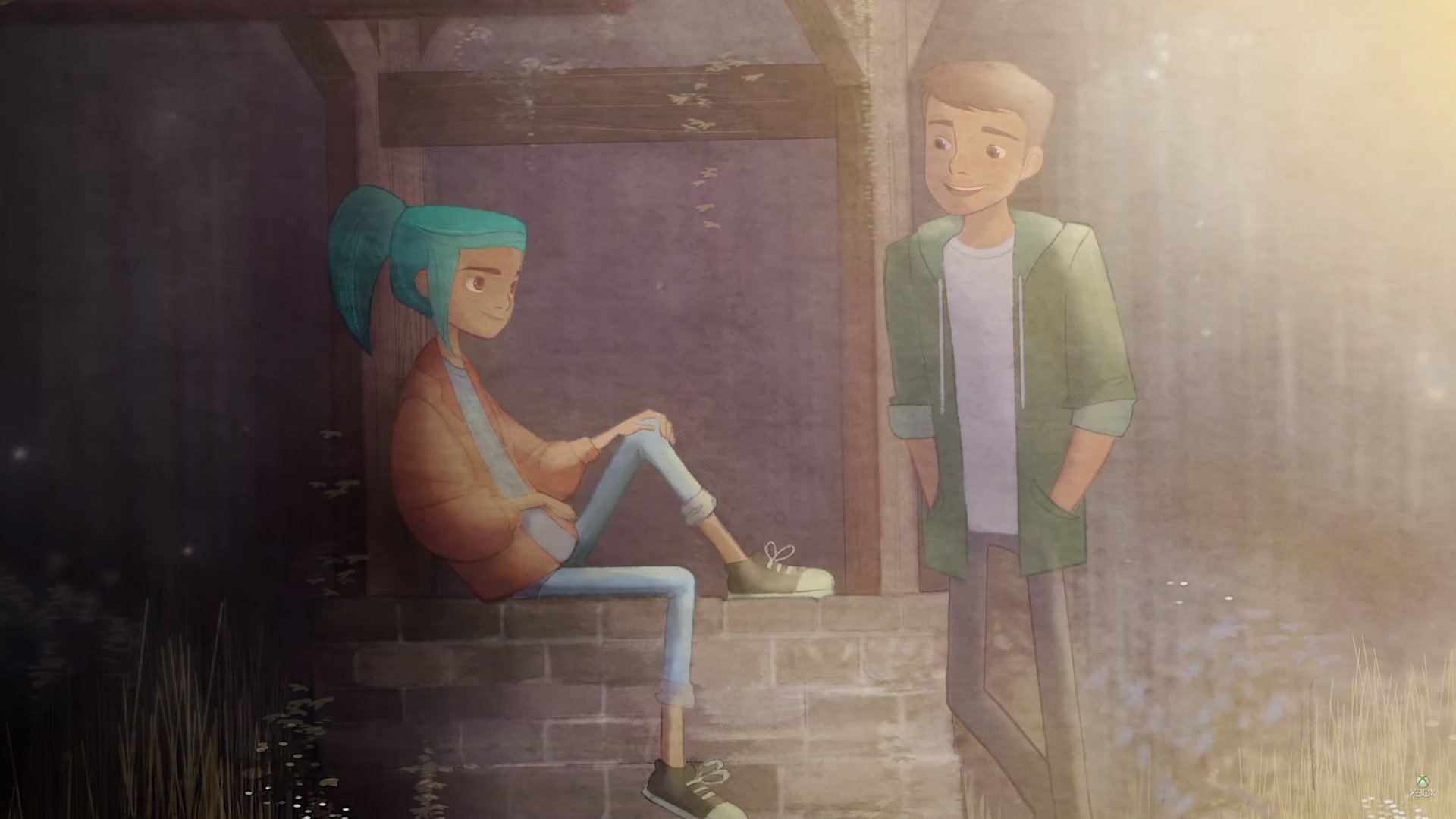
Oxenfree is an interactive supernatural thriller game made by developers Night School Studio. When I first saw the trailer for it, I immediately knew it was a game that I wanted to play. The art style was beautiful, the voice actors sounded fantastic, and the promise of a mystery needing to be solved got me hooked. The atmosphere of the game seemed like something out of a teen horror movie, and I could tell that it was going to be great. Playing through the game, it lived up to all of my expectations.
The game begins with a bunch of friends on a ferry who are going to a decommissioned military base on Edwards Island for a party. This island is where the entire game takes place. You play as Alex, a teenage girl who recently lost her brother, Michael. After her parents got divorced, she gained a new stepbrother, Jonas, who accompanies her to the island with their friends Ren, Clarissa and Nona.

During the beginning of the game when you first meet the characters, you will be introduced to the dialogue system that you will be using. When another character is talking to Alex, two to three speech bubbles will pop up, and you can choose however you want to reply. This all fits with the art style and it was nice to have a choice in what I wanted Alex to say. All of the dialogue in the game seemed natural and it helped to make the characters feel more real. Even though the group believed that they were being haunted by supernatural beings, it still didn’t stop them from cracking jokes from time to time. They talked exactly how I’d imagine teenagers in their situation to be talking. They were scared and confused but still young and stupid, and the dialogue showed this perfectly.
It probably helped that they had such amazing voice actors. Alex is voiced by Erin Yvette, who did an amazing job voicing Snow White in The Wolf Among Us and Sasha in Tales from the Borderlands. Jonas, who talks almost as much as Alex, was voiced by Gavin Hammon, who voiced Kenny in The Walking Dead video game. For this to be Night School Studio’s first game, they sure picked some excellent voice actors for their characters. Voice acting can be hit or miss, and in a game that relies on the characters’ reactions and dialogue, it is incredibly important to have good performances. If the characters were monotone or their voices didn’t show enough emotion, it could have completely ruined the game. Luckily, all of the characters sounded wonderful.

Most games today rely on some sort of combat as their main choice of gameplay. You’re either shooting someone in the face or stabbing someone to death. Oxenfree is a nice change of pace from that. Over the course of the entire game, you will advance your way through the island by using a radio. It may not seem like much, but this radio is actually what starts the ominous events that are haunting Alex and her friends. Edwards Island has a dark past, and Alex finds that out the hard way. When she starts to tune her radio deep within a cave, she accidentally opens up a temporal rift. Throughout the rest of the game, you will need to use the radio to get past certain sections by opening up more rifts. Every time you do this, you will hear menacing voices trying to speak with you, and Alex must try to understand why all of this is happening. Sometimes, these ‘voices’ can even possess Alex’s friends. It is an interesting mechanic and I loved how it was implemented.
By tuning into specific stations with the radio, you can change the music in the game and also learn about the history of the island near historical landmarks. The developers could have easily just thrown in some random text on a sign to read, but they decided to utilize the one tool at your disposal to tell more of the story. This serves to both show the importance of the radio and to make you more dependent on it. Being able to use the radio in various ways was a smart choice by the developers and a great way to make me more interested in the story.
There are set paths that you must walk along in the game, but it never feels restrictive. It isn’t exactly a traditional side-scroller, and although it has a 2D art style, it has a lot of depth to it. You have the freedom to move into the foreground and background of an open area. This was nice when I wanted to go and explore some of the island. You will be able to climb ledges and jump over small gaps just by pressing a button. The controls were simple, smooth and responsive, and never caused me any frustration.
The visuals in the game are gorgeous and you can tell that the developers put a lot of time and effort into them. Just looking at a screenshot from the game makes it look like something out of a painting. Walking around the island at night is like walking through an art gallery, and you can see that the use of certain colors in the game was very deliberate. There are a lot of blues, purples, greens, and blacks which make everything seem more mysterious and creepy. It has a darker and more somber feel to it. In one scene during the middle of the game, you’ll get to see the island during the daytime. This scene uses much warmer colors like yellow, red, and orange. Everything is much brighter and this scene has an air of happiness to it, even though there is still a sense of unease from the previous scene. This is a great juxtaposition going from the darker feel of the rest of the game, and it shows how the developers use the colors and lighting to affect your mood. Being able to affect how the player feels is key in a game like this, and the developers nailed it.
All games have ‘collectibles’ of some sort, and Oxenfree is no different. What makes Oxenfree better than most games, however, is that these collectibles actually mean something in the game. Collectibles can often be useless throw-away items simply existing to give the player a reason to play the game more. I’m glad to say that the collectibles in Oxenfree aren’t like that. Toward the end of the game, you will be able to collect letters from an older woman name Maggie Adler, who used to live on the island. These letters offer some insight into the unknown history of the island. They are used as a way to expand the lore and provide answers to both the characters and the player. I highly recommend finding all of them as they were interesting to read and allowed me to have a better understanding of what was going on.
The ending of the game came down to a final decision that I needed to make, and I loved how the epilogue showed just how much the characters grew throughout the game. The entire game took into account many of my dialogue choices without ever telling me that it would affect some aspects of the story. It was all being recorded in the background. A lot of these choices set the tone for what type of relationships I would have with certain characters. I could have Alex be more friendly or cold to Ren, and I could choose to form a bond with Jonas or pursue a more strained relationship. At the start, Clarissa was very unlikable and almost hostile towards Alex. Ren and Nona did not seem to be too close to one another. By making certain decisions, at the end of the game, it will drastically affect how the characters act. All of the characters came a long way from who they were at the beginning. They formed a special bond, and were much closer because of their experiences on the island.
Alex probably grew the most of all. The decision that I needed to make at the very end was a choice that I did not want to make, and I felt like Alex became a better person because of it. She made peace with a lot of the events that were happening and she knew what she needed to do to fix it. Seeing her transition from a rebellious teenager into someone with so much conviction to save her friends was wonderful to watch.
The game played out like an interactive horror movie and I loved it. The supernatural beings in the game seem to be toying with you and, at one point, one of them even asks “Do you want to play a game?” Just hearing this and seeing a door open up next to me gave me chills. This happened a lot when the screen would also tear out and turn to static. It was wonderful to have such a familiar feeling but at the same time dread crept in when I thought about what might happen next.
Summary
In total, I spent around six hours playing through the game, and I enjoyed every second of it. Everything about Oxenfree was such a joy to experience. From the pacing to the art style to the story and characters, all of it meshed together so beautifully. Nothing felt out of place. I honestly can’t think of anything that I would change, and I have no complaints about the game. It ran perfectly and I never experienced any kind of bugs. Immediately after the game ended, I just wanted to start playing it again right away. It offers a lot of replay value, and I’d be happy to spend more time with it. Oxenfree has so much personality and is so incredibly fun that everyone needs to play it.

Jennifer is a games journalist, former games journalist and PR Manager at Gearbox. They contributed 234 articles to ICXM between 2015–2017, focused on opinion pieces, game reviews, Windows and PC, and Xbox news: went on to write for Windows Central and later managed PR for Gearbox Software.