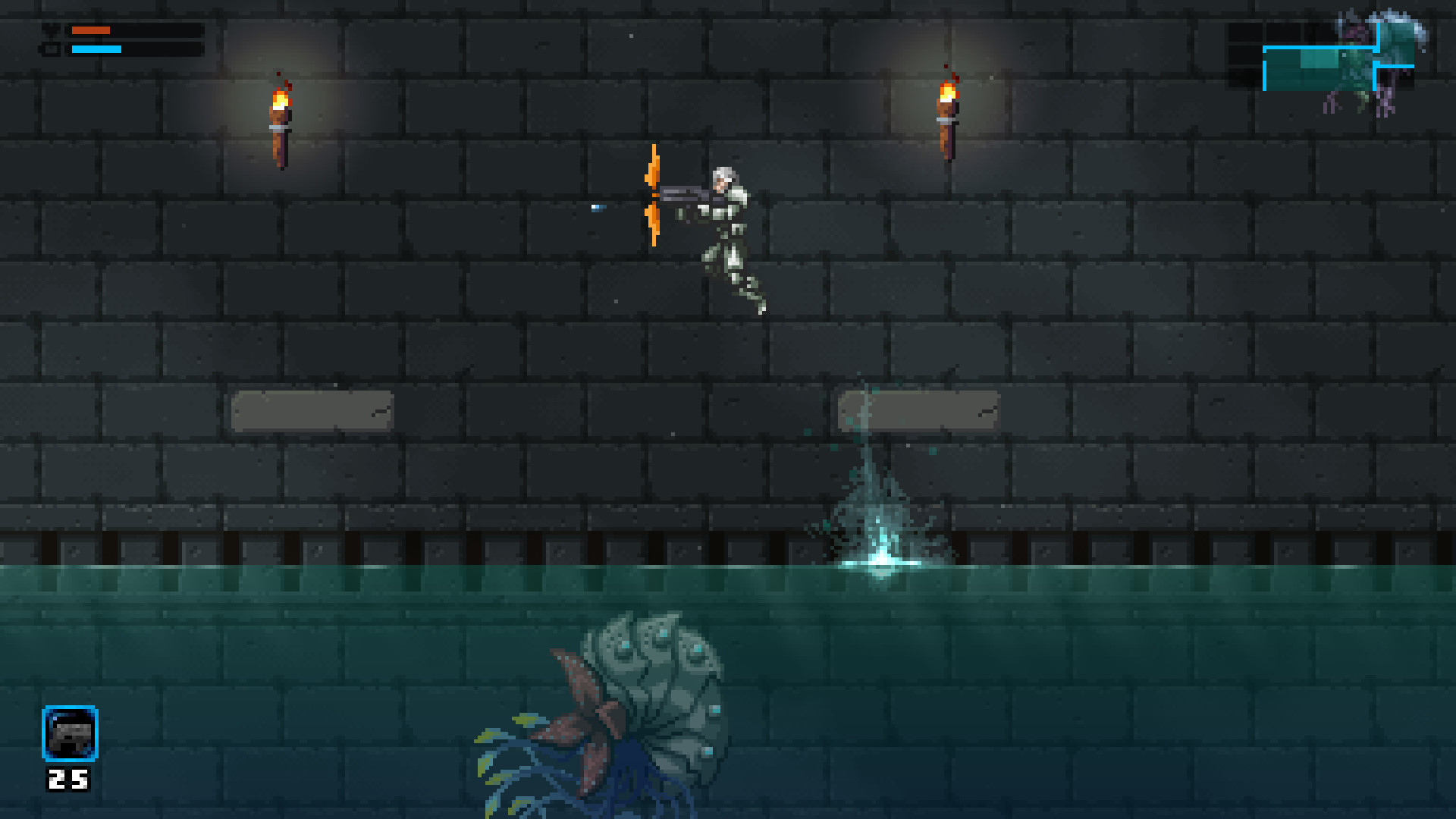
The indie game market is currently oversaturated with retro-inspired platformers. A quick peek at recent or upcoming releases on any storefront, especially Steam, and you’ll see a massive overabundance of indie side-scrollers and metrovanias inspired by some period of time designed to tint your glasses into a very nice rosy color.
With such an oversaturated market, repetition and similarities are bound to occur between products throughout releases. Such as with the modern military shooter phase that happened at the tail-end of the previous generation, so many products released with similar gameplay mechanics and art styles—since the AAA brown and grey color scheme was obviously extremely appealing when compared to games with more color variation than an original Game Boy title—that the market crumbled under itself and had to change itself up, hence the release of Titanfall, Destiny and Call of Duty: Advanced Warfare at the start of the current generation.

Exile’s End is one of the best cases of deju vu through market overflow. In its own right it’s a perfectly competent title which will undoubtedly make you want to bust out Super Metroid or in most recent cases, Axiom Verge, but that’s its exact problem. Exile’s End’s competence does not equal greatness. In every area, its passable but it doesn’t shine like it needs to when competing in a genre with so many other alternatives and so many other spectacular alternatives.
Gameplay is really quite standard. After awaking on a planet (since the pod from your ship has crashed here) you need to traverse through the environment by running and jumping—of which you will find an upgraded double jump—and shooting or throwing rocks at enemies. When you start, you have nothing. You take fall damage from any height bigger than you and you must constantly avoid snakes which deal large amounts of damage just from touching you.

Convoluted level design plasters Exile’s End while it is somewhat more sprawling and linked than, say, Super Metroid. Exile’s End is ironically less focused and relies on simplistic but annoying tactics to throw players off in order to pad the game’s overall running time. A short section of the game where it stands out the most is in the Cathedral where a small room requires you to jump in front of small, barely-visible indents in the wall which not only look like but are actually part of the environment in order to open a door in front of you.
Moment to moment gameplay in Exile’s End switches from being exhilarating exploration to frustrating, repetitious nonsense as you struggle with RNG pickups and frustrating level design. Much of this comes through the severe lack of health drops that some areas of Exile’s End provide you with. Unlike Super Metroid, Castlevania IV or, again, Axiom Verge, where fights are difficult but small health objects are just plentiful enough, Exile’s End’s pickups, be it ammo or health, are extremely random.
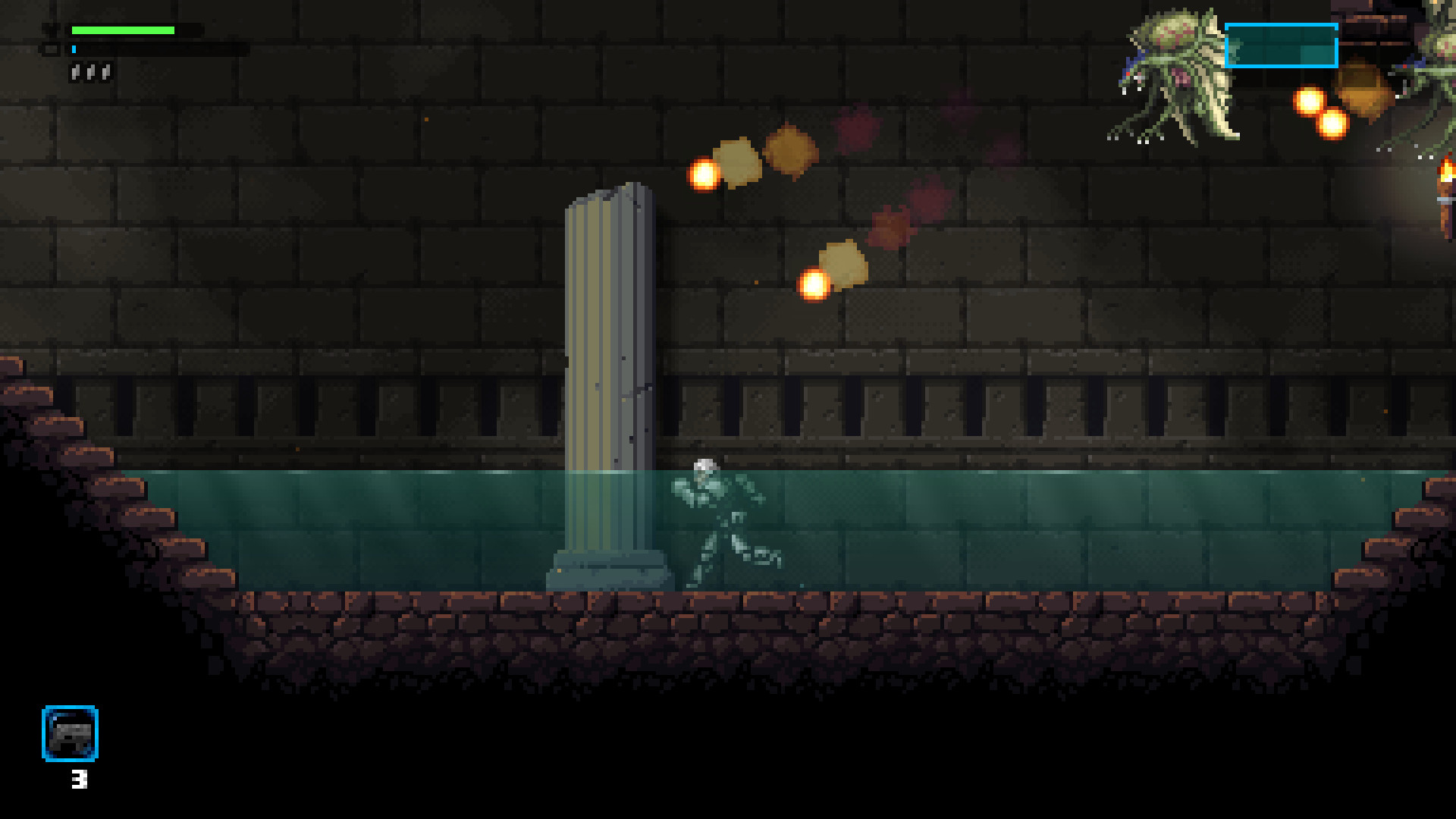
I spent ages wandering through the dark maze-like levels taking extreme caution to try and do rooms without taking a single bit of damage. Thankfully, death in Exile’s End means nothing as you respawn at the start of the room with everything you acquired before you entered the room. This means that large sections of Exile’s End can become long, strenuous sections of irritation as you perfect every room until one enemy decides it’s going to drop some health or until you can find a single-use first-aid pack somewhere in a hidden corner of the map.
The game’s inspirations from Commodore and Amiga system games are quite obvious in terms of its art style. While the game is substantially more detailed than games of that era, colors are very reminiscent of Shadow of the Beast or Exile and sound effects are simplistic in a way that brings out ye olde róse-tinted shades although are obviously of a much higher quality.
Summary
Exile’s End is by no means a bad game, it’s just a game with bad decisions. As a standard sci-fi metroidvania, it is more than competent but sadly does little to make itself stand out from a genre that has been flooding the market for years now.

Lewis is a games journalist, freelance gaming and consumer-tech journalist. They contributed 344 articles to ICXM between 2015–2017, focused on opinion pieces, game reviews, Windows and PC, and Xbox news: has since served as Editor-in-Chief at StealthOptional and Gaming Editor at MSPoweruser, with bylines at Gfinity Esports and FRVR.