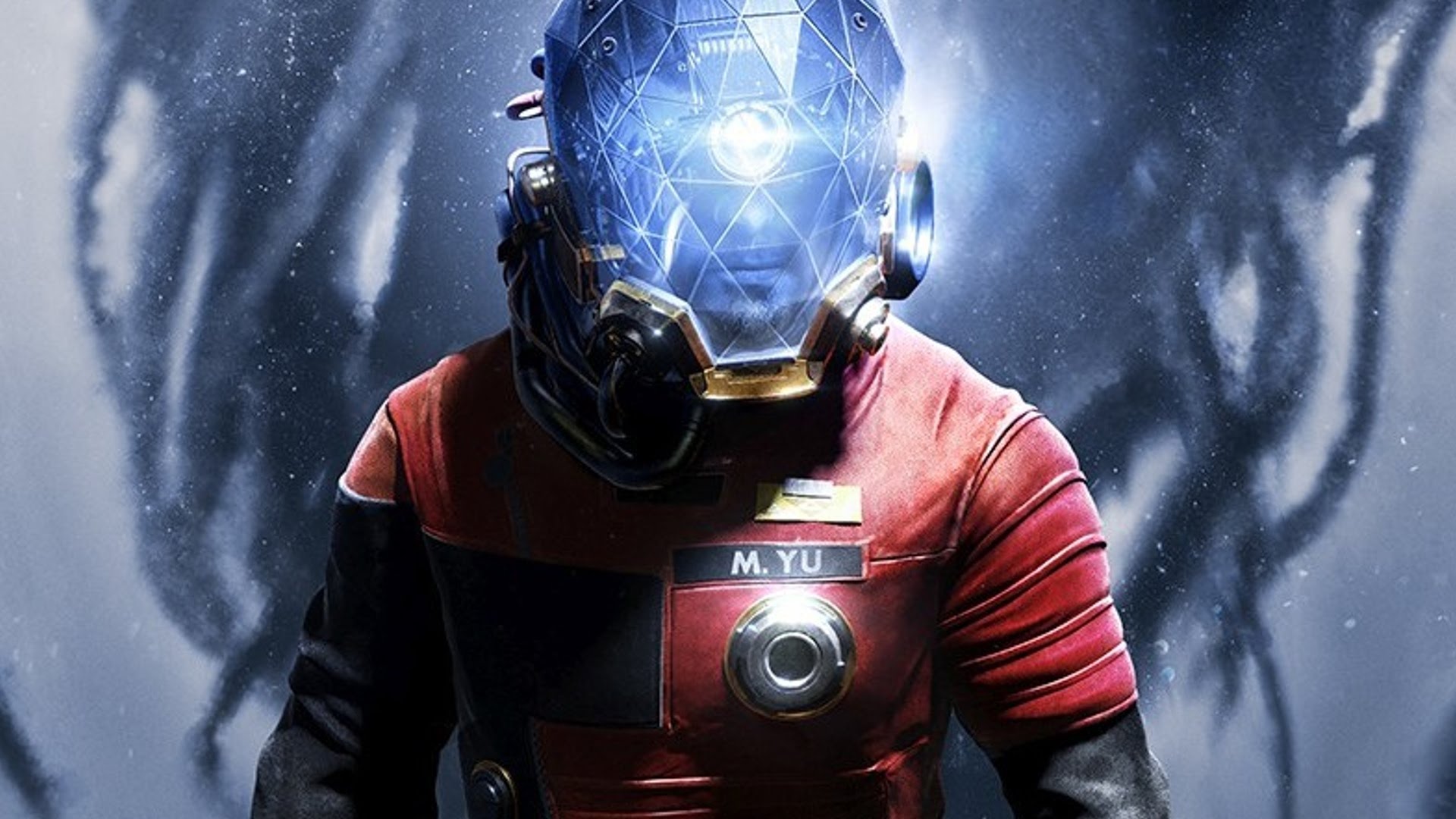
When Prey was officially revealed on stage at Bethesda’s E3 2016 press conference, I admittedly did not understand what the hype was about. I was not familiar with the original Prey from 2006, but knowing Arkane Studios was developing this project, and being a huge fan of their work from Dishonored, I kept my eye on it. I’m glad that I did. Arkane’s Prey is a love letter to System Shock, and BioShock by extension, with a lot of Dishonored in its DNA.
If you’re like me and you’ve never played Prey from 2006, you’ll be able to jump into this one perfectly fine. Though it’s a Prey title by name, that is the primary similarity that it harbors with its predecessor, aside from some thematic elements. Arkane created their own universe and made Talos I a brutal, eerie playground filled with mystery and terror.
In this alternate timeline where President John F. Kennedy survived his assassination attempt, the Space Race is accelerated through excessive funding. When the alien Typhon eventually invade, they are secretly captured through a joint effort of the United States and USSR, who build a space station called the Kletka for the purpose of containing these creatures. Eventually after the fall of the Soviet Union, the United States takes over Kletka and uses it to study the Typhon. This project, dubbed Project Axiom, is shut down after failed experiments and an incident that cost scientists their lives. By 2025, the station is acquired by the TranStar corporation who renames it Talos I in the early the 2030s and begins work on harnessing the powers of the Typhon through advances in neuroscience. This leads into the events of Prey.

Morgan Yu (who can be male or female) wakes up in her apartment, beginning a seemingly ordinary work day for TranStar, run by her brother Alex Yu, CEO of the company. Of course, as with most sci-fi media, nothing is ever really ordinary. The opening of Prey is a wonderful hook that grabs players and tosses them into an intimidating world, making them invested into figuring out the mysteries of Talos I. Even when you think you are finally starting to understand what is happening, Prey throws you through a loop and makes you question just what the hell is going on. None of this confusion is bad, however, and it makes you more determined to find out the truth.
One major downfall of using Neuromods (the tools developed by TranStar used to gain special abilities) in Prey’s universe is that you lose all memory gained after installation once they are removed. Because of this, Morgan needs to rely on other survivors and messages from herself to piece together the past. Unfortunately they’re not all trustworthy, and these unreliable narrators of sorts add to the sense of paranoia, never knowing what is real. The game is a surprising lesson in empathy by the end of it when events change based on decisions the player makes.
Unlike Dishonored, Talos I offers an interconnected open-world environment, with players capable of travelling throughout the entire space station, including its zero-g exterior. Take the time to explore every area and you’re rewarded with secret passageways to enter otherwise inaccessible rooms and alternate routes to avoid the dangers of Talos I lurking behind every corner. Arkane is truly masterful at crafting beautiful, detailed levels that give people the freedom to tackle challenges in a way that best suits their playstyle.

Your introduction to the true scope of Morgan’s predicament begins in the Talos Lobby, with a full view of the moon quickly revealing that you were merely living a simulation. The lobby, like much of Talos I, is pristine, decorated in shiny golds and bold blacks, a message of opulence with its lavish art deco style. Even being confined to a space station doesn’t seem to have held back Arkane, as the studio managed to create a diverse set of environments within. From a lush garden to labs used for testing, and extravagant living quarters to the Power Plant powering it all, each area is distinct and recognizable.
When Arkane creates a universe, they fill it with rich history and dozens of little stories to be discovered by the player through character interactions, emails, audio logs, and the environment itself. Talos I is a treasure trove of such stories waiting to be uncovered, some even triggering side missions. Every NPC in Prey has a name, including ones already dead. Though not all of them are memorable, it’s this attention to detail that sets Prey apart from other games. Reading a person’s email might give insight into their personality, relationships, and life before the outbreak.
Although Prey has horror elements and can be classified as such, it is primarily a sci-fi title. Talos I is crawling with Typhon, the hostile alien species that broke containment aboard the research station. Mimics, the smallest Typhon, become less frightening and somewhat of an annoyance early on when you can gain a chip for your Psychoscope (a device used to scan the environment and Typhon) that can detect them even as they are camouflaged. The more daunting enemies like Phantoms and Telepaths are tough enough to present fun challenges.

Aside from Mimics, most of the enemies tend to be bullet sponges and are exceedingly difficult to fight in groups. Because of this, and with a scarce amount ammo lying around, the combat in Prey should be approached differently than other first-person shooters. You can’t always rely on brute force to defeat a larger Typhon like a Technopath. Instead, you’ll need to plan your attacks with smart combos. The Gloo Cannon, which shoots fast-hardening foam, is a wonderful multipurpose tool. Not only can it be used to create platforms, block doorways, and suppress environmental hazards like fires, but it is also the perfect tool to immobilize certain Typhon. This is the one weapon that I believe has an ample amount of ammunition scattered throughout, and you’ll never have a shortage of canisters when you can fabricate more. Distracting an enemy with a foam dart, then combining the Gloo Cannon with a Nullwave Transmitter to cripple them is great way to gain the upper hand. Though you can certainly run into battle guns blazing if that’s your style (and at your own peril), Prey encourages players to think outside the box and experiment with weapons and powers in creative ways.
Being a research station, Talos I is not equipped with your typical weapons that you may be accustomed to in other games, like assault rifles, sniper rifles, or machine guns. You’ll come across security stations with a lone pistol or a shotgun next to a dead NPC, along with more unique experimental weapons like the Gloo Cannon and Q-Beam. Even though this was a purposeful design choice, I can see how some players may find it too restrictive. Personally, I think the trade-off for an immersive world is worth it, and the abilities gained with Neuromods more than make up for the lack of guns.
Neuromods are a core feature in Prey and central to both its narrative and gameplay. These are tools injected into you through your eye that grant Morgan enhanced human and Typhon abilities. You can acquire human skills like hacking, health and strength benefits, and much more, but Typhon powers are where the real fun is. With the help of the Psychoscope, Morgan scans the surrounding areas for different types of Typhon, which then unlock specific abilities. Scanning a Mimic, as the name suggests, awards players the ability to actually mimic other objects. Scanning more powerful enemies unlocks even better skills, like Kinetic Blast or Psychoshock, turning the Typhon’s own powers against them.

There is a gameplay downside for using too many Neuromods and purchasing Typhon abilities. If turrets detect any Typhon DNA in your body, they will shoot on sight, leaving you prone to injuries and detection. Furthermore, a dangerous, towering Typhon called a Nightmare will start to hunt you. Once this happens, you’ll be given a few minutes to either evade or kill the monster. This is a wonderfully implemented risk and reward system that makes sense narratively and makes players carefully consider their actions in choosing to use Neuromods.
While I enjoyed almost all of my time with Prey, there were parts that didn’t run smoothly. Instead of using their internal Void engine like with Dishonored 2, Arkane utilizes CryEngine in Prey. I first noticed some negligible lag in Morgan’s office and thought nothing of it, but I experienced severe frame rate issues in the Cargo Bay and Power Plant. I’m not sure if I was just unlucky, as I’ve talked to other people who say these areas ran fine for them, but it was almost unplayable for a good minute or two in my game. I don’t think this is a widespread problem as it doesn’t occur frequently. Two minutes of rough performance out of over twenty hours in no way makes Prey a bad game, but I felt it worth mentioning. Going back through those areas to test it out again, everything ran as it should.

Summary
Prey is easily one of the best games to come out this year, and I highly recommend picking it up if you’re a fan of BioShock or Dishonored. Arkane skillfully wove together a cohesive narrative, engaging gameplay elements, and a vast environment open to the player. Talos I is an incredible achievement in design and the world of Prey is as intriguing as it is chilling. Its performance issues can be bothersome but aren’t a huge detriment to an otherwise excellent game.

Jennifer is a games journalist, former games journalist and PR Manager at Gearbox. They contributed 234 articles to ICXM between 2015–2017, focused on opinion pieces, game reviews, Windows and PC, and Xbox news: went on to write for Windows Central and later managed PR for Gearbox Software.