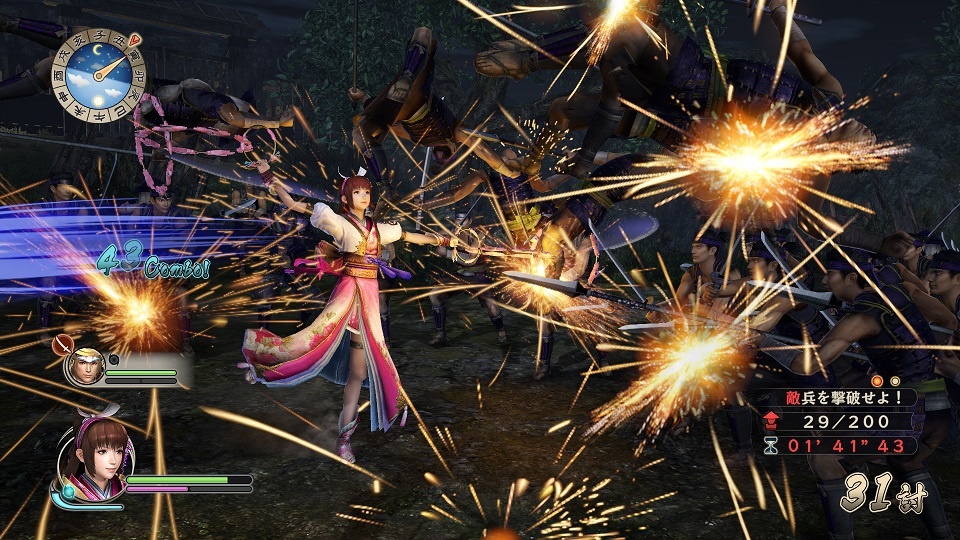
Before we begin my review of this game, I have to admit that I haven’t played any of the Samurai Warriors series from Koei Tecmo, and up to today, much of Japanese culture was quite foreign to me, beyond the few historical formalities. Much of this is due to our Western perspective on these matters, but also due to the fact that many Western games haven’t touched on much of Japanese history and the Japanese seems to not want to either. I had to read up on most of the historical aspects this game is based on, and this I must give credit to this game. The rich history this game tried to depict interested me more before playing the game than it did during, which takes that credit away.
When I started playing I was quite honestly expecting the usual brainless hack-and-slash game you would expect from what you’ve already seen from most Japanese games in general, many of which has that annoying turn-based aspect. However, during my playthrough several things stuck with me.
The story is based on historical battles between Sanada Masayuki and his surrounding clans. His sons also play a pivotal role in this game as well. You play as several significant characters in this game, and each one of these has several abilities and special battle moves that really made the game a spectacle to behold. I for one had difficulty pinpointing which game this reminded me of, but the fast-paced combat had a distinctly unique aspect.
Beyond the historical aspect of the story, the developer opted to keep the game dubbed in Japanese, which is quite jarring at first. Luckily for me, they had dialogue boxes in English, but the inclusion of the Japanese language added to the gameplay experience more than detract from it. The game is mainly played in the third person, and each battle is relatively linear in pace. For instance, the game would seem open world at first with the camps giving you ample exploring to do, and several people to converse with, but it quickly ends when you have to go to battle. I do believe this is part of the game design in general, however, I do have a few gripes.
Much of the games these days try to be as ‘real’ as they possibly could, but during the playtime I had with this game, I felt that this game belonged to a bygone era. The battlefields as I mentioned were extremely linear and had corridors where you had to go through, and each had a flurry of enemies you had to fight through.
Battles seemed quite one-sided as well for the most part. In most games where one on one battles are the norm with a bunch of smaller powered enemies in tow, you would expect there to be some challenge to the main fight. However, much like For Honour, the hundreds of lower-tier enemies mainly fill up space and become annoying when you’re trying to take on a specific target. In For Honour, this was also the issue, with a wave of enemies rushing in just standing there huddled around a specific area.
Samurai Warriors takes this one step further, and fills up the battlefield with sporadic swarms of enemies, then adds a few ‘generals’ or main targets you have to kill to complete the sequence. Even though this was mostly a fun experience, I had trouble seeing how they could stick with this archaic gameplay mechanic. Battlefields are often chaotic, however, for this game it makes the same mistakes For Honour did, without the dull and lifeless storyline.
Samurai Warriors is a beautiful game, with genuinely unique and exciting aspects that opens up much of the history and intricacies of Japanese history. However, the general lack of depth in battles—however fun they were—makes this game mostly enjoyable but it could have been so much more. For once I would love to see a Japanese game based on the history of that country in the format of The Witcher 3. Samurai Warriors also pushes the whole ‘kawaii’ graphical aspect here, which is off-putting to some degree. I can guarantee that no historical figure in Japanese history looked like they belonged in either Final Fantasy or Tekken 7, for the most part. If Japanese developers were to embrace their history and push the limits of the graphical capabilities that we have today, I could definitely see them offering us a game that makes us all actually want to hear about their past, instead of seeing the usual barrage of games that mostly look and play the same.
But for the most part I had genuine fun playing the game, but with it deprecating the historical aspect and muddling it with unrealistic fighting mechanics and quite hysterical facial animations I feel that Koei Tecmo and others can genuinely look at their techniques and try to do something truly out there. This does not detract from the brilliance of their storytelling ability, but for the most part, they tend to stick to what works, and to me that what is working is becoming quite boring, to be honest.
I know that most of my gripes with this game are due to the fact that Japanese developers seem to be stuck in the 1990s for the most part, but as someone who particularly enjoys a game that is fast-paced with flashy graphics, Koei Tecmo should focus on the narrative next time, and try to dial down the spectacle of the thing, which detracts from what I would assume they are trying to achieve. If they gave us a game that didn’t try and depict the history of the Sanada clan, instead opting for another generic gameplay story this wouldn’t be an issue for me.
I would feel the same if a South African developer took the historical aspects of the Anglo War and slapped Die Antwoord aesthetic to it and called it a day, luckily we’re not that good at building games.
Summary
The latest in the Warriors series seems not to disappoint if you were looking for more of the same from the developer. However, to me, this game seemed to take Japanese history and cover it up in glitter and Tekken 7 mechanics and offer it up to gamers as to get them to try and make history fun. To me, making games based on historical facts needs to have a serious aspect to them and bring the player closer to the story instead of making it all about the fighting sequences.
Games like Battlefield and Call of Duty have learned from their mistakes, pushing the art of war further and further away from historical accuracy to what would be regarded as fun. With the latest series of games, these titles seemed to have taken the cries from the community seriously and are giving us titles that tell stories more than it is about ‘fighting’.
Although I do understand it isn’t the place for this game to depict reality because of the main purpose of the genre and series, this just saddened me that the Japanese developers don’t really want to share their stories outside of the usual pop culture aesthetic. I truly hope that we will one day receive a historically-accurate game based on Japanese history, instead of another mindless rendition of what they’ve done for the last ten years.

Dreyer was a regular ICXM contributor between 2016–2017, publishing 139 articles across opinion pieces, game reviews, Windows and PC, and Xbox news. Their work focused on hands-on reviews, platform commentary, and breaking-news reporting during the Xbox One X launch year and Microsoft’s wider Play Anywhere / UWP gaming initiative. They post on X as @dreyer_smit.