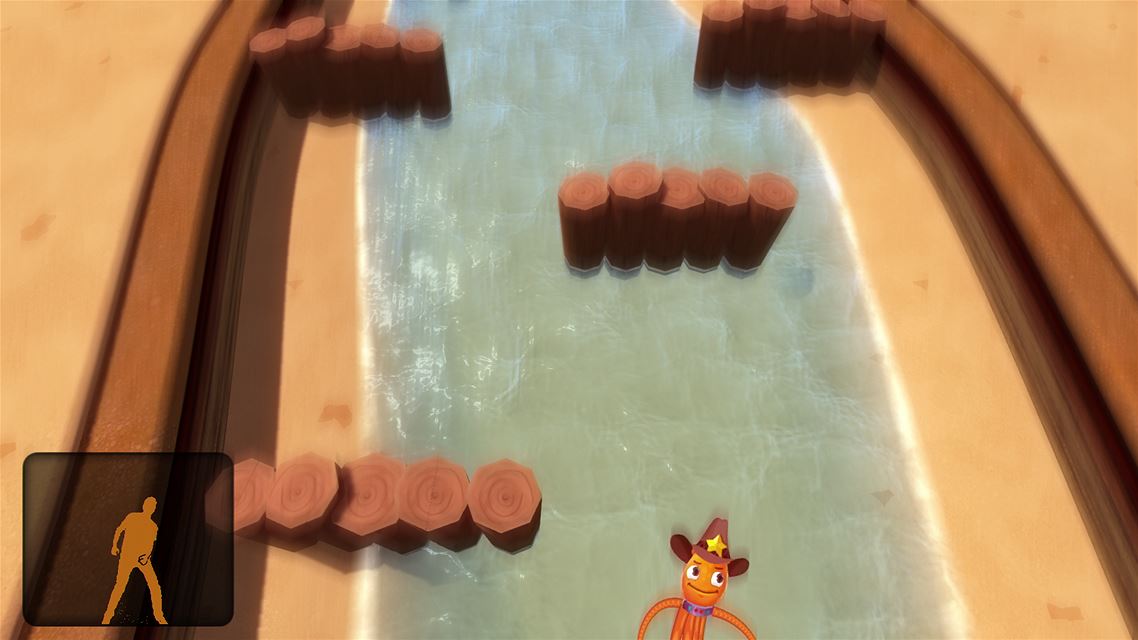
Squid Hero for Kinect recently released on Xbox One. This is the second game from developer Virtual Air Guitar Company to make its way to the next-generation console. Their first title was Boom Ball for Kinect which released back in November of last year. Squid Hero is about a squid who saves the planet from a new ice age. Boom Ball is a game that mixes tennis, breakout and gratuitous explosions in a unique package. While the subject matter of the titles Virtual Air Guitar Company develops varies, they all utilize motion controls in unique ways.
We recently got a chance to ask Aki Kanerva, the Lead Designer and founder of the studio, about their experience in making motion controlled games. His response reveals interesting details about the industry and the struggles developers in this space face.
You can read the entire interview below.

ICXM: I was also wondering if you could tell us a little about your desire to build Kinect games and how that journey started. Developers who focus on motion controls are so rare so it’s always interesting to know their stories.
Aki: Our journey with motion games started back in 2005, with three guys at Aalto University in Helsinki, Finland. We were researching virtual reality, new user interfaces and computer vision. One of our research projects was an air guitar that you could actually play: slip on a pair of orange gloves (the software tracked them by color), and make it like a rock star. The air guitar would respond appropriately. It had a pentatonic minor scale, slides and vibrato, and even a chord mode where you could play Smoke on the Water (four chords is enough!).
The air guitar was a success, went on display in a science museum, and received huge global media visibility – New Scientist, Discovery Channel, the works. So we started thinking of a way to bring it to a wider audience. We all liked video games, and this was the time when console peripherals were a big hit: you had dance mats and weird controllers, and Guitar Hero was just coming out. PS3 and Xbox 360 had just come out, so consoles were getting powerful enough to run computer vision in real time. We could use new technology to create a completely unique experience in your own home, without having to buy a whole VR studio.
And so the Virtual Air Guitar Company was born in 2006. Its first game would be Virtual Air Guitar, where you’d rise to rock stardom playing air guitar on stage – as your very own self instead of an avatar. It was also a real full-body workout! Sadly, our publisher cancelled the project, which is what often happens with publishers. We know now that Guitar Hero would go on to saturate its own market, so maybe getting cancelled wasn’t a bad thing after all…
But we still had our PhDs and our cutting-edge body tracking and background removal technology called FreeMotion, which ran on regular webcams like the PlayStation Eye. We took another risk and developed an entirely new, self-published game for the PS3: Kung-Fu Live (http://kungfulivegame.com). It was something that people had never seen, placing the player’s own live picture inside the game in a way that PS2’s EyeToy had never done.
About halfway through the project, rumours about something called “Project Natal” started to surface. And then, a bit before Kung-Fu Live was released, Kinect was revealed. Which ended up being kind of funny, because when the game came out in 2010, people started saying that Kung-Fu Live was “the best Kinect game on the PS3”.

ICXM: How did the Xbox 360’s Kinect sensor change that?
Aki: Being a depth camera, Kinect was more advanced than regular webcams. Some of our technology was no longer necessary, such as the smart background removal that worked without a green screen. With Kinect, such background extraction was trivial.
So Xbox 360 looked promising, and we started working on porting Kung-Fu Live to it. But multiplatform games were only allowed on Xbox 360 if they came out earlier or at the same time as on PS3. So instead of a port, we had to create an entirely new game. The other big limitation was that, unlike on PlayStation, independent developers couldn’t self-publish on Xbox 360. There was no such thing as ID@Xbox back then. So we found a third-party publisher, got down to work, and released Kung-Fu High Impact (http://kungfuhighimpact.com) after a hectic seven-month development crunch in 2011.
Sadly, that publisher didn’t really do well with marketing the game (such as insisting on a full-price disc release when it should have been a downloadable game, and not being able to sell it in the UK at all). They also went bankrupt, which was not fun for us. This was also a time of outright Kinect hate in the media. To this day Kung-Fu High Impact has huge fans – we still get messages from people who say they play every day – but many reviewers didn’t get Kinect games at all. One memorable review said it was a “not very good 2D beat-em-up”, with the reviewer somehow failing to mention that it was the only game where you could fight the bad guys with real kicks and punches!
In this general atmosphere, Microsoft was the only one who kept believing in Kinect while third-party publishers looked elsewhere. Where 2011 had seen many Kinect games from all around, in 2012 the only non-Microsoft Kinect game was a dance game sequel. Publishers no longer wanted anything to do with any Kinect concepts, including our prototype of Kung-Fu in full 3D, complete with an over-the-shoulder avatar view.

ICXM: I’m sorry to hear that. It must’ve been very difficult.
Aki: Times were tough, our team got smaller, and we looked for other motion control opportunities. We worked on bringing Kung-Fu to a completely new set-top box platform, but the platform itself didn’t sell at all and went bankrupt. There was another attempt to get Kung-Fu on a smart TV which was based on a 3D camera made by PrimeSense, the company responsible for the original Kinect. Then Apple bought PrimeSense, and suddenly there were no 3D cameras available anymore, and so all camera-based projects were cut short, ours included.
In 2013, we ended up making a small game for the Leap Motion Controller called Boom Ball. The first one was received very well, with user comments saying it was the best game on the device. It was even bundled with HP laptops. So we made a sequel, Boom Ball Adventures, which was better in every way. However, the Leap Motion Controller had come and gone, and people weren’t buying new software for it anymore – and a lot of what was available was free, so that wasn’t a great place to compete with a paid product.
Then Xbox One came along, with a better Kinect and rumours about the possibility of self-publishing through ID@Xbox. We were excited about being able to work with the latest technology once more. So we took the concept of Boom Ball and made it into an active, full-body game. The result was Boom Ball for Kinect (http://boomballgame.com) in November 2014.

ICXM: Has the way Kinect games are viewed and talked about changed since?
Aki: By now, the worst of the anti-Kinect sentiment had disappeared. Review sites and blogs that specialized in Kinect games had sprung up, and the whole indie game renaissance was in full swing. Also, streaming had become a thing, and Kinect games are brilliant for that. Boom Ball received a positive welcome. It may not have offered a hundred hours of gameplay, but people seemed to think that the $9.99 price was fine. This encouraged us to start working on a new ID@Xbox Kinect game. And that’s how we’ve arrived at Squid Hero today.
We’re aiming at a family audience now. Even with Kung-Fu, we’d discovered that kids really love camera games thanks to the physical activity, and parents like being able to play together. Seeing six-year-olds playing Boom Ball, jumping around in glee…that’s just awesome.
We’d love to revisit Kung-Fu and bring it to Xbox One at some point. That 3D avatar prototype has definitely not gone stale yet, either. We have others in store, too…there’s a stealth game, a mech game, and others. Even the original Virtual Air Guitar game, the one that was cancelled, could still make a comeback. These are big projects that deserve to be made well, but being an indie studio now, we rely entirely on what Boom Ball and Squid Hero make. Each new game can only be as big as the sales of the previous one. And now that Kinect is no longer bundled with every Xbox One, it’s even more important to keep releasing new games for it as much as possible.
So if you want to see bigger and more awesome Kinect games…go and buy Boom Ball and Squid Hero! Tell your friends! Help us show that Kinect is worth investing into!
ICXM: Thank you so much for the interview. You really helped us understand how you got interested in the segment and your experiences in the industry. It provided a lot of insight.

Asher Madan is a games journalist, former News Writer (Gaming) at Windows Central. They contributed 182 articles to ICXM in 2015, focused on Windows and PC, and Xbox news: joined Future plc’s Windows Central in 2017 covering Xbox news, hardware, and reviews.