Bulimia is a very serious issue. That much is not up for debate. In Britain, 8% of women suffer from some form of it and, of the 1.6 million people in the UK that have an eating disorder, 25% of them are men. So yeah, this is a problem and can affect anyone.
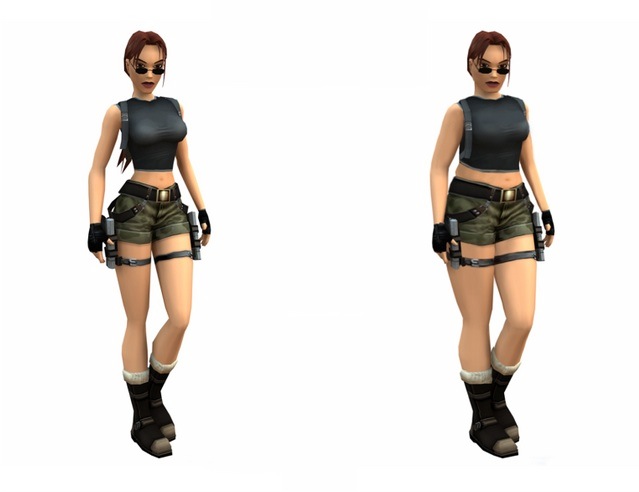
To combat it, a bulimia charity recently released images of famous game characters that have been edited to match the American national average body shape. With this campaign, the charity asks, “With such high attention to detail in gaming, why can’t they accurately portray the female body?”
The examples they give include Lara Croft from Angel of Darkness, Cortana from Halo 4, Jade from Mortal Kombat, and that one bikini woman from GTA 5. While I suspect this campaign is only partially serious, mainly concerned with raising Bulimia awareness and probably intentionally trying to whip up controversy for publicity, it’s not something I find acceptable.

The problem I have with this, is that they ask for an accurate portrayal of the female body. The examples given include a rock climber, a fighter, a valley-girl, and a virtual hologram. These are not your average women. Firstly, GTA V is satirising the shallow, materialistic lifestyle of those kinds of people. The image in which she appears, she’s taking a selfie; one of the symbols of modern vanity.

Secondly, Cortana is a simulacrum, not a simulation. In other words, she is a creation that “bears no relation to any reality whatsoever.” She’s essentially a videogame character in a videogame universe. It’s like if a character in a TV show drew a picture of a “perfect” woman; nobody would base their own appearance on that because it’s not a representation of a woman, it’s made-up a drawing.

As for Lara and Jade, it’s only practical for them in their respective professions to be as fit and as lean as possible. Here’s Sasha DiGiulian, a respected female rock climber.

She certainly doesn’t have the impossible waist of Lara, but it’s not as far off as the “realistic” version the charity provides. The point I’m making though, is not that women in videogames are misrepresentative of reality (because they often are) or that Lara’s waist is completely realistic (because it isn’t) but that these kinds of arguments are themselves misrepresentative.
Firstly, much like Hollywood movies, videogames are a fantasy. Whose fantasy is up for debate, as the ‘male gaze’ argument rages on. But the fact is that while many women do not appreciate these depictions, many do and enjoy the sense of escapism. Personally, as a man I hate looking at male models as they make me feel bad about my body. But in a game, hell yeah I want to play as a ‘roided up space marine and indulge in a primitive power-fantasy. Who is to say women don’t deserve the same opportunity? Of course, there aren’t as many body-types for women in games as there are for men. Most of them fall under the skinny, supermodel type. But those don’t all have to go away if some women enjoy them.

The main point I want to make though, is that if the aim of a game is to look as realistic as possible, then it should do just that. Lara Croft should not ever look “average”. She is basically a rock climber, so she should be ultra-lean with rippling abs. These kinds of campaigns, whether they are for body image or personality, actually fight against reality. The problem is that there are too many skinny women in games, not that skinny characters exist. People are all different, and that should be celebrated, not derided.
It should not be the job of social progressives like myself or like this charity to attempt to fit everyone into an average-sized box. Nor should the games industry cram all their character models into an hourglass-shaped mold. If a character is a rock climber, they should look like a rock climber. If they are a vain, body-obsessed valley girl, then that’s what they should look like. The same is true for character personalities. If Bayonetta is a sexually adventurous, liberated feminist, then let her look and act like that. Or if a woman cries instead of fights, that is who they are, not a commentary on the weakness of women.

Fighting Bulimia is a worthy cause, and fighting for more realistic body types in games is too. But those that truly seek to see humanity be more accepting of our differences must embrace those differences, even if they have come to be stereotypes. We should not lie to ourselves that leaner, more muscular, or larger body types exist purely to give the illusion that average is “normal”, just like the current designs give the impression that skinny is “normal”.
What we want to avoid is being pro-normative, because the best thing about humanity is that we are all the same while being so very different. That’s the message we should be sending. Still, who am I to say how others should be represented? Let me know what you think in the comments.

Dean Balloch contributed 12 articles to ICXM between 2014–2015, covering game reviews, and Xbox news with a focus on hands-on impressions and verified-source reporting. Their bylines on the site span the Xbox One’s first full year of post-launch coverage, including the early days of Backwards Compatibility and Windows 10 gaming. They post on X as @SpookyWomble.