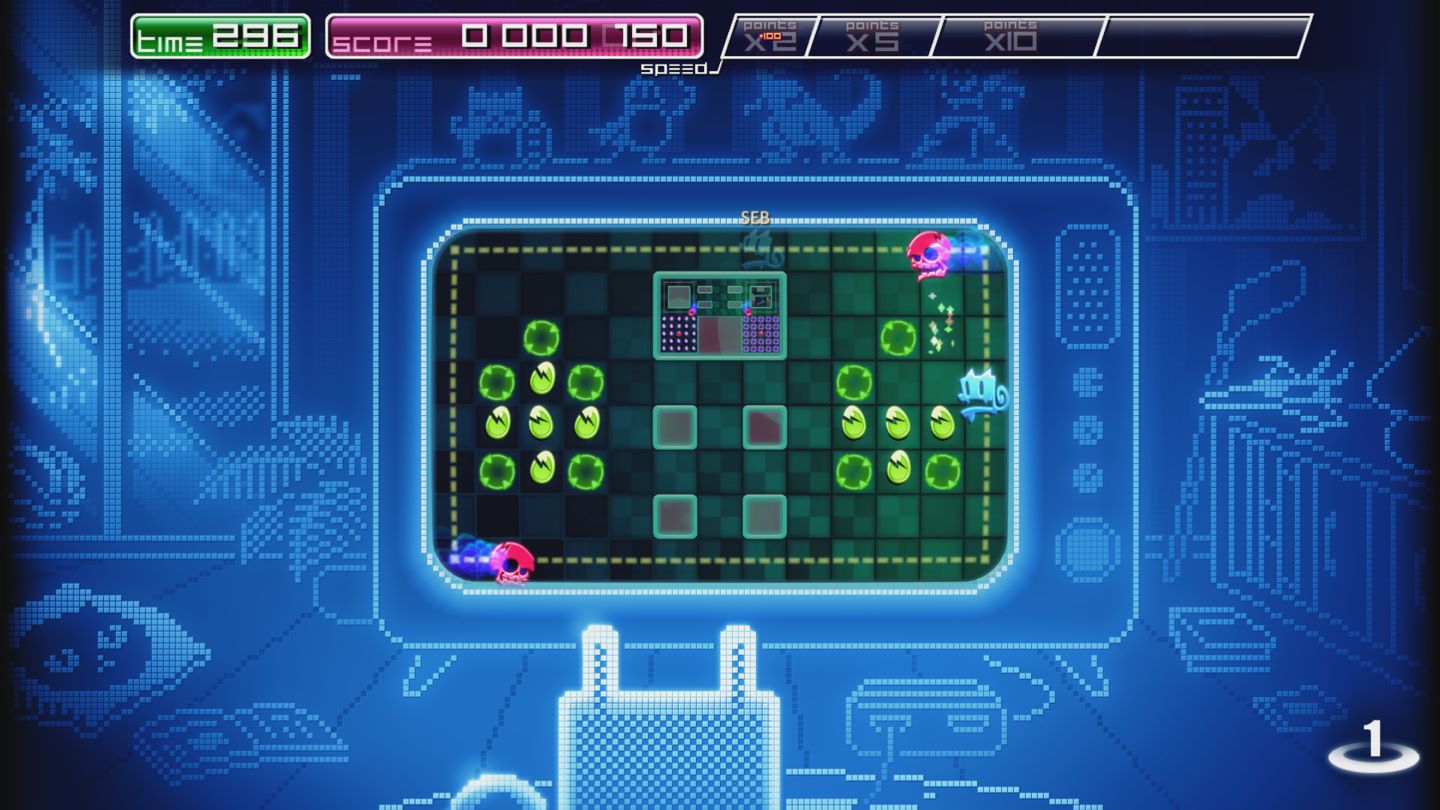
Neon psychedelics and feline escapades collide in a colorful explosion on the television screen. Pix the Cat mixes classic arcade style with a flair for the overdramatic in an attempt to create a fun and fast-paced title. But has the developer, Pasta Games, figured out how to capture the pure joy that arcade games can bring?
For an arcade game to succeed, it must have two main points. It must be fun, and it must be replayable. While gamers are willing to overlook normal video game tenants like graphics, story, voice acting and sound design in an arcade game; they are completely unwilling to accept bad gameplay or a lack of replayability.
Luckily, Pix the Cat is pretty fun and incredibly replayable. With four different modes included in the game, Pix the Cat promises at least a few dozen hours to complete everything contained within. The gameplay for the base arcade mode involves controlling Pix and collecting duck eggs. These duck eggs then become ducks that must be dropped off on different targets. Once all ducks are delivered, a portal opens to the next room.

A timer is constantly ticking down while playing Pix the Cat. Combos created by collecting a long chain of ducks will help increase the time and extend Pix’s life. The game also changes color schemes with each new room I entered, and everything is overlaid with a techno dream to match the chaotic happenings.
It is very clear that this game has absolutely no theme. There is no story line worth mentioning, and it is best not to try and figure out why this cat is collecting duck eggs that magically hatch when touched. It also makes zero sense that the ducks then follow the cat around in a very long trail. However, this is not to the detriment of Pix the Cat as it is an arcade game.
The part that is disappointing is that the gameplay is too simple to keep me coming back for more. Pix must move about a maze collecting the eggs. In the very beginning the movements are very slow and easy to control. As the game progresses, Pix’s speed increases. However, I regularly ran out of time before Pix’s speed was too fast to control.

Much like Pac-Man, Pix would move in a cardinal direction until I told him otherwise. If Pix crashed into a wall, his speed would slow down and the game would quickly remind me to pick a direction. I then would click the analogue stick in one of the available directions, and Pix would scurry off. The main objective was to time the changes so that Pix never hit the wall and continuously picked up speed.
But unlike Pac-Man, where ghosts were the reason the game ended, an arbitrary timer is put in place to increase the tension. I really feel what this game is lacking is a skill challenge. No matter how well I did, every game felt exactly the same. The levels changed, the colors changed, but the game felt the same. Each playthrough ended around the same room, and after 25 games I still felt like I wasn’t getting any better.

Pix the Cat also contains a nostalgia mode and a laboratory mode. Both of these modes are unlocked by achieving a certain score in the arcade mode. I was able to unlock both after my very first run, as the barrier is not too high. I appreciated that the game required me to learn the controls in the main game before gaining access to all of the features, but it didn’t build an impenetrable wall around the other modes.
The nostalgia mode was instantly forgettable. It is basically a glorified version of Snake. I collected ducks and grew a long train behind me, then I had to navigate around the level to insure I didn’t touch my tail and end the game. This was also part of the arcade game, as running into my own train would have ended my chances. The nostalgia mode seemed to lack creativity and felt tacked on.
Laboratory mode involved beating puzzles through the same mechanics as before. The pace was slowed slightly and it felt a bit more laid back. I really believe this was a very strong addition to the game, and I actually spent a lot of time playing the puzzles.

Some people will have a hard time with the flashing lights and pulsing music that Pix the Cat offers. The sudden changes from grayscale to rainbow to sepia to anything else can overwhelm the senses and causes a fair amount of distraction. I was not fond of these design choices and would have been happier if the colors were a bit calmer.
Overall, I feel this game lacks originality. The game boils down to a mixture of Snake and Pac-Man with flashing colors. The nostalgia level art is pretty impressive, but is not enough to make that game mode exciting. The puzzle levels are the only saving grace, but lack the replayability that an arcade game demands.
Summary
Like so many before it, Pix the Cat has tried to tap into the nostalgia of old arcade games at the expense of innovation. Those old games had solid gameplay and the replayability that defined the genre. Pix the Cat is a competent arcade game, but overall it lacks anything to make it special or memorable. I really was hoping for a bit more out of this title, but I was left out in the cold.

Joshua was a regular ICXM contributor between 2016–2017, publishing 42 articles across game reviews, and Xbox news. Their work focused on hands-on reviews, platform commentary, and breaking-news reporting during the Xbox One X launch year and Microsoft’s wider Play Anywhere / UWP gaming initiative.