This review has taken us a really, really long time. We are a fledgling website, many of us are new to this whole blogging, reviewing thing, and receiving UFC from EA hit us like a southpaw sucker punch. It’s taken us over 2 months to write this review, having passed our copy from pillar to post, trying to make sense of this deeply complex game.
To review it at face value would’ve been the easiest option, but the least honest.
At first glance, the game suffers from the most convoluted controls ever concocted. It would appear to have been the brain child of a pure masochist, who set out to make a sports game with input schemes based on Silent Hill, complete with lack of screen prompts and a sense of “I don’t want to play anymore”, for all the wrong reasons.
But first impressions aside, the game bares hallmarks of quality that made it hard to put down, and begged deeper analysis. Would I discover a great game beneath all the needless complexity?
Graphics & Setting
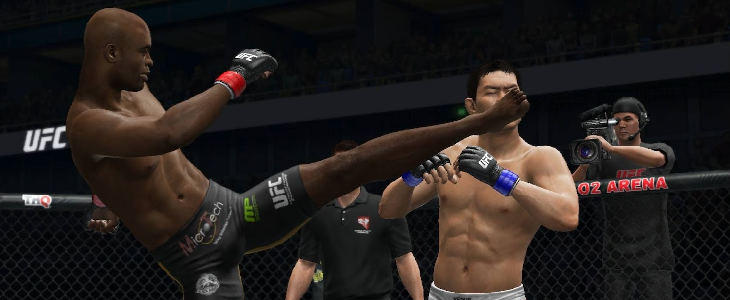
Let’s get the easy stuff out of the way first. EA UFC has some seriously impressive graphics, designed primarily for realism. It is the fourth game to use EA’s Ignite engine, which has been custom built for its sports titles. Fidelity aside, which is impressive in of itself, the engine’s strength lies primarily in rendering simulated human beings. Fighters realistically accrue bruises, deformed noses, and the (visibly pungent) glisten of sweat over the course of a fight, truly putting a stamp of quality on the genre. The Ignite engine shines when it comes to contact, punches and kicks never pass through player models, but instead ricochet with visceral impact. Your kicks will drag realistically off your opponents shoulders or arms if they attempt to punch you mid-kick for example. The interaction between animations, reactions and collisions are seamless and dynamic. The lack of canned animations gives each fight its own personality, reducing the repetition to 0.
The character models themselves are spectacular. Muscles tense and skin contorts realistically, skin ripples in response to the shockwave from punches and kicks, becoming all the more apparent during slow motion replays. However, similar to games like L.A. Noire, which also feature incredible face rendering tech, the flaws stand out more starkly. There are dedicated systems for rendering the flow of hair in EA Sports UFC, but the textures leave a lot to be desired, snapping you out of the illusion more punishingly than games with less emphasis on simulation might. Perhaps I’m nit-picking, but this game is certainly designed to be a simulation, and it’s these minor things which will set it apart from obtaining that design goal.

The atmosphere of the octagon is captured well. The audience responds dynamically as you’d expect, as well as the commentators. Blood paints the canvas realistically as well, becoming smeared if you roll in it, right down to the pattern of body hair your character has. There’s a commendable attention to detail on display which entices you to keep playing, even if your initial impressions of the gameplay aren’t stellar…
Gameplay & Features
The majority of my time with EA Sports UFC was spent in the game’s career mode, which serves newcomers to the sport extremely well. I’ve always had a vestigial interest in UFC, but the live action vignettes throughout the career mode, in addition to the messages famous fighters send between career stages really pull you in. My TiVo is bursting with UFC, which I suppose is part of the intent with EA’s sports license monopoly.
The career mode has you build your own fighter, which offers fairly a decent amount of customisation without being overbearing. You then progress from training to the Ultimate Fighter tournament, and eventually rising through the ranks of UFC to champion.
Normal difficulty grants the CPU opponents clairvoyance. In this mode combatants parry and block many of your attacks with relative ease, even when you’re mixing it up. It’s hard to know what exactly you’re doing wrong when you lose, the game offers little explanation or tips on how to improve – furthermore, you cannot alter the difficulty once you’ve begun career mode. Starting over with easy difficulty seems to lobotomize the A.I., making it uncompelling. I was able to overcome the first guy on normal mode with a single lucky punch, after losing on stats 4 times in a row. After several weeks with the game, and repeated tutorials and training sessions, I’m still unsure exactly how the game works. There’s few visual cues, so manipulating a clinch or selecting the correct block can be quite difficult. It’s hard to say whether that’s my own failing or the game’s, but it’s fair to say that the average gamer might struggle to get to grips with the control systems.

The most fun I had with EA Sports UFC was playing on the couch with a friend (and whiskey), perhaps because failure rates for parrying and dodging were more evenly matched. Working different parts of the body prevents your opponent from blocking, leaving them open for that crucial knockout punch. Similarly you can dodge with flicks of the joystick, which is often more successful than parrying, which requires you to press two buttons at the right time in similar fashion to Killer Instinct’s combo breakers. Follow ups to parries deal more damage, making them an important tool for achieving victory – but in career mode, when the CPU is hardwired to react to things the average gamer might struggle with, it becomes frustrating. The frustration would be limited if you could return to the gym and grind extra stats to improve your character. This unfortunately isn’t the case, you’re doomed to re-live the same fight over and over until you obtain victory, and when you do, at least initially, you might not know exactly how you obtained that victory.
When do you conquer aspects of the games systems, and utilize them as the game intends, it can be very rewarding. The difficulty and complexity could be considered an intentional part of the simulation, perhaps imparting a slither of the struggle of real UFC… or it could be considered poor design choices that restrict the game’s audience.
Conclusion
Beneath the needless complexity and ambiguity, there are certainly aspects of the game to be appreciated. From the visceral blood, bruises and realistic facial deformation, to the meticulous digital reconstruction of the octagon and its atmosphere are to be applauded. The games control schemes act as a hefty barrier to entry for newcomers to the genre, as well as casual veterans. Significant time should be spent learning the game to properly appreciate it, which is in part why this review took so long to emerge.
Whether the complexity is intentional to mimic the technical intricacies of the sport or the result of short sighted over eagerness is hard to say, but if you have the time (and patience) to fully clinch EA Sports UFC, you will certainly find fun to be had, especially if you’re a UFC fan who revels in a solid challenge.

Jez C is a games journalist, Executive Editor at Windows Central. They contributed 16 articles to ICXM between 2014–2015, focused on game reviews, Windows and PC, and Xbox news: an early Jez Corden byline before he joined Future plc’s Windows Central as Executive Editor.