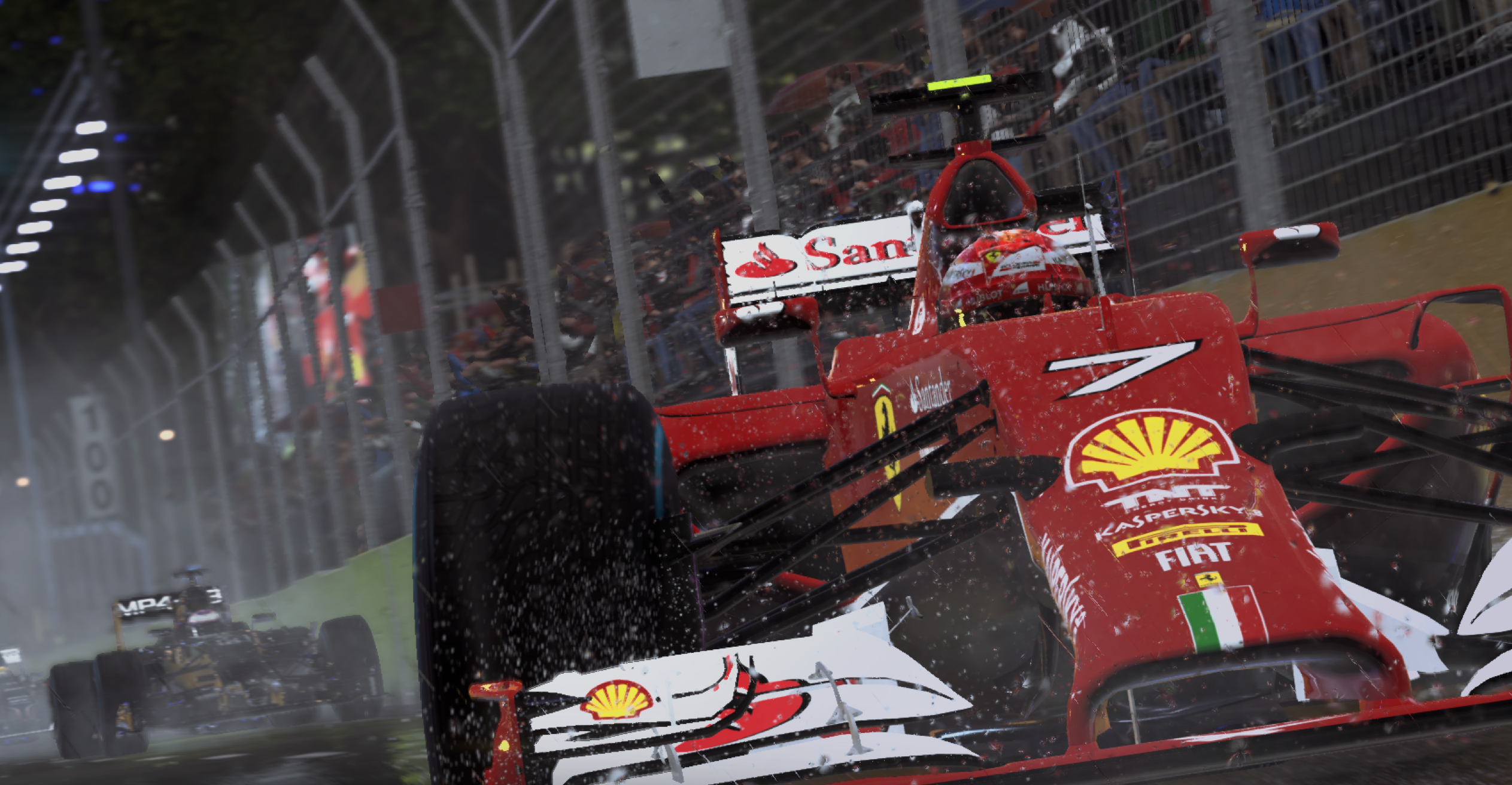
It’s hard to describe Formula 1 in a positive way. While F1 2016 isn’t bad by any stretch of the imagination, the sport itself—like NASCAR albeit to a much lesser degree—is focused on long stretches of repetition. Going around the same stretch of track for twenty-two laps may have its moments of excitement and exhilaration but at some point during every race you just start to put up with the fact that you’re going through the pace until something exciting happens.
This was exactly how I felt for the first few hours of F1 2016. As someone who isn’t great at racers as a whole and rests at the just over competent level, F1 2016 was quite a challenge to get into at first. It’s a racer second and an F1 simulator first and, by God, it’s a fine good one. F1 2016 is by far the most immersive racer I’ve ever played, even though it looks like something you would find during the end of the 360’s life cycle.
Character models, shadows, animations and foliage may look laughable compared to the likes of Forza and the 900p resolution, while not taking away that much, is slightly disappointing, however, F1 2016 runs at a flawless sixty frames-per-second during races—although replays seem to run at thirty or less. Thanks to the high framerate and amazing responsiveness of F1 2016’s controls, everything in F1 2016 feels fast, it’s the way F1 should feel. Braking around corners feels smooth and bombing down the straights into a sharp corner feels exhilarating.

But F1 is a simulator and that’s really where it really shines. At the start of every race you’ll change various settings of your car, the most important being the tyres. Choosing your tyre set is vital to how you’ll race with different tyres allowing you faster speed but also having different levels of wear causing you to stop in the pits and have them swapped out. Along with this, you’ll have to manage fuel and your vehicle’s condition. Getting slammed into by another vehicle can cost you your position for the rest of the race as the thirty seconds it takes to replace the entirety of your front wing allows a substantial amount of the competition to overtake or gain on your position.
Along with this, you’ll have to abide by the rules of the sport, F1 isn’t the type of dirty racing you’ll find in an abandoned field outside of town, it’s structured and professional. Penalties are given for cutting corners, colliding or scrapping with other drivers, jumping the start of race, unfair blocking and entering outside track boundaries without justifiable reasons. Although this may be hard to get used to at first, braking lines and following proper formation allow you to quickly get used to the way in which Formula 1 structured.

The high amount of immersion in F1 2016 will be variable by how your game is set up. Playing with a headset, including the standard Xbox headset, allows your coach to speak directly into your ear, updating you about weather conditions, vehicle conditions—including your brake and tyre wear, the condition of your wings and how much fuel you have left—how far away you are in seconds from the drivers in front and behind you and much more. This along with the fantastic use of the Xbox One’s impulse triggers makes the Xbox One version of F1 2016 an absolute joy to play.
Compared to F1 2015, this instalment of F1 is chopped full of content. Including both standard and professional career options, championship season, quick race, time trials and a large amount of multiplayer options. Career is by far the highlight of the game which allows you to pick a pre-set face, sponsor company and then choose your own name, with me going for the Red Bull sponsored Garland Bigboi. You’ll start in a very shiny white room full of horrible, terrifying character models with a mobile phone and a laptop which allows you to listen to voicemails explaining your track positions, tell your R&D department to make improvements to your car and start the next race.
The main problem with the career mode, which won’t be a problem for the patient players out there, is the large amount of practice sessions you have to compete in. A single practice session for as long as you feel is necessary is great in order for you to get a feel for the track you’re playing on but before some qualifiers you have to play the practice between two to three times. You can skip these, of course, but not only do you have to load the practice track up and retire after it starts but also playing these practice tracks allows you to gain more points to spend on research and development which you need to improve your car meaning that practice laps are essentially created not so much for practicing but for grinding the games currency.

Along with this, the AI occasionally make some stupid decisions which, if they’re near to you, cause the majority of crashes in the game and the aforementioned visuals are not as good as they could be. The tracks are nicely detailed with tyre marks burning into the tracks over the course of the race, cars are very nicely detailed and reflections are fantastic. Backgrounds, shadows and character models are poor though with the animations on models celebrating at the end of a race looking like something out of your nightmares.
The changing of track conditions is also a strain on the AI as they seem to perform weirdly during the wet. Whereas rain does affect your cars handling in a big way, collisions are much more frequent when the weather turns south than when you’re driving in the dry. This does, however, provide one of the most fun challenges in F1 2016 as wrestling control of your car during the heavier rain is an entertaining challenge. If you do mess up badly, though, the Forza/Grid style rewind mechanic—entitled Flashback—allows you to watch a thirty-second replay and start from a place of your choosing.

Summary
Codemasters have crafted the best F1 game that you can get on a console. With near perfect gameplay albeit hit and miss visuals, F1 2016 is a must for fans of the genre.

Lewis is a games journalist, freelance gaming and consumer-tech journalist. They contributed 344 articles to ICXM between 2015–2017, focused on opinion pieces, game reviews, Windows and PC, and Xbox news: has since served as Editor-in-Chief at StealthOptional and Gaming Editor at MSPoweruser, with bylines at Gfinity Esports and FRVR.