
When Limbo launched in July 2010, it changed the modern day gamer’s interpretation of independent video games forever. As one of the biggest mascots for the ever-raging games-as-art war, Playdead Games created one of the most atmospheric 2D platformers ever with their maiden title. Since the release of Limbo, many games have attempted to rip-off its style and gameplay but none have ever reinterpreted Playdead’s work in a way that captured the perfection of the original and Feist is one such failed attempt.
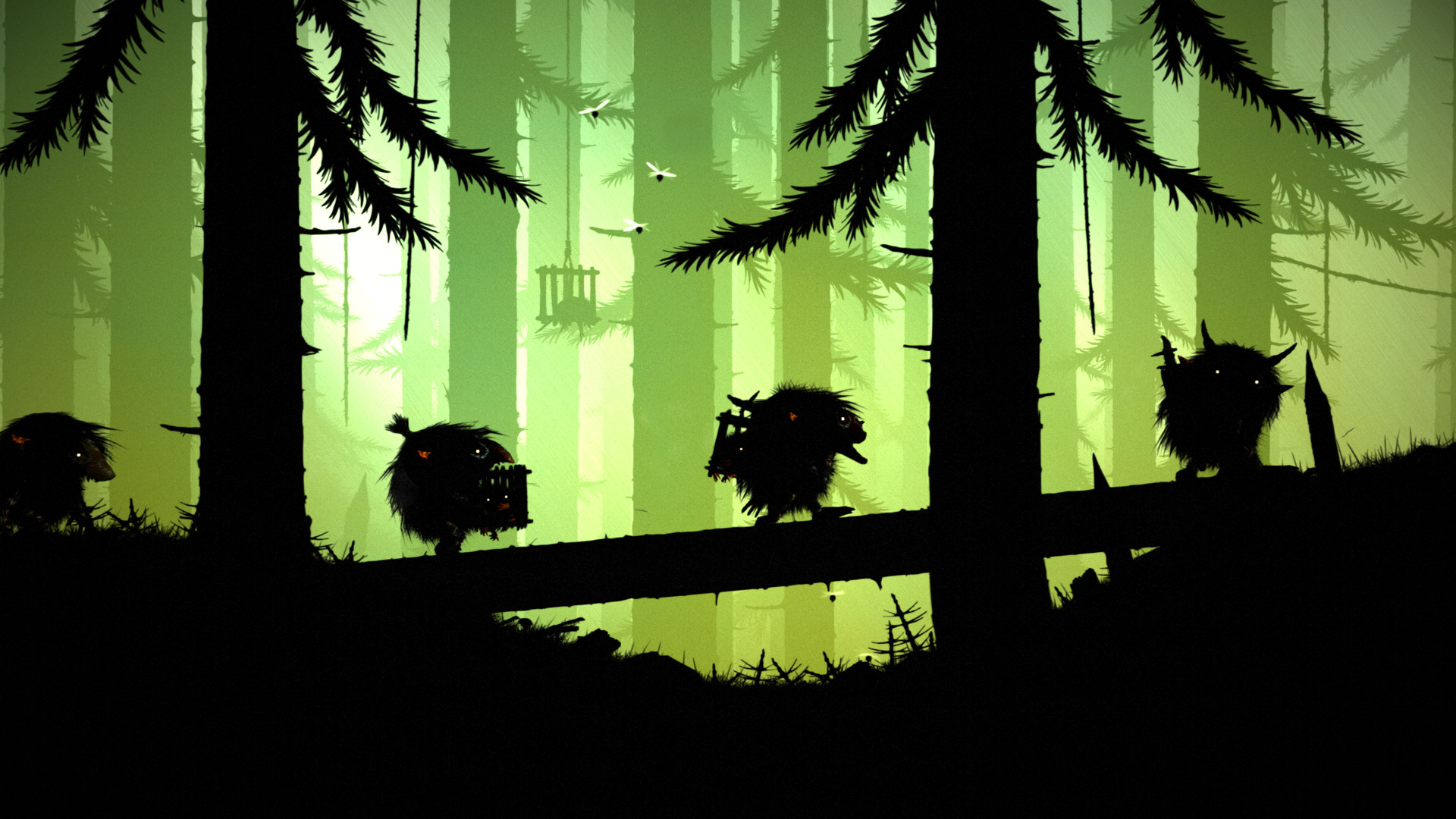
Feist follows the journey of a small, black insect-like creature escaping a dark, dangerous forest. When you start, you’re trapped in a small wooden cage being transported through the environment by a group of large furred creatures. In a few seconds, you wake up with your wooden prison being strung high in the air. After using your body to swing the cage from side-to-side, the rope holding you snaps and your cage tumbles down.

Wood splinters everywhere as the cage cracks against the surrounding landscape. The cliffside, tree branches, boulders and finally the ground all assist in breaking open the box restricting you and releasing you into the wild. Just like the beginning of Limbo, you’re left to wander. The surrounding forest, as well as the majority of other objects including yourself, are drawn in the same silhouette style of Playdead’s platformer and the essence of Limbo’s world immediately screams through albeit with one clear difference, a bright green background fills the air with more of a fantastical mystery vibe than a you’re-going-to-die-down-here one.
The protagonist of Feist immediately controls remarkably different when compared to the boy from Limbo. Movement speed is rapidly increased, jumps leap you much further into the air and your character glides along the environment. You’re much more suited to fighting back against the perils of the forest as well with the ability to push, pick-up and throw things all being given to you straight away.
Throughout its short ninety-minute run time, Feist’s challenges never really stray far from that of your ordinary platformer. Your goal is to pretty much run to the right with the occasional small puzzle, enemy or insta-death situation stopping you from progressing. Most of the time, Feist’s challenges are easy to overcome. The boss enemies are stupidly defeated by picking up a rock or a tree branch, corner trapping them and spamming the throw/pick-up button until they die, every time. Puzzles as well are usually solved in a few seconds when compared to the few minutes you’ll spend in other games (at a minimum) and enemies are generally very easily dispatched by not only yourself but also by the crossfire of other enemies.
Environments are kind of samey throughout the entirety of Feist. Unless you’re travelling through the short mine section, the majority of your journey will take place in the forest. Whilst the short runtime means that the forest doesn’t become too repetitive, when compared to Limbo or other platformers of the same length, Feist falls short. Whereas in Limbo you would travel from a dark, bleak forest to a mine to a city area with a collapsing hotel, in Feist you’ll travel through the forest to a mine which will then take you back into the forest.

Feist does bring new ideas to the table. One interesting mechanic that really shines through Feist’s dark, bleak environment is the ability to grab a hold of some enemies and use them to help you. The bloatfly enemy can be grabbed and carried around in order to shoot sharp needles which can one-hit the majority of other enemies. This mechanic, while neat, doesn’t hang around for too long and can only be seen in about two chapters overall. Another mechanic comes in the form of gliding along the game’s tree branches—obviously quite common in the forest—and using them to gain momentum to reach higher places. I thought that this mechanic would be much more utilized throughout Feist’s campaign but disappointingly many of the branches are placed higher than you can reach.
Sadly, Feist does fall short in terms of its puzzles dependence on its AI. Certain sections, especially in the mines, rely on certain AI moving out of a particular place, in a particular way, in order to move items out of your way before you can progress through the path that was initially blocked. A lot of the time, however, Feist’s AI fail to do this, instead finding a way around the item they need to move instead of moving it where it needs to be.
Summary
Feist is an enjoyable platformer and its short length allows its limited amount of environments and gameplay mechanics to never feel stale. While it certainly takes certain cues from Limbo in terms of its art style and atmosphere, Feist is undoubtedly different and brings some interesting mechanics to the table, but its unrefined AI and extremely easily-exploitable boss enemies mean that Feist just feels like a limited and broken platformer.

Lewis is a games journalist, freelance gaming and consumer-tech journalist. They contributed 344 articles to ICXM between 2015–2017, focused on opinion pieces, game reviews, Windows and PC, and Xbox news: has since served as Editor-in-Chief at StealthOptional and Gaming Editor at MSPoweruser, with bylines at Gfinity Esports and FRVR.