I find simulation games to be an incredibly rewarding experience. While many people question their value as an actual game, I love the idea of using real-life knowledge to influence in-game outcomes. Forza is an excellent example of how to properly design a driving simulation experience. There is the beginner tier, where the player has all assists on and an automatic transmission. In this mode, holding the right trigger wins the race. Then, there is the amateur tier where only a few assists are on and a manual transmission is utilized to provide the driver with more realism. Lastly, there is the professional tier, where a car nut can go crazy and spend countless hours tuning drive height, weight ratios, gear ratios, and even steering wheel tension. Options allow the player to choose the level of simulation that is most enjoyable for them.
Professional Farmer 2017 is an example of how not to make a farming simulator. This game suffers from a lack of realism due to muddy graphics, a terrible interface, and an overall case of missing the point.

I wanted to review Professional Farmer 2017 because I was looking for a game to get lost in. I thought plowing, sowing, and harvesting a farm would offer hours of repeat enjoyment as I slowly worked my way up the crop list. Instead, I spent most of my time wondering where Professional Farmer went wrong. The best place to start is with the vehicles.
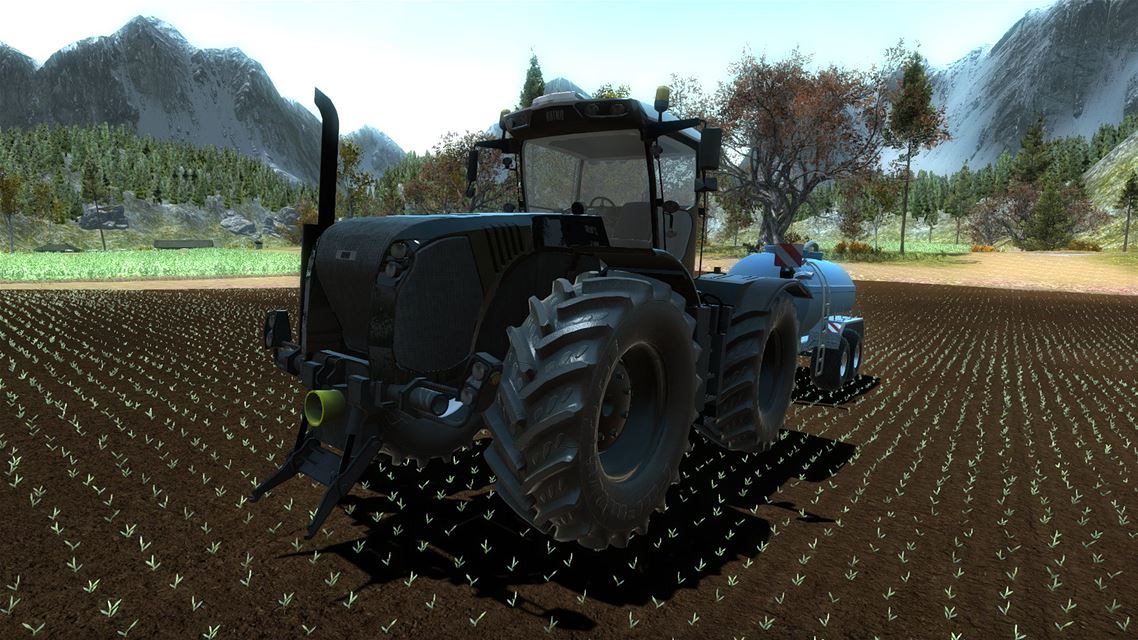
I am spoiled with simulation games like Forza or Elite: Dangerous when it comes to graphics. These games offer unparalleled scenery and the vehicle fidelity is top notch. When I get behind the wheel of one of these vehicles, I am transported to another world. In Professional Farmer, I remained firmly planted on my couch. The most important vehicle of Professional Farmer is the tractor. All of the available tractors are generic vehicles that look like children’s toys. The interiors come in two shades of grey, and all dials, levers and buttons resemble stickers stuck to the dashboard. Nothing about the tractors, or the farming attachments, felt like they were built with precision or care.

The handling of the tractors is fine. The controls are slightly loose, but that is how I imagine a tractor would drive. The gas and brake pedals are another story. The gas is extremely sensitive, and a small press of the right trigger sends the tractor hurtling forward at 30 or more kilometers per hour. While modern tractors are easily able to reach this speed, whipping through the field with the plow down would cause ground destruction and giant clouds of dust. In Professional Farmer, it just causes nice little lines to appear on the field.
The realism continued to fall away when I realized I had driven all the way to town with my plow still touching the ground. No indicator told me that I was making an extremely costly, real-world error. Instead, Professional Farmer settles for having a prompt in the top left of the screen. But the button prompts never leave, and are occasionally even incorrect.

When the player first enters the tractor, the prompt says to press up on the directional pad to turn on the lights and down to change the camera. However, that is the exact opposite of what each button does. The tutorial is also marred with poor grammar and spelling. The title screen reads, “Welcome in Professional Farmer 17”. While this does not affect gameplay, I think it speaks volumes to the developer’s lack of care for their product. Couldn’t they have found someone to check this if it was being translated?
At first, the world around the farm looks huge and well-designed. But the large map in the corner is actually four very small maps that are separated by loading screens. Once I hit a tunnel, a loading screen took over and teleported me to the next area. There were two far off land plots that I could purchase once I received enough capital, and a town where I could generate the capital.

The gameplay loop of Professional Farmer is as follows. I hooked up the plow to the tractor, drove it to my small farm, plowed the field, and then decoupled the plow back at my home. I repeated these steps with three more tractor accessories that prepared the land. Next, I filled up the seed distributor with canola seeds and planted them in the field. After growing season, I was able to use my harvester to harvest the grain and transport it to the silos. I would fill my grain silo with some of my product, then tow the rest to town to sell for money. With this money I could buy animals, the real money powerhouse.
Animals are expensive and need a lot of care to keep alive. The cows produce milk, the sheep produce wool and the chickens lay eggs. Every day, I had to ensure that my animals had enough food and water to survive and provide me with a product. However, a weird coding error made it impossible to keep all my animals alive. I would fill the troughs with more food than a pig could ever want, I filled the water can with enough water to last a week. Then, I fast-forwarded a day or two to speed up my growing season, and all the pigs would be dead from hunger. Hovering over the pig pen with the cursor tells showed how much food, water and hay the pigs needed on a per-day basis to survive. Even if I put ten days worth of nutrients in the pen, the pigs would still always croak. This cost me thousands of dollars in wasted feed and animals. There are many other problems like this throughout the experience.
Summary
Overall, I did find some enjoyment in Professional Farmer 2017, but I would not call the game fun. I found hooking and unhooking the tractor accessories tedious due to the wonky camera. My inability to keep my animals alive while progressing time forward was incredibly frustrating. The lack of detail in the tractors was just icing on the cake. There are far better farming simulation games available that mix fun with realism to create a worthwhile experience. I would recommend you check them out instead.

Joshua was a regular ICXM contributor between 2016–2017, publishing 42 articles across game reviews, and Xbox news. Their work focused on hands-on reviews, platform commentary, and breaking-news reporting during the Xbox One X launch year and Microsoft’s wider Play Anywhere / UWP gaming initiative.