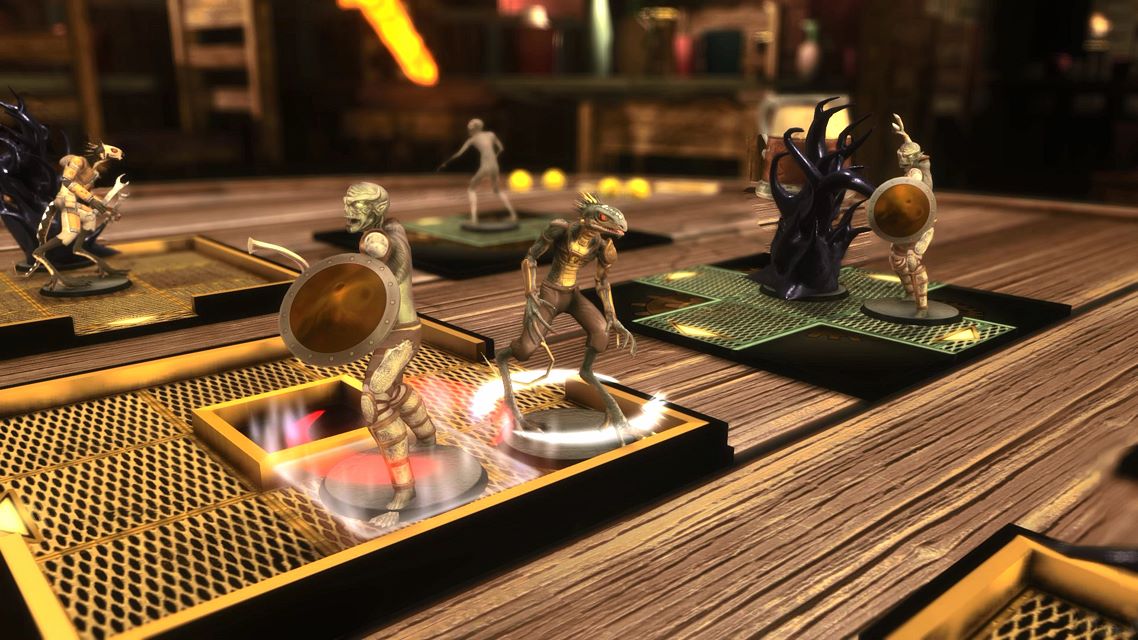
A half-dead god is screaming for the pain and suffering of all from deep within its mechanical tomb. A city has been built around the dungeon, its inhabitants seek its treasures, immortality, or to worship the god itself. Others are forced to flee to escape certain death, whilst others attempt to take control of the evil deity for their own gain.
The Living Dungeon is the first console release by Middlesbrough based British developers Radiation Burn. The game itself is a turn-based tabletop dungeon crawler, with plenty of dice rolling, luck and strategy added for good measure. Characters throughout the game’s story and multiplayer are represented as the playing pieces of a board game, static and only moving upon that player’s turn, or upon their death.
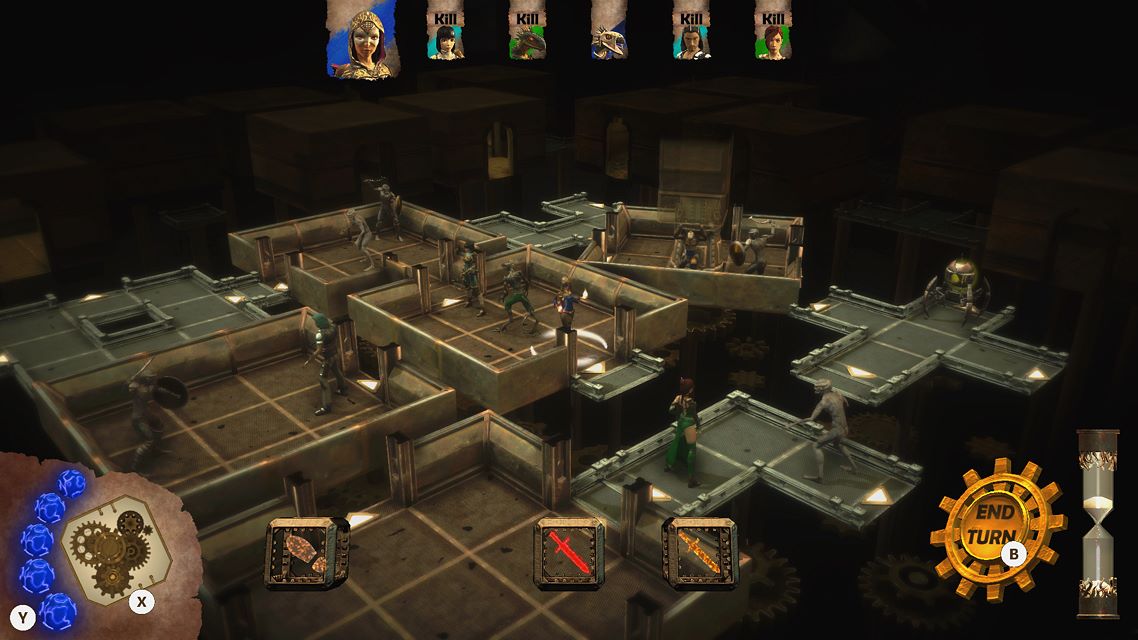
Your playing space will on most occasions be symmetrical, covering 9 squares set up 3×3, each with their own mini 3×3 player movement spaces within. The individual squares can be manipulated with rotation and flipping mechanics earned through dice rolls. Compared to other games in its genre, this offers a unique twist over most of the tabletop games available on consoles today. To me, this is the most important strategy to master in a game in which perseverance is a must in the early hours of play.
Dice rolls are the lord and master of how you play. There are multiple colours to roll, each with different attributes. Combat dice are red, mechanicals are brown, and agility/movement dice are blue. There are also generic dice which are orange and yellow. These will offer a mix of the original 3 colours as well as give gems and one time use booster cards which can be used to kill harder enemies and steal items from others. They also offer many other useful ways to play.
How your dice rolls will dictate how you play and the options available to you in your next turn. The opening missions of the game’s story do a very good job of explaining this to you, showcasing the abilities of the player characters, and are set up with specific rolls. This will make it almost impossible to fail the training levels, although without concentration, this is possible.
Not all squares are filled in within the playing space, and if somehow you manage to be in a hole at the end of your turn, then your character will be met with a fatal fall into the depths below. If your turn begins with you in a hole, you want to hope that the correct dice are rolled, because if not, then death will be certain if you are unable to escape. Not getting the dice rolls you need for several turns in a row can add to your frustration. This can lead to your death with little or nothing you can do to change its outcome. This is where the luck factor comes in, and how you play is controlled by what rolls you receive. How you make use of your turn is key for being the master tactician you need to be to survive.
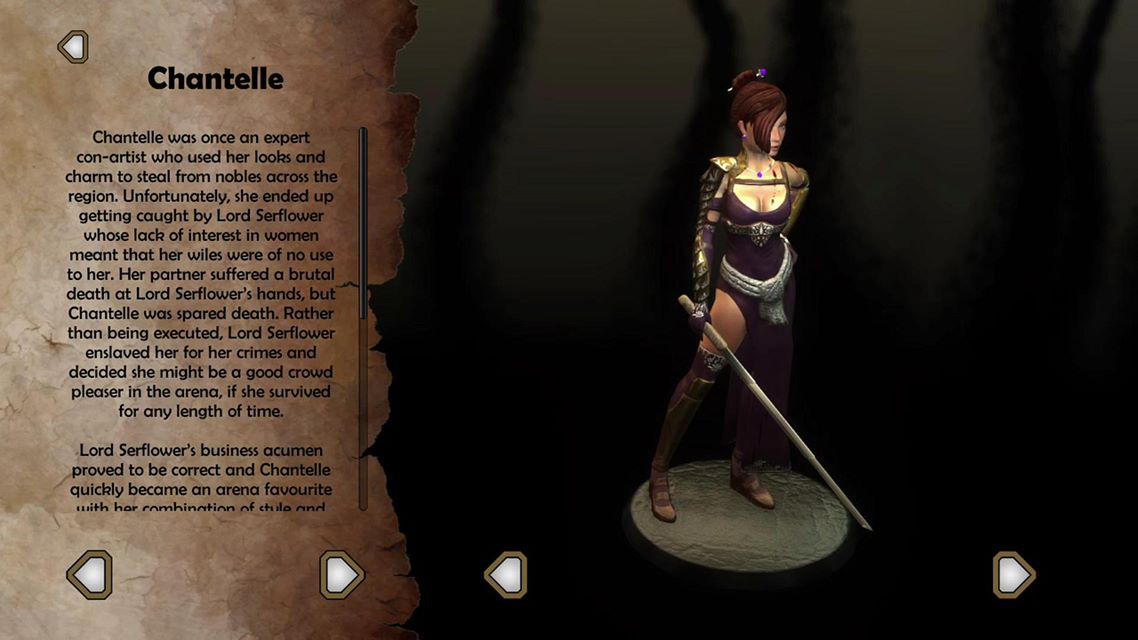
The backstory is explained by a character named Sajitor, who is a future playable figure. He tells the tale of the city built around the dungeon, and how he has his own plans for the dark below. You will begin as Chantelle, an ex con artist and arena Gladiatrix, who escaped to the dungeon after being sentenced to death by her captor, Lord Serflower. You quickly meet up with Lady Meru, who has also fallen on the wrong side of the Lord and has been thrown into the dungeon as punishment.
The two damsels in distress soon come into contact with “The Darkness,” a malevolent entity who has control over the dungeon. The locals more commonly refer to The Darkness as the Dungeon Master. The Dungeon Master will make attempts to block all of your heroes from reaching their goals. It also boasts its own unique dice, which can spawn more monsters, and manipulate larger areas of the board than what is available to the player.
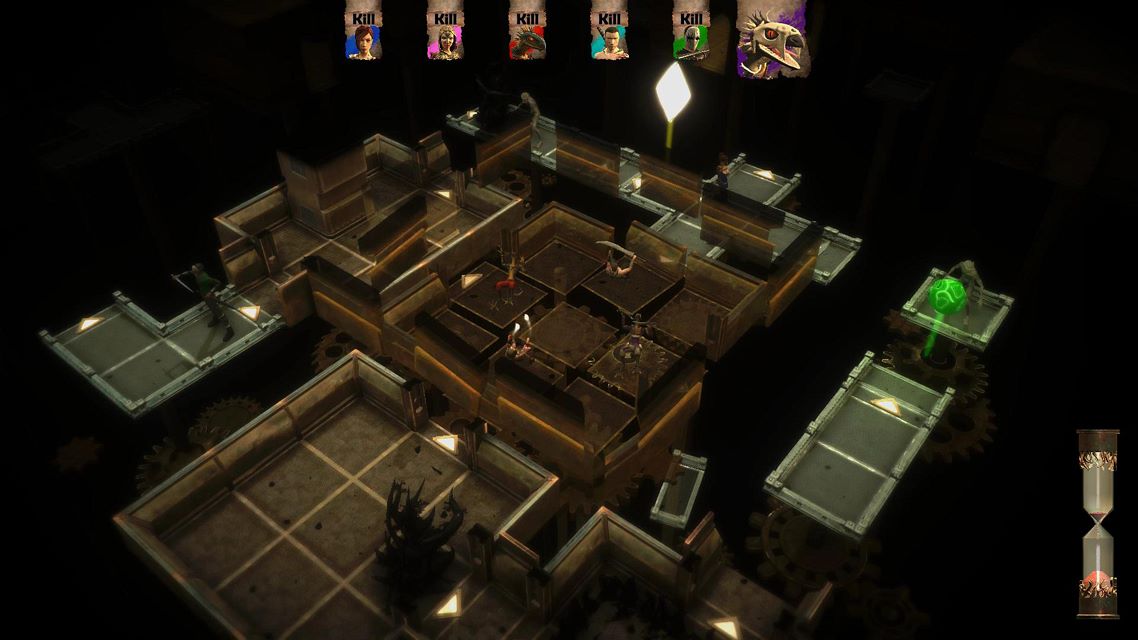
Despite the rich lore that The Living Dungeon tries to tell, it is let down by any real lack of story continuation throughout the game. Individual missions can become quite long, especially if your character dies and you need to start again. This is made especially frustrating in some of the following missions where it does not matter if a character lives or dies, only for them to be alive in the next part of the storyline. To me, this makes the campaign feel very disjointed at times by getting mixed up within its own timelines.
With nice, but basic, hand-drawn cutscenes, mixed with poor voice acting and recording quality, this makes me wish a little more time was spent on the overall polish. The playing board lacks the detail that you would expect in a game of this type, and I feel the player characters should have a little more detail in their design.
Where The Living Dungeon really shines through is in the game’s local multiplayer. With the fate of your friends and family hanging by a roll of the dice, up to 9 local players are supported. You can play in a mix of the Deathmatch style games of Assassination and Headhunter, as well as the more strategic Escape mode. In all modes, you have a lot of customisation options, from final scores, starting number of gems and bonus cards as well as advanced options like if you want the teams balanced and will it go to sudden death.
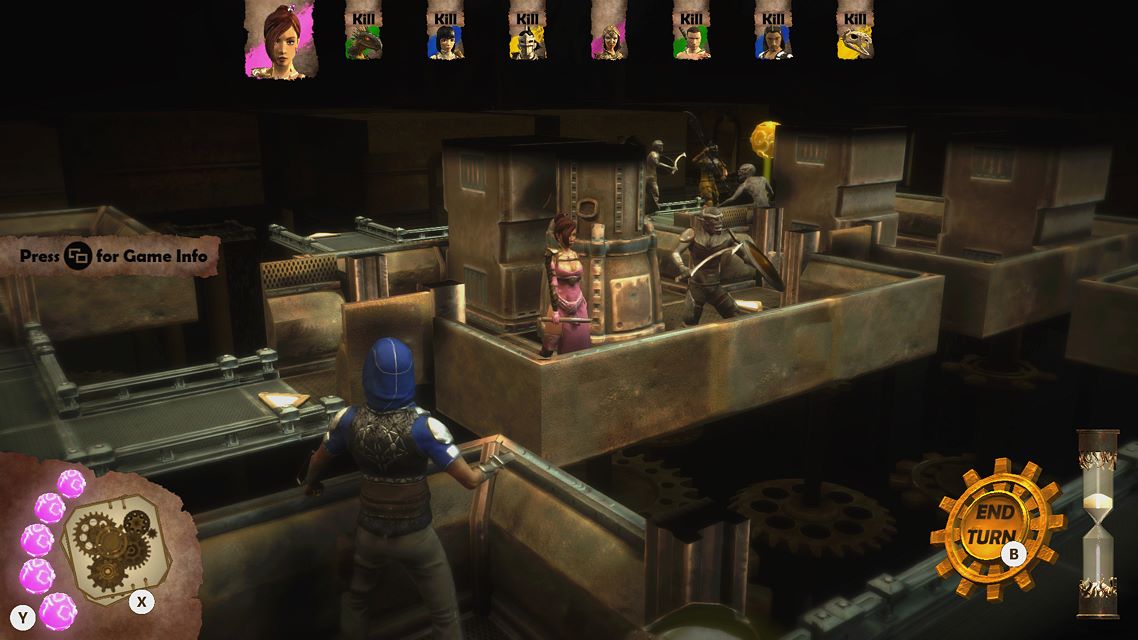
Escape takes place on a slightly larger, 3×5 square board and requires the player to make it from one side of the playing area to the other, alive. You can customize the size of your team, with the ability to add AI for a more balanced or unbalanced game.
Assassination, Random Assassination and Headhunter are the developer’s own take on your classic Deathmatch and free-for-all game modes. Just like Escape, you can have large 4v4 games, or allow everybody to go their own way in a fight to the death. As with all multiplayer games, one player can also play as the Dungeon Master, giving you the chance to take control of the evil which plagues you so much during the campaign. Being the harbinger of death is a very fun and welcome change from the repetitiveness of the game’s campaign.
The Living Dungeon’s multiplayer feels fun with AI, but even better over a few beers with your best gaming buddies packed around the screen. You don’t even need more than one controller, as classic pass and play is the name of the game here. Although the game does only support local multiplayer at the moment, developers Radiation Burn have confirmed that online capabilities will be heading to the game soon with a future update. This is good news indeed as right now you need to rely on friends coming around and then teaching them the basics of the game, hoping they don’t catch on too well, just so you can send them tumbling into the abyss. Online gaming will really help the game grow once available, and will really help with the longevity of the game, as without it I feel The Living Dungeon would quietly fade away.
Summary
Overall, The Living Dungeon is a very enjoyable but frustrating experience at times. The environment and voice acting could be presented better, as well as the storytelling. However, Radiation Burn have provided an enjoyable experience, with a much more enjoyable multiplayer which will only improve once online matches are made available. Definitely check this one out.

David Anthony contributed 13 articles to ICXM between 2015–2016, covering game reviews, and Xbox news with a focus on hands-on impressions and verified-source reporting. Their bylines on the site span the run-up to Xbox One S and Project Scorpio, plus the broader Windows 10 gaming push. They post on X as @ziplobthud.