Game development for the current generation of consoles is more expensive than ever before. This is no secret. But what gamers fail to realize is that games have never been cheaper to consume than they are today. During the Nintendo 64 era, games regularly sold for $75.99 USD. Adjusting for inflation, these games would now retail for $120. In contrast, games regularly release today for $60 at retail, under $20 on digital platforms, and for free on iPhone, Android, and Windows Mobile stores.
The contrast between a game’s price tag and the cost to develop it explains why many ports and rereleases from the mobile space are jumping onto Xbox One. Sometimes, these ports are nothing more than cash grabs. Other times, the developers put in work to ensure that they are releasing a product worthy of the player’s time and money.

Has Plunge Interactive spent the resources necessary to create a meaningful experience in Tiny Troopers: Joint Ops, or is this just a quick, cash-in port?
Tiny Troopers: Joint Ops is the third game in the franchise from developer Plunge Interactive, and the first developed for consoles. While the publisher and developer websites make no mention of this game being a re-release of the previous mobile titles, I have played both Tiny Troopers and Tiny Troopers 2, and I believe that it is. The tutorial level and subsequent first levels have no variation in level design from the previous installments. This is not a criticism, just an observation. Other than these first few levels and the overall gameplay loop, most of the key features are new for Joint Ops.

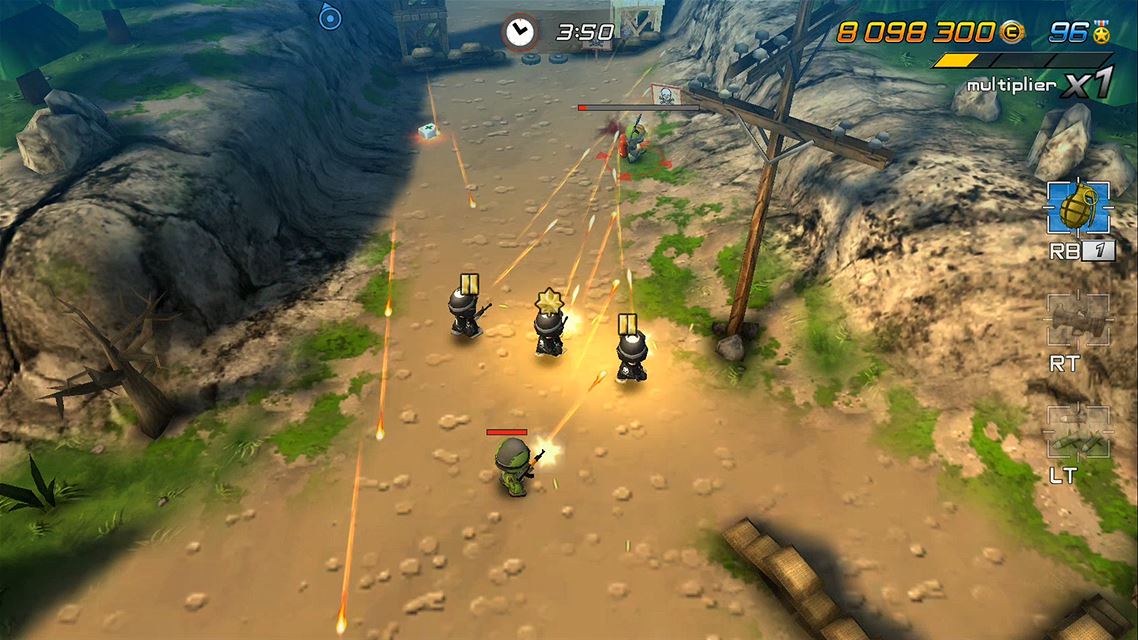
As with the previous titles, the Joint Ops player commands a small squad of miniature soldiers tasked with completing a few objectives per level. There are ten levels in each of the three worlds for each of the two campaigns. The playable characters level up by completing missions and getting kills. Leveling-up is important, as it gives the individual trooper more health points and fire power. A squad can, and will, face perma-death if a squaddie is lost during a mission. They can be saved if enough medals have been collected to revive them, otherwise they are gone for good, leaving the squad with a rookie instead of an awesome colonel.
The point-and-click controls of the previous titles are replaced by a twin-stick shooter layout on controllers. This layout was much more engaging, and made it easier to keep my squad alive. My shot accuracy was better, I could maneuver to avoid bullets easier, and overall the experience was more enjoyable.

Dog tags and medals are collectable throughout each mission, and they add squad experience points to your totals. Combined with the XP for eliminating targets and completing missions, the squad experience points are used to give the team permanent upgrades. These include: faster fire rate, more health, better accuracy, faster movement speed, and different costumes. Unlike the trooper-specific leveling that is lost when a squad member dies, these team upgrades last the entire campaign.

I really enjoyed the leveling system. I did not immediately realize that it was helping, but when I lost a high-ranking officer that could destroy a tank in 20 seconds and his replacement was a rookie that spent minutes on the same task, I understood the importance of keeping my squad alive. I also had the ability to select a level and replay it on 4 different difficulty settings. If a great trooper is lost, it may be best to go back a few levels to ensure the new rookie is worn-in before attempting the higher difficulty levels again. The levels are balanced and increase in difficulty at a predictable rate.
The level design for the two campaigns is good, but it has a few issues. Each level feels fresh and unique from the last. Graphically, the game shines as I experienced no screen tearing or frame rate drops. The colors are vibrant and the character models are interesting and varied. There were a few sections where I got trapped in an invisible wall while trying to explore the terrain. At these times, I had to restart the level as there was no way to escape. This happened a few times on different levels which discouraged me from exploring the later levels. Invisible walls are unacceptable, especially when they interfere with normal play.

Tiny Troopers: Joint Ops has features that are specific to the Xbox One as well. Included are 4 new zombie wave missions. These were entertaining the first couple of tries, but the rapidly increasing difficulty made it difficult to get past wave 10. The player spawns in as a single trooper and destroys waves of zombies, including zombie chickens, while waiting for additional squad members to join in. Each map has a variant of this formula. After playing a couple times, getting to higher waves loses its magic as it becomes less about strategy and more about luck. The screen eventually gets clouded with too many enemies, leading to an imminent demise.
Another exclusive feature for Xbox is the soundtrack. The foreground guns, bombs, grenades, and explosions sound really good. They are not realistic like in Battlefield or Call of Duty, they are subdued and toy-like which is very fitting for this game. The cinematic soundtrack in the background of the levels and the menu system ties the whole package together. The effort put into sound and music is just another example of the developers proving that this is not a meaningless port.

Summary
Overall, I found Tiny Troopers: Joint Ops worth my time. Plunge Interactive has spent the necessary resources on this game to make it feel fresh and native on an additional platform. The extra game modes, graphical fidelity, sound design, and improved controls make for a long and tasteful experience. Some people may enjoy the cartoonish charm, others may prefer the strategy and gameplay. But it is clear that this game will not be a disappointment to anyone.

Joshua was a regular ICXM contributor between 2016–2017, publishing 42 articles across game reviews, and Xbox news. Their work focused on hands-on reviews, platform commentary, and breaking-news reporting during the Xbox One X launch year and Microsoft’s wider Play Anywhere / UWP gaming initiative.