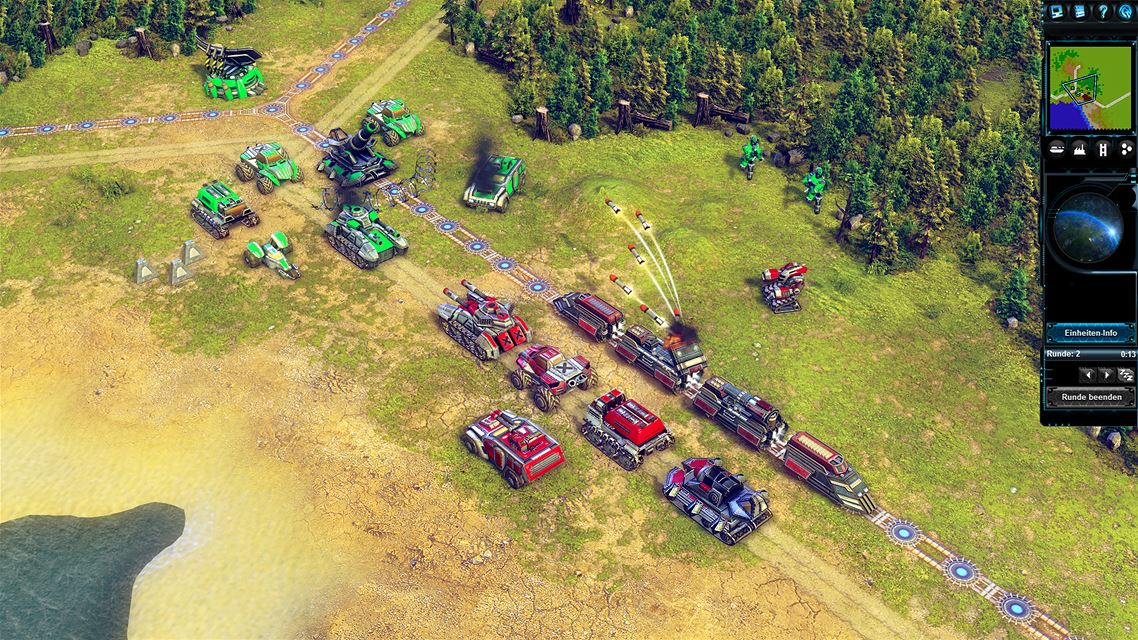
I always enjoy a challenge. The thrill of finally defeating a boss that has crushed me countless times before is exhilarating. But the exhilaration tends to be short-lived, as my valiant effort is typically rewarded with yet another boss that will consume hours of my life. If the game is good, these bosses can eventually be overcome through repetition, determination, and skill. This is why I love turn-based strategy games.
Strategy games challenge the player to make decisions many turns in advance. The player must anticipate their opponent’s moves and set up attacks with backup plans in mind, just like in chess. Usually, there is more than one right answer that will lead the player to victory. But what happens when the opponent is an unbeatable machine? A machine that only has one weakness, but the game offers no hint as to what that weakness might be? You end up with Battle Worlds: Kronos.
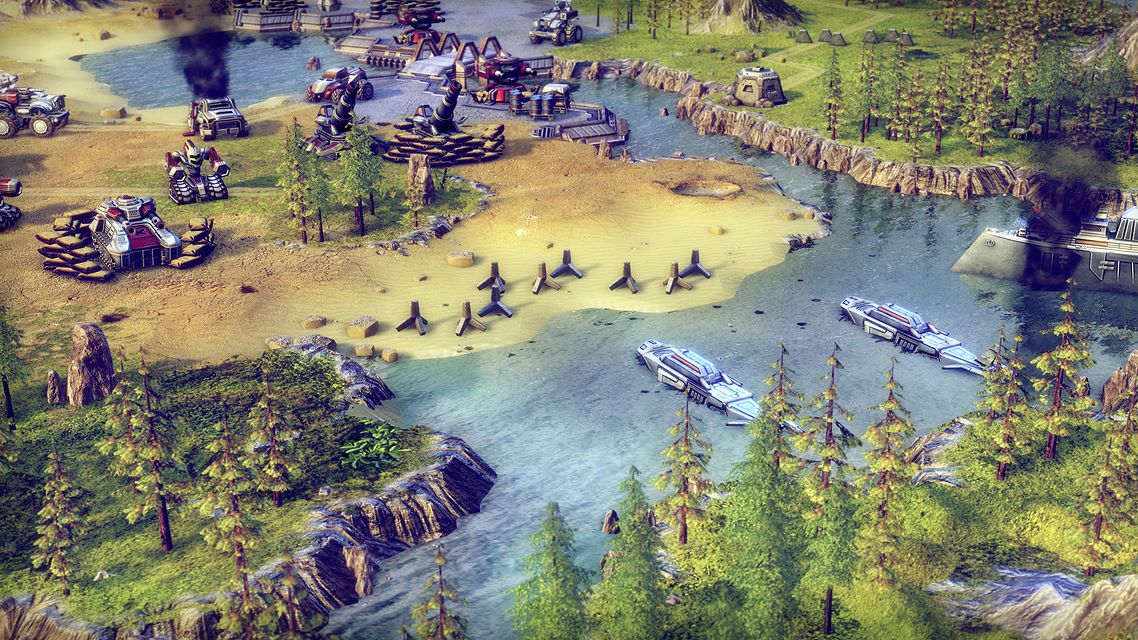
I was extremely excited for Battle Worlds: Kronos when I first launched it on my Xbox One. The opening screen warned me that I would be facing an incredible challenge, and that my hand would not be held. Prior to Battle Worlds, I dismantled Massive Chalice, smashed Xcom: Enemy Unknown, and stomped every iteration of Command & Conquer into the ground. I welcomed the unforgiving challenge that Battle Worlds promised. I did not realize I that would be facing the aforementioned unbeatable machine.
Battle Worlds: Kronos opens with an epic cutscene that immediately grabbed my attention. The voice actors boomed through my headset and the audio balancing of the explosions, dialogue, and orchestral soundtrack was on point. However, this immediately ceased once I was in-game. The level opened up to my little vehicle sitting in an open field in silence. There was absolutely no background music and the awesome voice acting was awkwardly replaced by scrolling text. The in-game sound effects of guns firing, grenades exploding, and engines revving were decent enough, but the background music mostly remained absent. Only once in a while did the music fade in for a second or two before promptly ceasing again.
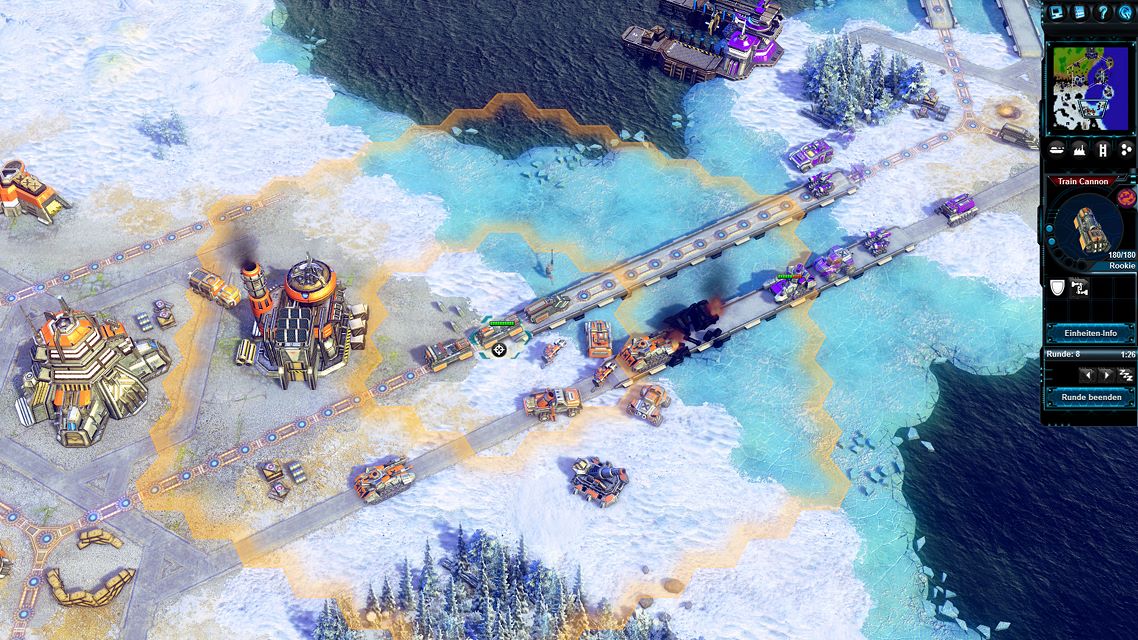
The cutscenes made me feel like I was involved in an epic conflict, while the main levels reminded me of playing a board game. Sound is arguably the most important feature in a game about war, and here Battle Worlds: Kronos falls flat. But sound is not the only feature that differs significantly between cutscenes and the main game.
The game ran smooth as silk during my play time. I never saw any drops in frame rate or screen tearing. Artistically, the levels were vibrant and colorful and the user interface was easy to understand. The cutscenes, on the other hand, looked like they were from the first generation PlayStation. The character models were polygonal and lacked any realism in their facial features. Normally I am not a big critic of art design, but in this case, the lackluster art design contributed to my conclusion that Battle Worlds: Kronos is a series of half measures. The cutscenes have amazing audio fidelity but ugly visuals; the main game has impressive gameplay but a noticeable lack of sound. These half measures are also apparent in the level design.
Chess is the ultimate strategy game. First developed in India in the sixth century, chess has continued to challenge countless people with the same board and pieces. The only thing that has changed is the strategy deployed by the player. Every match will be completely new as the opponent changes the flow chart of the player’s decision making. All of the great video game strategy titles follow this same logic, allowing for multiple solutions to a single problem. Battle Worlds: Kronos decided to change things up, and paid the price for it.
The levels of Battle Worlds can be summed up in one word: ridiculous. I was given a two minute tutorial in which I was shown how to attack and heal. Immediately after that, I was swarmed by multiple enemies of varying levels of difficulty. I made quick work of destroying them without a single casualty on my side; what followed was two grueling hours of trying to get across a simple bridge, dying over and over again.
Eventually I learned that you could call in reinforcements. This was mentioned in the tutorial but I was never shown how to actually do it. I figured it out by pressing every single button combination until I was rewarded with extra soldiers. I also learned through clicking around that I could steal bases and release extra backup for my group. Then I tried again to cross the bridge and, again, I was defeated. I tried using the boat to cross with a few vehicles and split up the opposing forces, but the enemy just squashed my scouting team and returned to decimate my main squad.
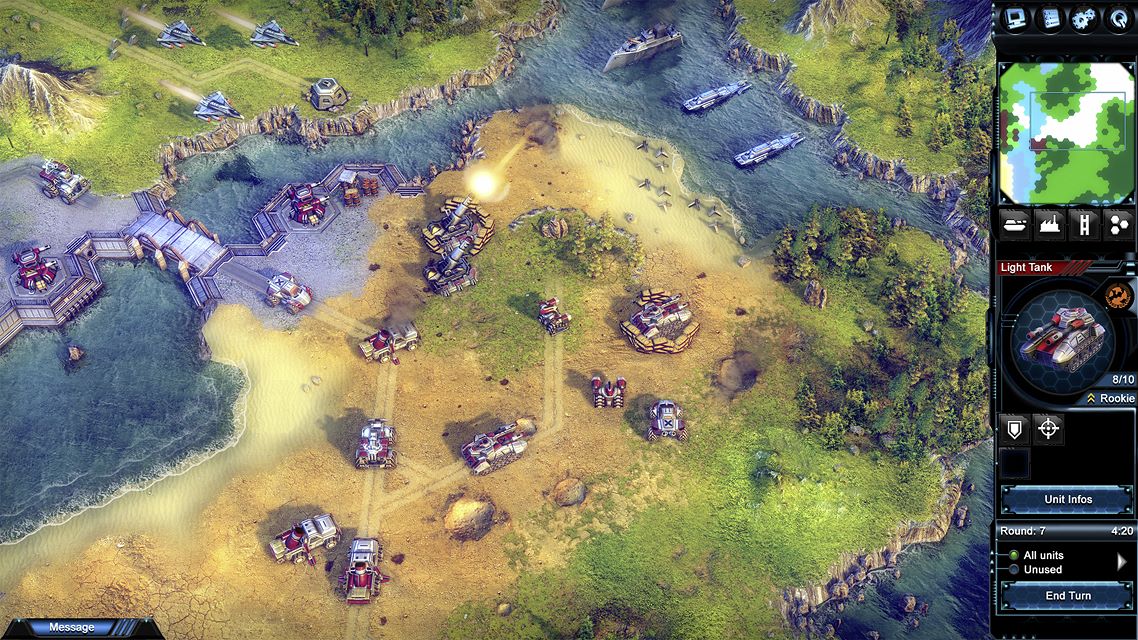
I had to take a break, multiple times, on the first level just to maintain my sanity. I do not understand why this game needs to be so hard. When gamers state they want a game to be difficult, it is because they want to overcome a challenge. Playing Lebron James in one-on-one basketball may be fun the first time, but after he flawlessly defeats me for the tenth time, I am not going to try any more. There has to be a gradual progression of learning and improving, and Battle Worlds lacks that completely. I never felt like I was improving, I was never given the tools to succeed, and after finally beating the first level I just felt frustrated by what the winning strategy ended up being.
Summary
Battle Worlds: Kronos is a series of half-measures that never add up to a whole. Weird audio decisions, mismanaged visual choices, and the overall strategy design show a game that needs a lot of work to roll with the strategy giants. Some will read this review and scoff that I just didn’t know how to play the game. But that is essentially the problem: the game never took the time to teach me how to play and I cannot recommend a game that accepts that I may never even beat the first level.

Joshua was a regular ICXM contributor between 2016–2017, publishing 42 articles across game reviews, and Xbox news. Their work focused on hands-on reviews, platform commentary, and breaking-news reporting during the Xbox One X launch year and Microsoft’s wider Play Anywhere / UWP gaming initiative.