Every now and then, a game comes along that somewhat defies explanation. If it’s good, then that makes reviewers’ jobs a nightmare. Her Story is verging on being one of those; something that really needs to be experienced to be understood, somewhat like The Stanley Parable and Gone Home – two of my favourite games of the past few years. Her Story is more straightforward than either of those and, like them, it isn’t pretentious, anti-interactivity nonsense like Dear Esther. Still, summing up the experience without spoiling anything is no easy task. Before diving into it though, it’s important to say that this has nothing to do with social justice or feminism or anything like that. So if for whatever reason that isn’t your bag, don’t worry (and maybe open your mind a little in future). Anyway, that’s enough dilly-dallying. The game’s afoot.

Essentially, Her Story a police investigation, or rather a post-investigation analysis. In this game, the police work is already done; the crime is already committed, the suspect arrested, the evidence collected, and the interrogations done. That last one, however, is where you come in.
You are a detective of some kind, tasked with piecing together the footage of police interviews from a fictional murder case in 1994. The videos are all out of sequence, and have seemingly been randomly cut into small, contextless segments. Thankfully, the footage has all been transcribed, allowing you to search the database of clips for keywords. For instance, if the suspect says “knife” in a few of the videos, searching for “knife” will bring them up for you to watch. That’s really all there is to it, in terms of gameplay. But part of the genius of this game, is in the simplicity of this system, which allows for a purely intellect-driven detective experience.
Sam Barlow, the developer (and writer of two Silent Hill games), has said that he originally considered more traditional elements of detective games; examining evidence and the like. However, Barlow decided that games like LA Noire did not allow players to truly feel like an “awesome detective who was having to read things and follow up threads of investigation.” He preferred the more layered storytelling of the Phoenix Wright series, saying they “have enough layers of misdirection and character motivation that make it an actual interesting detective story”, but that “the illusion is lost when you realise how carefully controlled that game is to make you feel like you’ve been clever.” Instead of superfluous gameplay elements and rigid storytelling, Barlow designed Her Story with the intent of allowing players to connect the dots in as natural a way as possible, saying, “It’s about freeing the player up to be clever, and have the confidence they’re going to be able to be clever.” Remarkably, it works.
While you’re going from clip to clip, jotting down notes as you go and piecing together the events that took place, you really do feel like a detective. It’s rare for games to use your mind in this way. Plenty of games require puzzle solving skills or strategic thinking, but few consistently encourage and reward unprompted assumptions like Her Story does. If you’ve ever wondered whether you have that instinct for “hunches” so many great fictional detectives have, then this is the game for you.

The closest comparison that could probably be made, would be a great mystery novel or TV episode. But the interactivity -the unique element that sets games apart from other mediums – allows you to indulge yourself in the story more than any passive narrative could. Imagine being a detective, up at 3am with unkempt clothes and unshaven stubble, staring at a flickering computer screen and obsessing over footage like he can’t let go of this case; like this is his life’s work. He’s locked in a battle of minds between cop and killer, with dedication and attention to detail his only weapons. That’s this game.
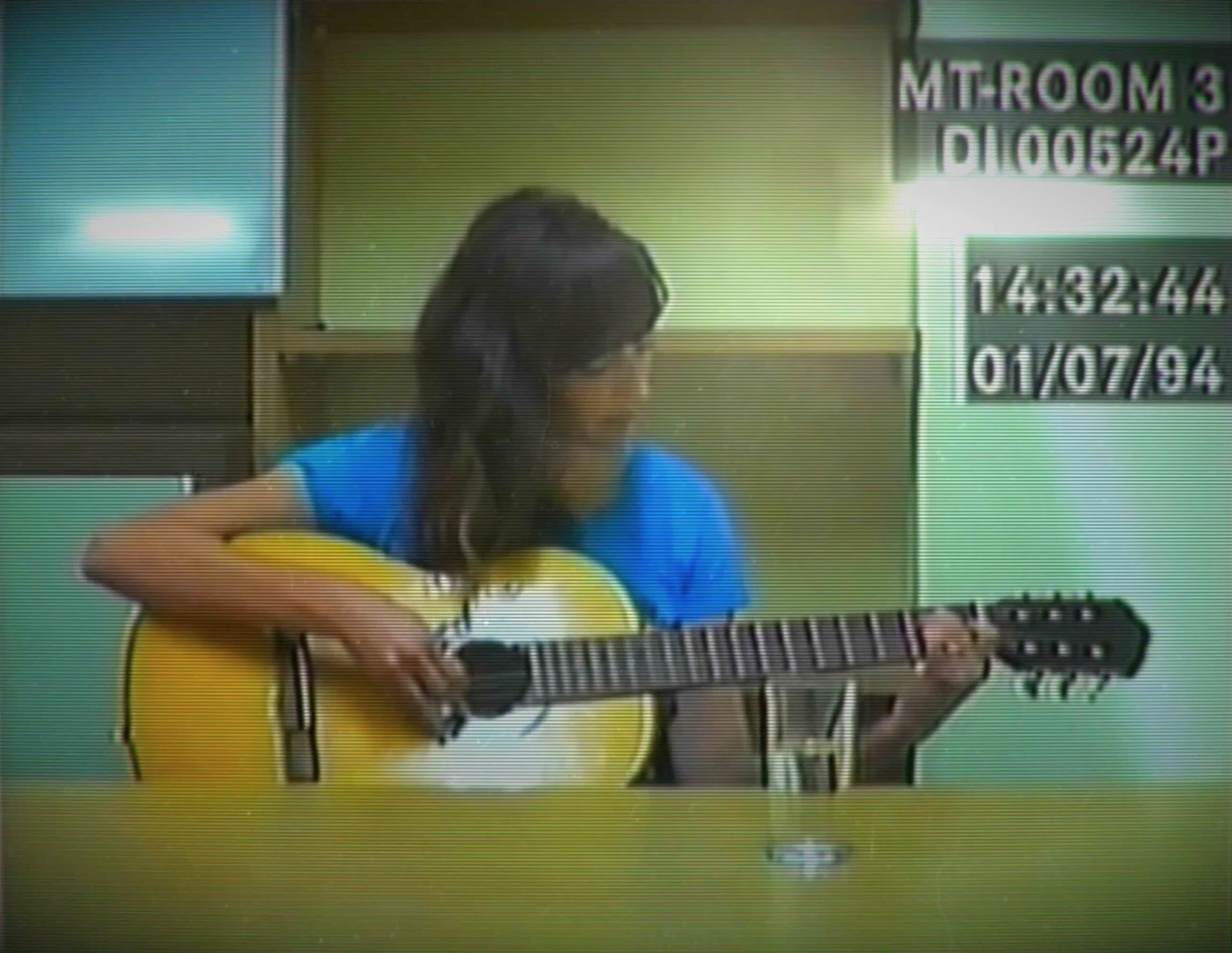
Helping immerse you is the the brilliant design of the interface; a low-res 90s era computer, complete with screen glare and the typically function-over-form efficiency that’s associated with government systems. It’s a convincing illusion, but if the screen effect is a little too much for you, rest assured that you can turn it off. By the way, don’t worry about system specs or graphical settings with this one as there aren’t really any.
As you’ve probably noticed from the screenshots in this review, the interviews are entirely live-action footage. Now, for people familiar with the old FMV games of the 90s, that’s probably a huge warning sign. But if this is to be compared to those, then it’s definitely one of the better ones. The actress, Viva Seifert, does an excellent job of not just reading Barlow’s masterfully written lines, but conveying genuine emotion that serves to both affect the player and clue them into what she may be thinking. Her performance is especially impressive considering that this is her first real acting job; being an Olympic gymnast-turned-musician by trade. She isn’t going to be winning Oscars anytime soon, but she’s more than good enough to hit most of the right notes, even if there is the occasional lacklustre moment.
While the early stages of the game leave something to be desired – namely a clue as to what the bloody point of all this is – the pace of revelations quickly increases as you follow the trail of breadcrumbs. That’s when the sense of being a proper detective kicks in and from then on, you’re hooked. The story rapidly evolves from a simple murder case, to something bizarre, then something utterly genius. From the midpoint onwards, there are a certain moments that will flip you on your head as you naturally connect the dots in your mind and startling realisations set in. All the odd little bits and pieces that you’ve watched and set aside suddenly begin to make sense in ways you hoped but didn’t really expect.

It’s a cascade of knowledge that simultaneously leaves you feeling like a smarty smartpants and a stunned onlooker. Even when you’re done with the game, the complex nature of the narrative forces you to reconsider it over and over in your mind, like a good twist ending to a movie would. That’s really the takeaway from Her Story; it makes you think, before, during and after. For a game with a main selling point of being “clever”, it’s a good job it pays off.
As clever a beast though it may be, there’s not a lot of meat on it. It’s quite short, and there’s little reason to play it again. Still, Portal was only a couple of hours long, so it’s not a huge problem. The minimalistic nature of the game is not as big of a let down as it first seems, as it does enable a pure investigative experience. But that doesn’t mean there isn’t room for improvement in the formula. The very nature of the game can occasionally feel either like a bit of a grind, or a stab in the dark. There’s nothing inherently wrong with that, as it’s all part of police work. But the early stages do not prove as inviting as they could be, even if the later parts make up for it. The intellectualism on display will also invite a few accusations of pretentiousness, and there are certainly a rare few moments that feel a bit too indulgent for their own good. Combined with the occasional weak line or unconvincing moment from the actress, it might struggle to get certain players to stick around long enough for the intriguing twists of the later moments. It’s a game that is brilliant for a good majority of people, but will certainly feel like a missed opportunity to many.
Whatever perceived flaws it may have, with Her Story, Barlow has created a convincing piece of interactive crime drama, one which has raised the police tape themed bar up a few notches. While it lacks testosterone-fuelled thrills or traditional puzzle mechanics, the mostly brilliant writing, strong acting performance and streamlined nature of the gameplay, enable a narrative that will satisfy the intellectual and emotional needs of gamers like few others have ever done. While the style of the game may not catch on, the philosophy behind it hopefully will. Thanks to this game, we’ll probably get many more exceptional entries in the crime genre that finally make you feel like the detective you’ve always knew you could be, or rather, solve the crimes you always knew you could solve. Because that’s what detective games should really be. The nature of detective work is one of watching, analysing, almost living other people’s lives. Who you are doesn’t matter, only those involved matter. Detective work is not a hero’s journey. It’s not about you, or about your story. It’s about their story, or his story. It’s about Her Story.
Her Story out now and available to purchase on Windows, Mac and iOS.

Dean was a regular ICXM contributor between 2015–2017, publishing 39 articles across game reviews, Windows and PC, and Xbox news. Their work focused on hands-on reviews, platform commentary, and breaking-news reporting during the Xbox One X launch year and Microsoft’s wider Play Anywhere / UWP gaming initiative. They post on X as @SpookyWomble.