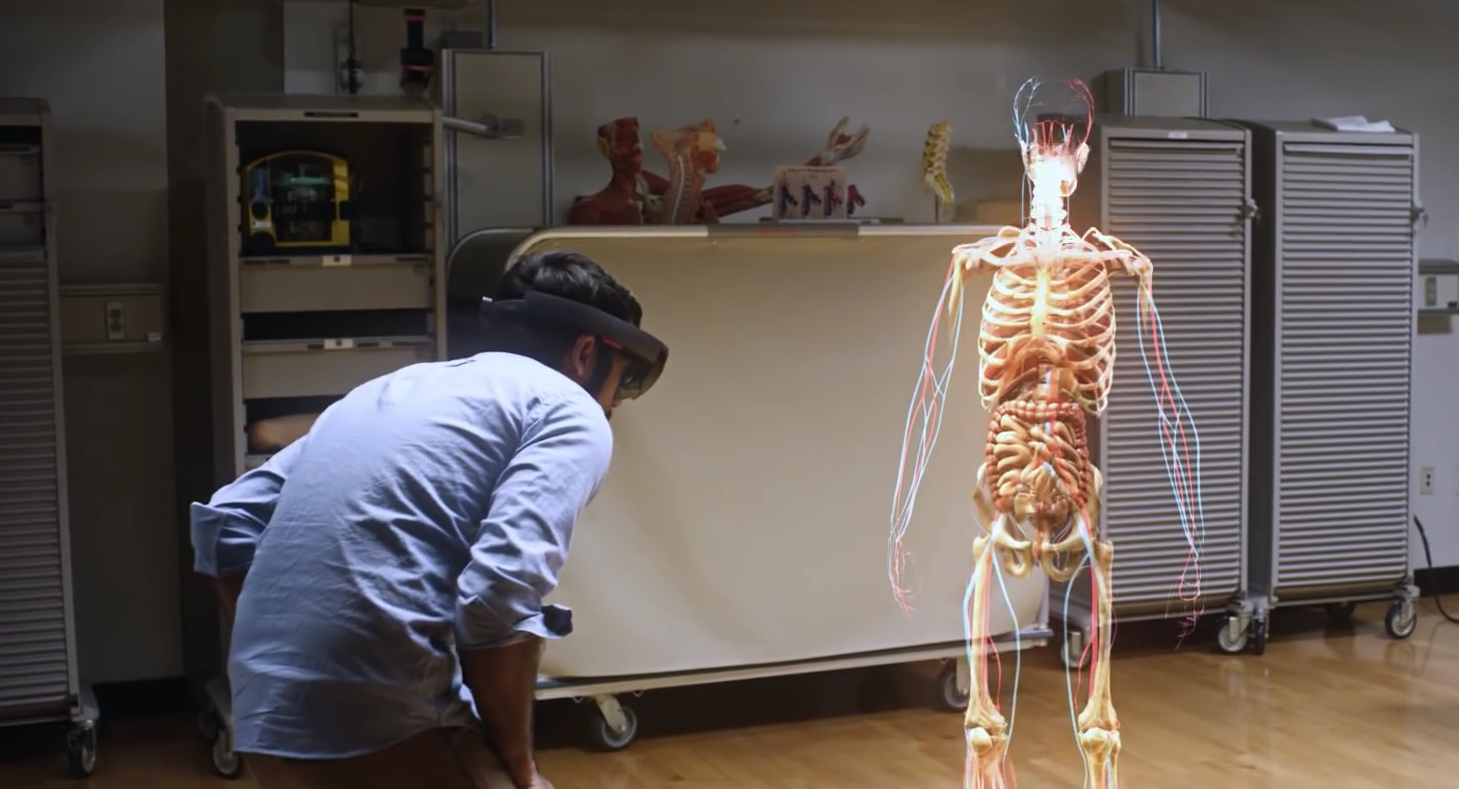
With every advancement in technology there are benefits which extend to everyday consumers but, surprisingly, such technology can also be used to advance or at least enhance medicine. Doctors around the world are using Microsoft products like the Kinect camera to treat stroke patients by creating specific exercise programs and using the peripheral to monitor physical activity. However, what about other devices like the upcoming HoloLens platform? How can they help individuals beyond the target audience. HoloLens has the potential to revolutionize medicine in order to make it more accurate by providing a stronger learning experience for medical students and access to more detailed information presented in a clearer fashion.
One of the most challenging courses in medical school has to be gross anatomy. Mastery of the human body requires countless memorization and one of the issues I had when I took that class was the visualization process. Having printed guides is helpful but it’s still up to the medical student to carry out a successful dissection. Having an overlay of a human body atlas on the cadaver would’ve been an invaluable learning tool. Not only would it have been easier to find certain nerves which can be damaged or completely cut during the dissection process when you’re first starting out, it would’ve also provided continuous information about adjacent organs and other important parts. Gross anatomy is taught in sections and it can sometimes be difficult to conceptualize the entire human as a whole. Imagine wearing a HoloLens headset while taking gross anatomy and having access to additional information when you need it. How about dissection videos if you’re having trouble with a certain procedure? There is so much potential here because having access to the information in a fully three-dimensional overlaid manner instead of a two-dimensional handout would enhance learning.
The benefits of the HoloLens platform can also extend to radiology and surgery. Imagine having access to all the data from an MRI or other scan in a three-dimensional fully-movable hologram in front of your eyes. While the same could be done using virtual reality, only the HoloLens offers a cordless solution with significant battery life. Devices like the Oculus Rift need wires for power and input to a rather powerful computer if you want to view any type of detailed scan in that environment. The HoloLens is a standalone device with a built-in GPU and other technology which can allow this to happen. Right now many developers are already making human atlases for the device. Porting over an MRI-viewing tool like OsiriX wouldn’t be much difficult.
Additionally, imagine having access to the same MRI data when your surgeon is performing a complex operation. Overlaying the MRI onto the patient while the surgery occurs would give the surgeon a constant feed of visual information which could make, let’s say, excising a tumor much easier because you can see a hologram of it on the specific part of the patient’s body when you need it. I’m sure I haven’t even mentioned half of what’s possible with this technology because it really has the ability to revolutionize medicine.
While these are just some of the examples as to why HoloLens can enhance medicine, it can also provide benefits to bedridden patients or others who have mobility issues. It can be used as a form of entertainment or more depending on what’s required. It’s up to medical professional and developers who focus on that field to come up with even more interesting and innovative uses. I’m sure when the HoloLens is available to everyone we’ll see its widespread adoption in hospitals and clinics around the United States and possibly the world.

Asher is a games journalist, former News Writer (Gaming) at Windows Central. They contributed 1110 articles to ICXM between 2015–2017, focused on opinion pieces, game reviews, Windows and PC, and Xbox news: wrote over 1,100 ICXM pieces on Xbox news, hardware reviews, and platform commentary before joining Future plc’s Windows Central in 2017.