I am attracted to different games depending on my mood. Sometimes I want a deep-space exploration game where I can zone out for a few hours while scouring the solar system for space dust. Other times I dive head first into challenging, turn-based strategy games that require all of my concentration and commitment. This ideology is important in understanding Hyper Light Drifter, because you will need to be in the right mindset to enjoy this game.
Hard as nails, pretty as a Monet, and as confusing as sub-prime mortgage lending are all accurate descriptions of Hyper Light Drifter by developer Heart Machine. An amalgamation of Dark Souls, Zelda, Star Wars, and Ninja Gaiden; Hyper Light Drifter has the ability to have something for everyone, and everything for someone.
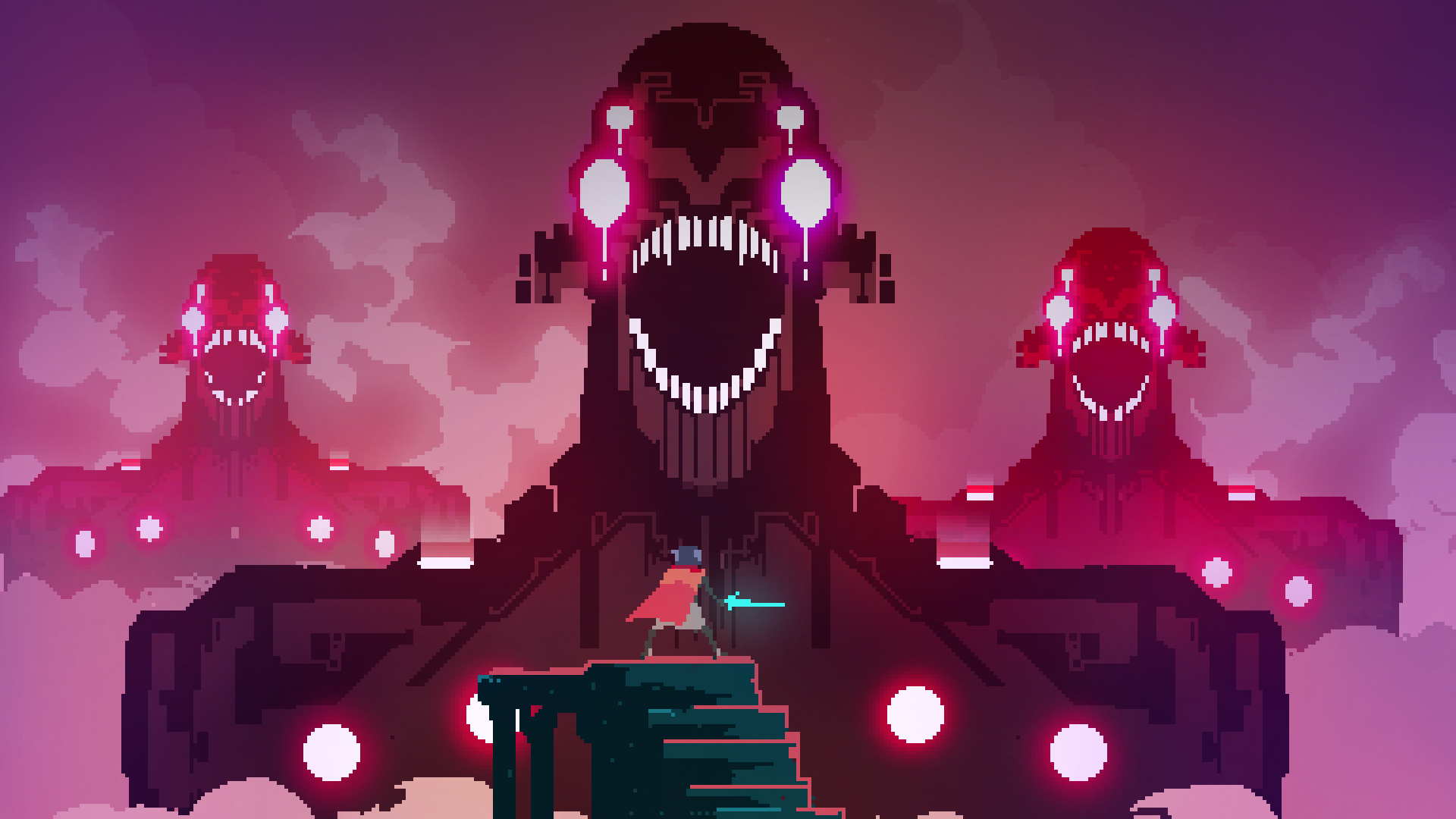
The first thing I noticed when booting up Hyper Light Drifter is how absolutely gorgeous it is. The opening cutscene, while offering very little by way of prose, set up an incredible world that I could not wait to dive into. I was hooked on every bit of imagery pushed into my eyes from black rain falling up from the ground and my character puking up phosphorescent blood to the giant robotic monstrosities that decay in a flash of lightning and the black dog of Anubis opening giant stone gates of a cyberpunk temple. The pixel art is superb, utilizing vibrant colors from the entire color palate to create enemies, characters, and environments.
The second thing I noticed was that I had no idea what was happening. There are no voice actors in Hyper Light Drifter, and cutscenes are basically ten-second pictures about what has happened or what will happen. Speaking with the villagers also gave me a few pictures of their back history or what happened to the village. There is no dialogue or text documents to help understand what has happened or why I was continuously coughing up blood. I have gone online and watched a few YouTubers explain the lore of Hyper Light Drifter, but the in-game clues were not enough to build a narrative for me. I did not find the lack of traditional storytelling disturbing, only slightly disappointing.
Hyper Light Drifter is heavily influenced by the properties I mentioned before. Something many gamers will find favorable is the direct link to Dark Souls. The lack of a main story, cutscenes that add more to the confusion than to the solution, and a dead and decaying landscape are only the beginning of the similarities.
Hyper Light Drifter is broken into five sections: the central village, the North, the South, the East, and the West. Each area has a unique aesthetic, color palate, host of enemy characters, and boss overlord. The jumping, frog ninjas in one area have a completely different attack pattern than the swooping, bird wizards of another area. Each area offers a distinct challenge that keeps Hyper Light Drifter feeling fresh and frustrating.
This game also mimics Dark Souls in its difficulty: the game is hard, very hard. While some enemies and rooms can be beaten by brute force, most require memorizing and adapting to attack patterns in a puzzle-like manner. Utilizing the projectile weapon, melee sword, and dash maneuvers while employing both aggression and patience was the only way I could take down the bosses of each area. Getting to the bosses was taken right out of the Shigeru Miyamoto game design handbook.
Hyper Light Drifter is also heavily influenced by The Legend of Zelda. Our mysterious, sword-wielding, silent hero is on a quest to collect triangular pieces to accomplish a quest. Sound familiar? But unlike Link’s quest to save Zelda, or even the world in later games, our unnamed hero has the nebulous quest of surviving. Each area is a small room filled with enemies that I had to slash my way through in order to progress deeper into the dungeons. At the end of each dungeon, I was rewarded with 1 of 4 pieces of a triangle. These 4 triangles formed a square that allowed me access to the boss area.
There is also a lot of mystery still left in the game. After beating the final boss, there were still a number of collectables that I had left untouched. It turns out there are 8 triangular pieces in each area, and also key cards that I never figured out how to use. These items could be used to unlock more story pieces, more bosses, or more areas. All of this is left up to the player to figure out on their own.
Some areas were inaccessible at first until I was able to upgrade my dash and weapon abilities. Upgrades are accessed by collecting four yellow shards that give the player a coin. The cost of one upgrade is completing three coins. I really liked this mechanic in the game. Instead of arbitrarily increasing my health or strength, I was given tactical upgrades like the ability to dash twice or reflect bullets with my sword. I found the upgrades to be extremely useful and sometimes necessary.
Hyper Light Drifter also played as smooth as silk. My frustration from dying was never caused by frame rate dips, input lag, or screen tearing. The character always reacted the same to my inputs and made fighting predictable. This allowed me to focus on memorizing enemy attack patterns rather than worrying about poor control schemes.
I would also be remiss if I did not mention the incredible soundtrack of Hyper Light Drifter. The cutscenes, gameplay, and boss fights had memorable tracks that really felt like they tied the whole package together. The mixing and timing of the individual tracks was completely on point. I also felt that the sound effects used for enemy attacks and deaths, character attacks, and weather effects were also of note. Overall, my listening experience was on par with the visual experience.
Summary
The fantasy, sci-fi mash up is usually left alone to Star Wars and Flash Gordon. Now we can all add Hyper Light Drifter to the mix. The cyberpunk world created here was a blast to run around in, while simultaneously being beautiful and terrifying. While I still have no idea what the story is about, players looking for the deep lore can find tons of it hidden within the game’s secrets. I cannot recommend enough that you spend time on this title, as it is on worthy of your time.

Joshua was a regular ICXM contributor between 2016–2017, publishing 42 articles across game reviews, and Xbox news. Their work focused on hands-on reviews, platform commentary, and breaking-news reporting during the Xbox One X launch year and Microsoft’s wider Play Anywhere / UWP gaming initiative.