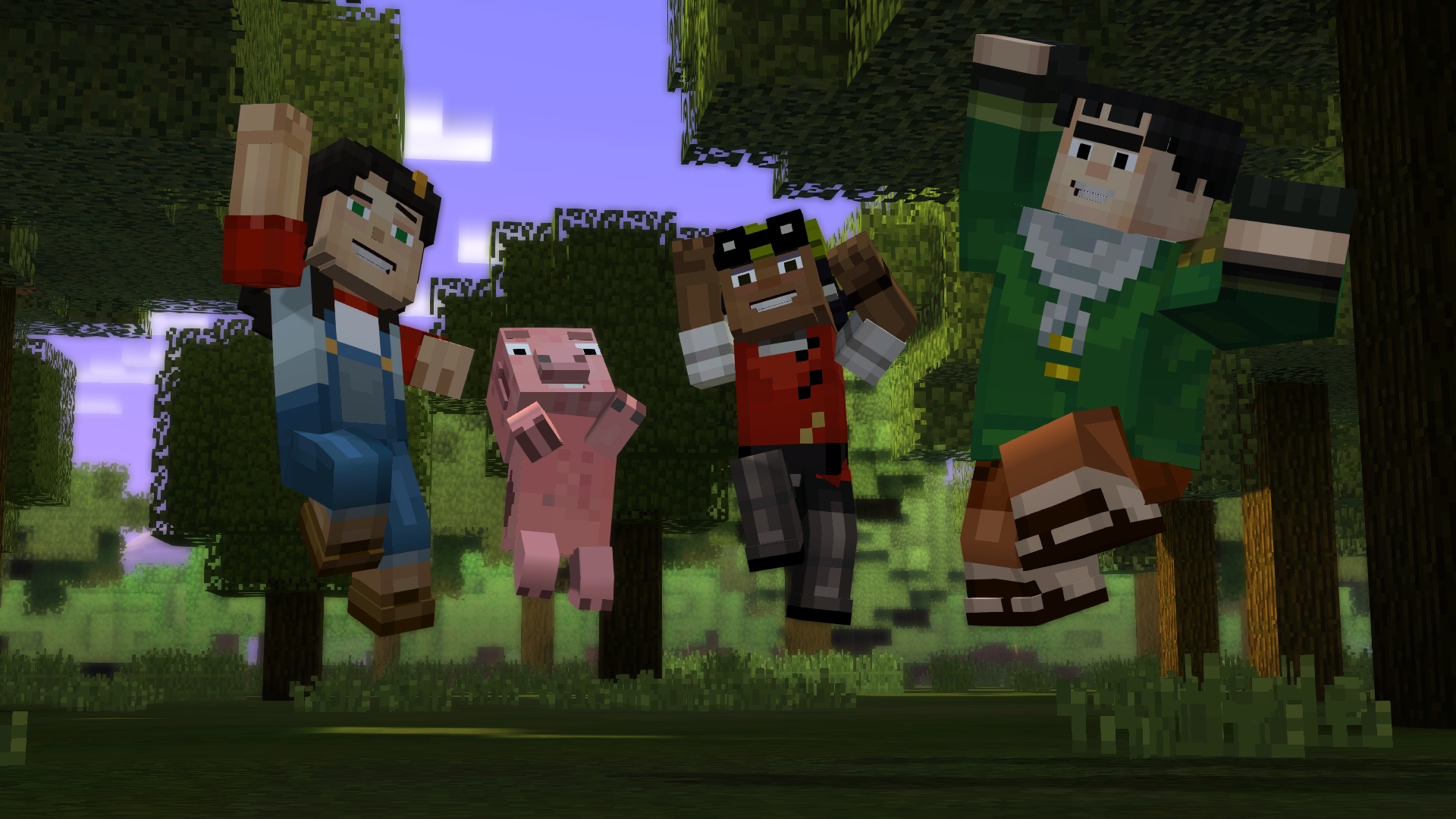
It’s well known in media, especially games, that people often have vastly different experiences when given the same material. Minecraft is a great example of that; with some players preferring to build, fight, explore or do something totally unique. The essence of the game is the vast possibilities for players to create their own experience. Because of this, trying to distil that magic into a tight, scripted narrative was always going to be a tall order.
Minecraft: Story Mode has more than competent people making the impossible possible though. Telltale Games – the studio behind The Walking Dead, The Wolf Among Us and half a dozen other great adventures – are one of the hottest teams around right now, that seem to have somehow made a name for themselves by making other people’s games. Their ability to tell a tale in an accessible yet still interactive format is more or less second to none.
But unfortunately, after their first episode for this new five part series, it’s still unclear whether Minecraft is a suitable subject for traditional storytelling methods.

Story Mode uses the same clunky yet practical, point-and-click mechanics found in Telltale’s other games. It’s set in the world of Minecraft, if it were some kind of actual society rather than a sandbox. It gives the impression that there are thousands of people in the world, with towns and cities and a history all their own. It’s not really what most players of regular Minecraft will think of as being Minecraft-like. It’s more of a metanarrative, with the characters being stand-ins for the real-life Minecraft community.

The first chapter of the season is called The Order of the Stone, which chronicles the legend of the titular group, then skips forward to the player’s part in the story. The Order has become famous, with their dragon-slaying deeds idolised and the members made into celebrities. The player character is a fan, who celebrates the heroes at an annual Endercon event.
After competing in a competition, the hero gets arbitrarily sucked into an adventure through a series of contrived plot threads. They go from schoolyard bullies, to making besties with a cool kid, to sneaking round a spooky basement with their mates, to battling monsters, all over the course of a day. Its simplistic structure isn’t necessarily a criticism, as the game is most certainly aimed at kids. It’s about as narratively noteworthy as an episode of Scooby-Doo, but that’s okay, because Scooby-Doo is awesome.

But while there’s nothing wrong with being primarily for a younger audience, some people might have hoped there’d be something for adults too, like how some family entertainment manages to please both audiences; such as the regular Minecraft. It will be a disappointment for older fans of the original, as well as parents looking to play with their kids and not be bored out of their mind.
Even if something is entirely focused on catering to younglings, it doesn’t mean the writers can slack off. There’s a ton of great stories for kids that don’t appeal to adults, but are still packed with quality ideas and intelligent writing. Unfortunately, in this first outing, most of the hits are just references to things that are fun in the proper game, so it doesn’t seem like Story Mode is among those yet.

The dialogue is simplistic and patronising to an almost sickly degree. It doesn’t have the accessible-yet-engaging quality found in something like a Disney movie. The voice-acting is superb, with plenty of emotion and nuance. But despite this, there’s a distinct lack of weight to anything that happens and never gets beyond mild peril. It’s probably too tame for all but the very youngest of audiences; young enough that it’s unlikely they’d even be able to play the game, let alone understand it. It certainly hasn’t got anything on the death of Optimus Prime circa 1986.

There are only a couple of subversive moments that kick the brain into gear, such as when the player chooses a name for their team and gets a classic Telltale “nobody will remember that” pop-up. Aside from a handful of similar nods to attentive players, there’s really nothing else to the dialogue choices. They’re all mostly bland, throwaway options or completely flat non-jokes.
Despite the ultra-safe writing, though, some narrative choices might be slightly troubling to certain kinds of parents. The fact that the player character obsesses over celebrities and cool kids will be off-putting to those who believe fame and the cult of personality to be distractions or generally negative influences on children. Reinforcing American highschool-style cliques and popularity discrimination isn’t everyone’s preferred narrative hook.
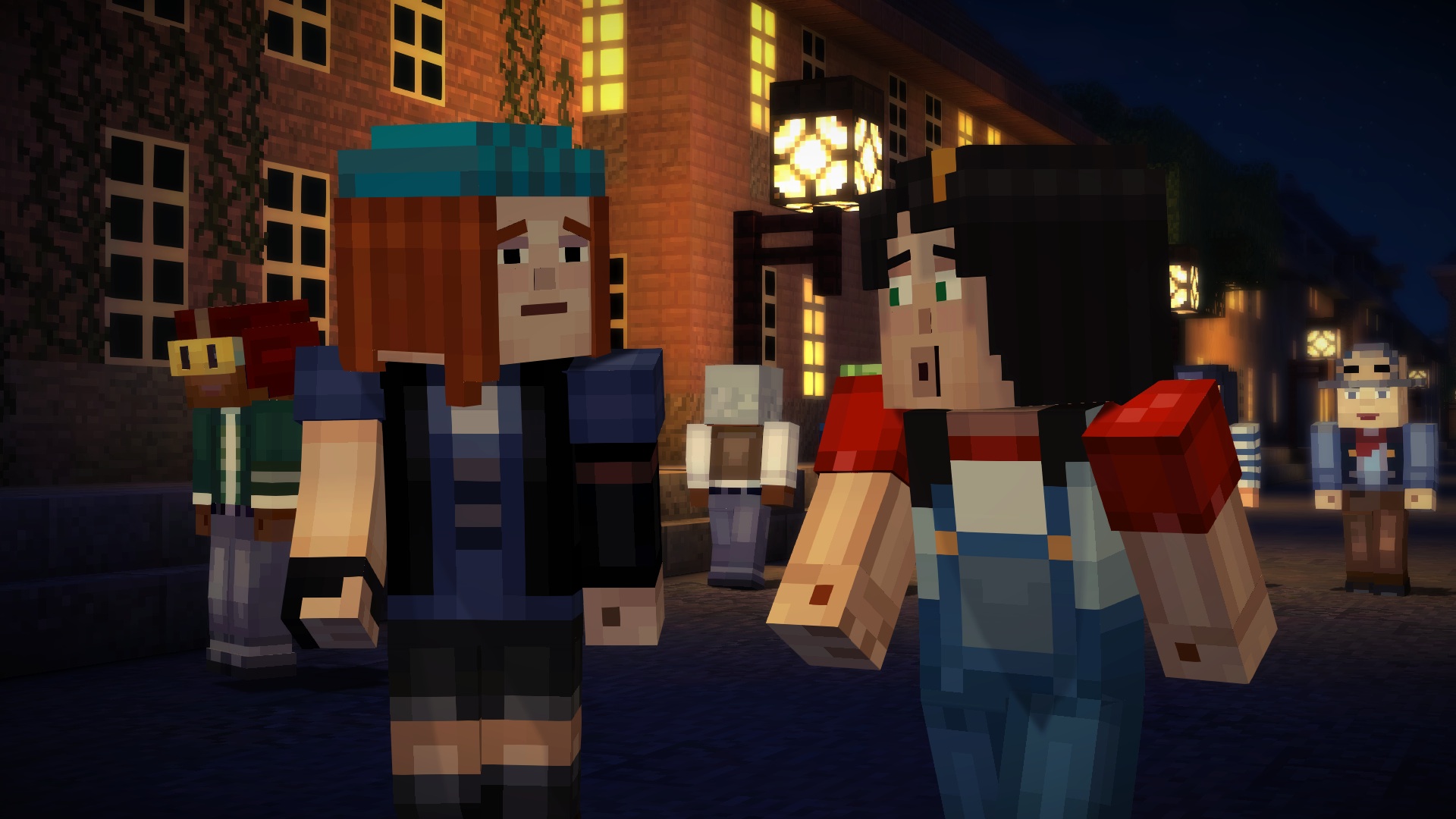
While the storytelling is just okay and the dialogue is a bit flat, the art style is bang on, albeit with some understandable liberties taken with animations. There are several different biomes on display, including woods, cities and the nether; the latter of which incredible to behold and home to some exciting minecart action, straight out of Indiana Jones. There’s also a super cool take on one of the monsters from source game, which won’t be spoiled here.
Almost everything from the original game is wonderfully recreated; with chests, crafting and creepers all present, among a plethora of other items. There’s even combat of sorts, which is on-rails like in Telltale’s other games – a simple matter of hitting the attack button enough to win or choosing a direction to dodge something. Collecting resources is also parodied, with several button-mashing montages of the player punching trees and building mud huts at super-speed. It’s nice to see, but clunky to the point of seeming forced.

All this makes the game look convincingly Minecraft-like. It’s so convincing that when combined with a few subtle changes and the different perspective, it creates a kind of uncanny valley effect; or dissonant reminiscence, in fancier words. Minecraft was never supposed to look this polished. It’s quite disorienting at first but not a major problem.
Aside from the weird interpretations of known gameplay mechanics, there are also puzzle sections that use existing ideas in clever ways, like crafting an item to solve a puzzle. These are mind-numbingly easy, as are the more traditional attempts at puzzles. Not only are the solutions shoved right on the screen the moment the puzzle begins, but there’s also usually a piece of dialogue that explicitly states what to do. If kids used to beat old-school point-and-clicks without internet walkthroughs, then this will just be an insult.

Mechanically, narratively and visually, Story Mode is alright. This first episode gets a pass on those terms, with some really cool new ideas and lots of potential for much better stuff as the series goes on. But while those basic elements might improve, there’s a deeper and more troubling issue that might undermine the entire project. It’s too complicated to fully examine here, so it will be explored more comprehensively in a separate opinion piece very soon.

The essence of the problem though, is that Story Mode is about nothing. The entire point of the real Minecraft is to create a platform for player-driven storytelling. The plot is the metanarrative; the player’s own story. Story Mode contributes to the wider, community-driven metanarrative, but’s it’s really just somebody’s vacation photos. Anyone playing this could be having their own adventure in this world, so there’s no reason to watch somebody else’s unless there’s a point to it.
The trouble is, Story Mode doesn’t seem to be making the only compelling point it can; that Minecraft is about creativity, a la the Lego Movie and its titular subject. That wasn’t just a movie with Lego, it was about Lego. Any more generic kind of story could more effectively be told without being Lego, or rather, Minecraft-themed. This might well end up being a tremendous adventure in a Minecraft setting, but it might also never truly be in the Minecraft spirit.

Summary
Episode one of Minecraft: Story Mode is a competent, if uninspiring experience. The presentation and voice-acting is excellent, but the writing is a bit dull, even for kids. It might be a charming experience for some, but it’s almost an irrelevant product for various reasons. There are some neat ideas, but they’d be better suited either to Minecraft itself or to a story in a different media. Even if it were the latter, Minecraft is doing just fine without a Saturday morning cartoon.
Of course, the existence of this doesn’t make the real game disappear. It’s really just another way to experience Minecraft. It is unfortunate, however, that it seems like it might miss the point of its source material. It’s early days in this series and Telltale are smart people, so they could have something special planned to make all these concerns redundant. Right now though, the impression is that it’s a decent game, but it probably doesn’t need to exist.

Dean was a regular ICXM contributor between 2015–2017, publishing 39 articles across game reviews, Windows and PC, and Xbox news. Their work focused on hands-on reviews, platform commentary, and breaking-news reporting during the Xbox One X launch year and Microsoft’s wider Play Anywhere / UWP gaming initiative. They post on X as @SpookyWomble.