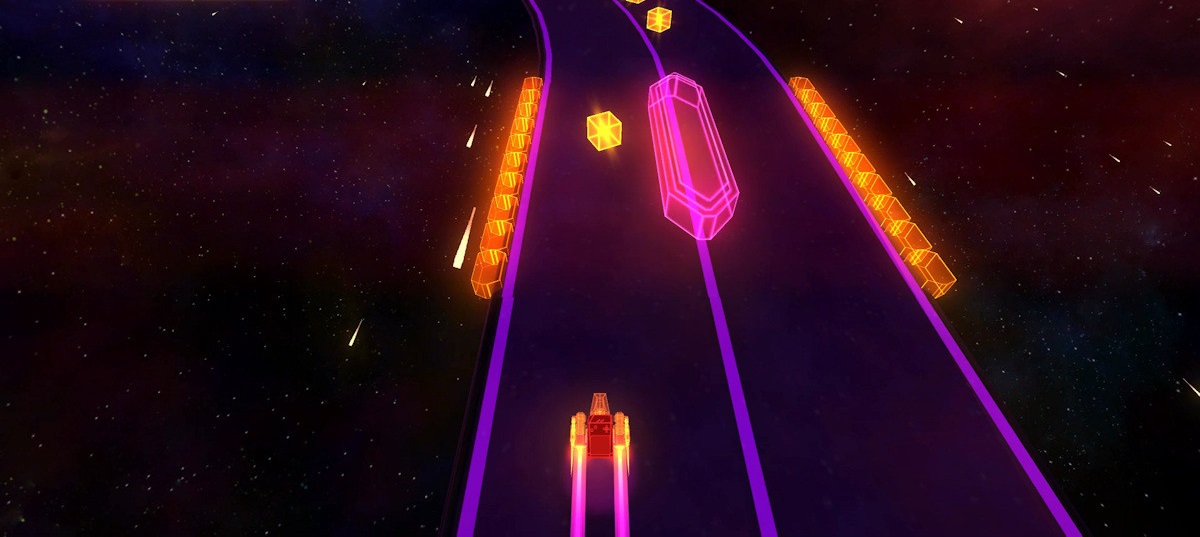
Since its success on the Windows platform, Spectra has been set to make an appearance on Xbox One, offering its unique concept to a home console. The Windows Phone version did extremely well, and was known for bringing this 8 bit racing style to mobile. Spectra has finally released on Xbox One, and while its success was seen on other platforms, some major design flaws hold back the game’s potential.
Spectra for Xbox One is the next release of the retro racer, bringing the 8 bit racer to the living room. The game is simple and easy to pick up, but after a small amount of play, begins to challenge the player. It introduces some traditional features to the tracks, such a boosts and obstacles, requiring precise movement and fast reactions to bypass, and if done successfully, rewards the player by keeping their scored earned from collectible pips on the track. When this is paired with a layout of sharp bends and split paths, keeping a high score can become challenging. The tracks themselves pose a challenge, however the real competition comes from the final score. This not only promotes completing levels, but also adds a numerical value for comparison with other players. For those who have a competitive flair, this feature may hit the spot, however replaying previous levels a certain amount of times can get tedious.

The main problem with Spectra is the lack of variation, and unoriginality. Many times I found myself losing motivation to play, as each level felt the same as the last. Never did any track feel unique, and sadly my experience was massively affected by this. Never could I tell the difference between levels, due to the similar layout and universal colour scheme. No customisation or changes are available, giving every player the same bland experience.
The tracks used in Spectra have a style influenced by early games, and the traditional 8 bit titles. The flowing, vibrant colours reminisce the style of Tron, with structures consisting on contrasting neon colours. The design of the tracks help give a dynamic feeling, while still offering sharp, and responsive movement. Sadly, while the initial idea shows potential, the tracks soon become dull and repetitive. The layout of courses never drastically change, with the basic obstacles and objects being repeated hundreds of times per course. While this style aims at being consistent, the tracks soon become near replications of one another. The game could even improve this by offering a more varied colour scheme, as the glowing orange and purple soon wears dry.

The music in Spectra is one of its largest strengths, and something that should be applauded. The fast paced rhythm is adapted to the style of the game, using a techno/electric palette of sounds. This is one thing that I found close to flawless in Spectra, and should be commended. If a soundtrack was available to purchase on the side, I would seriously consider this. However, no matter how good the music is, once blended with the unimaginative gameplay, the music’s unique charm is soon taken away.
While I tried to like Spectra, the concept isn’t executed successfully. The simplistic style favors the game for the first few minutes of play, but once the minimalistic control scheme is learned, gameplay itself never fulfils. If this review had been of a mobile version, I could justify some elements, but when played on a console they seem out of place. Rather than a top tier ID@Xbox title, this feels like a mobile game that shouldn’t have been brought to the console. This is a game I would play on the bus to work when bored, instead of on my couch. Spectra has a great concept, but fails to innovate and offer variation.
^ Matt – @RTEnvi

Matt was a regular ICXM contributor in 2015, publishing 110 articles across game reviews, Windows and PC, and Xbox news. Their work focused on hands-on reviews, platform commentary, and breaking-news reporting during the Xbox One’s first full year of post-launch coverage, including the early days of Backwards Compatibility and Windows 10 gaming. They post on X as @RTEnvi.