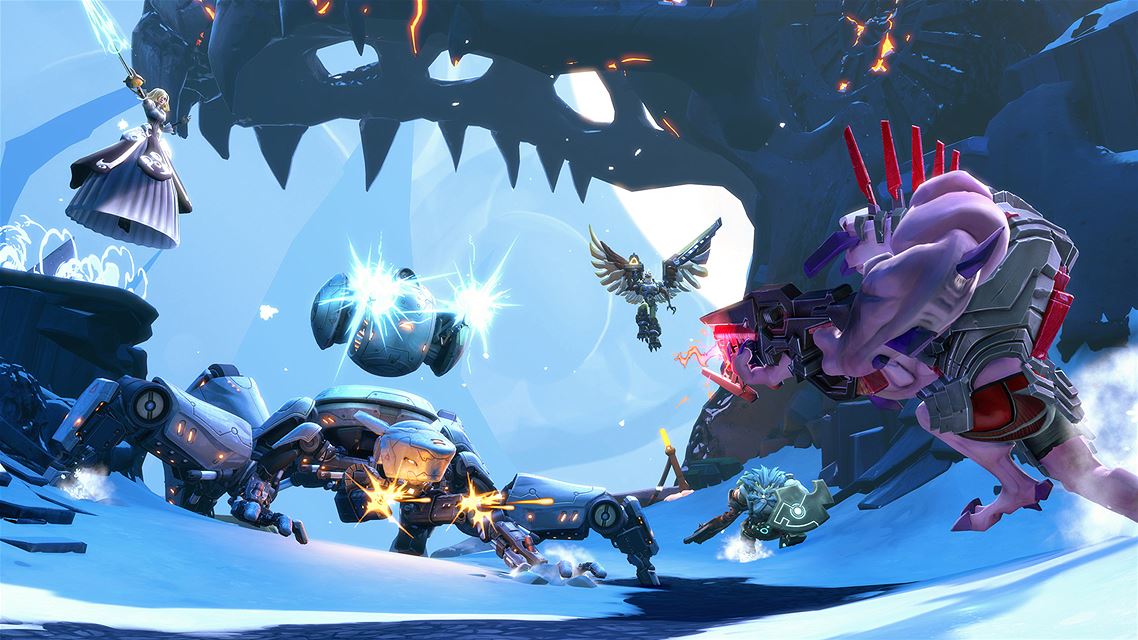
Battleborn is the newest shooter from Gearbox Software, the company behind the widely acclaimed Borderlands series. While Battleborn features humor and visuals similar to Borderlands 2, and while it also runs on the same, slightly-modified Unreal Engine 3, it still manages to stand fairly strong on its own as a unique hybrid of first-person shooter and MOBA. There are some drawbacks and technical issues, many of which could be fixed with a patch, but overall Battleborn is a bunch of plain old fun for those interested in cooperative and competitive play.
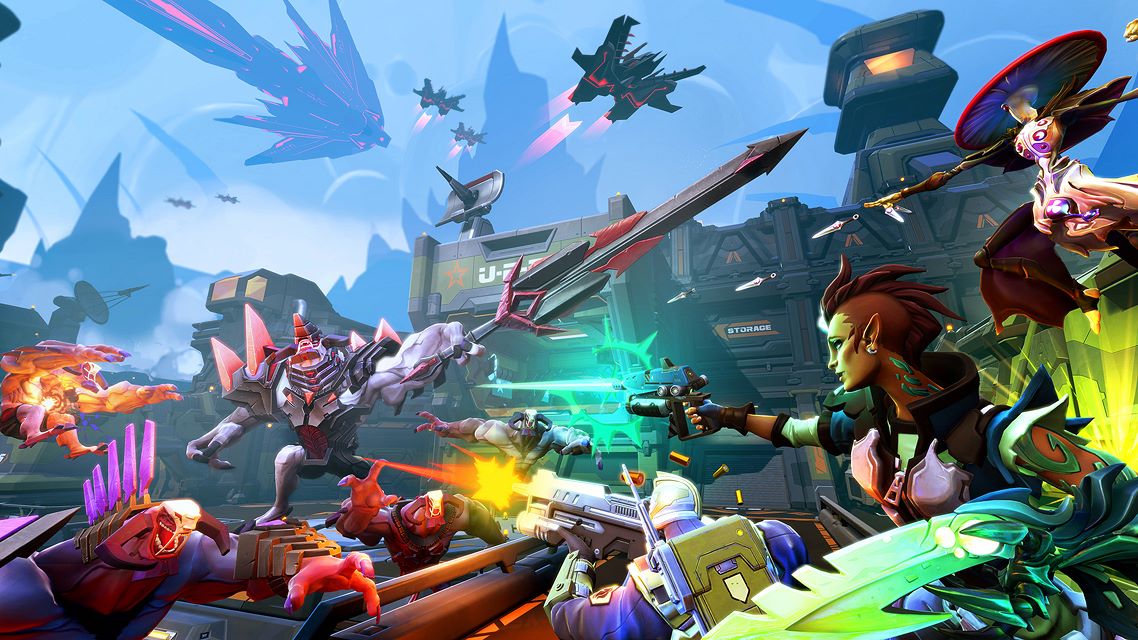
By far the finest quality of Battleborn is its immense roster of twenty-five distinct characters from five different factions, each designed with the utmost attention to detail. Humorous personalities are brought to life by striking art direction and outstanding voice acting from people such as Chris Rager, Ian Sinclair, and Ashly Burch, many of whom also voiced characters in the Borderlands’ series. You unlock playable “Battleborn” as your overall command rank increases or as you complete certain challenges. While it is easy to play as whichever Battleborn you prefer since the control scheme translates well from character to character, certain individual attacks and abilities require a lot more expertise than others, incentivizing practice and the varying of techniques.
The game does a good job of allowing players to unlock new Battleborn at a reasonable pace and as they become more accomplished. Anyone can try out Oscar Mike and his traditional assault rifle and frag grenades right away, but a more complicated support class like Reyna, who must focus on marking the strongest enemies, shielding her teammates, and attacking all at the same time won’t be available until a little bit later since she requires so much more adeptness. Every attack feels powerful and sounds precise, and even running at thirty frames per second Battleborn manages to feel like one of the smoothest first-person shooters this generation.
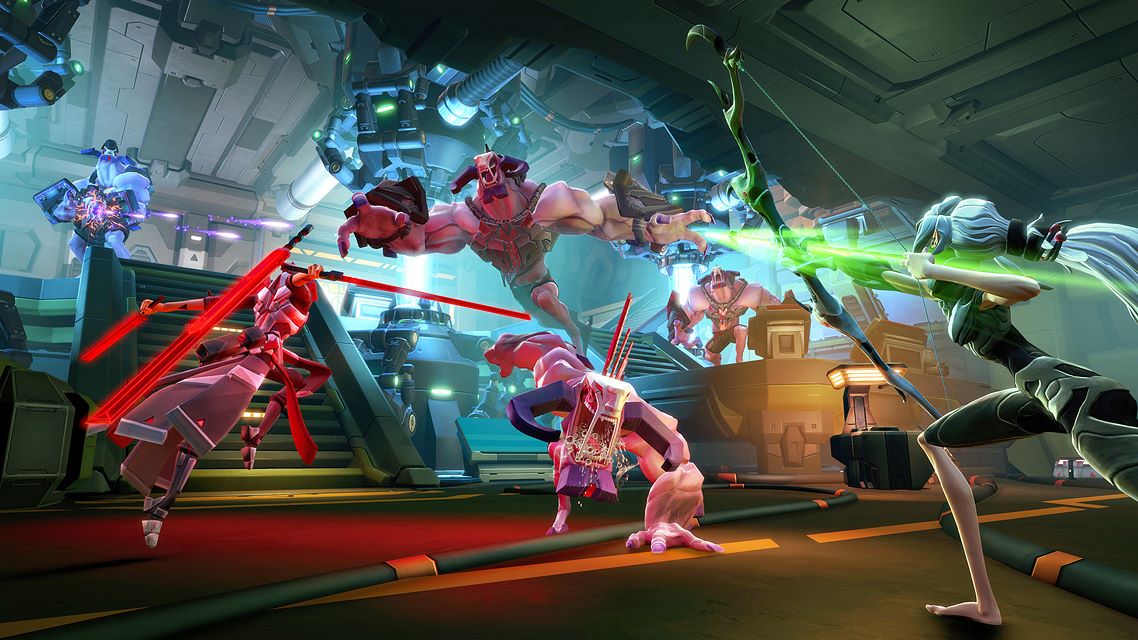
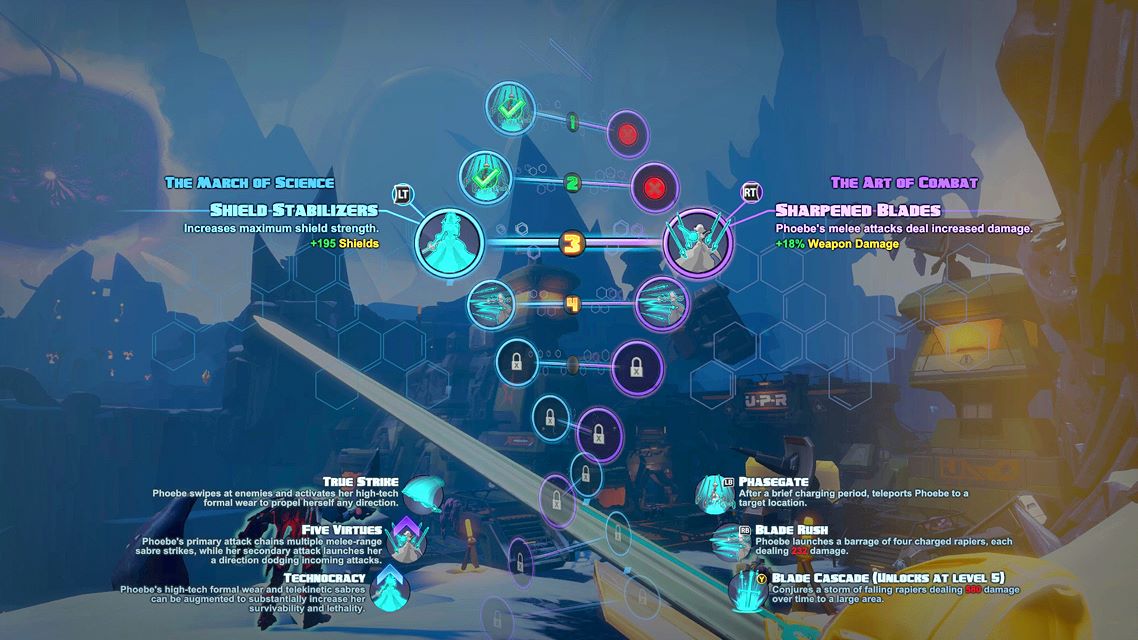
The Helix system is the most innovative feature of Battleborn, allowing players to choose between two different augmentation choices as they level up their character from one to ten. These augmentations alter how your weapons and abilities operate, and reset at the end of every campaign mission or multiplayer game so that you can adapt to the situation at hand. As you progress, each of your characters will also permanently rank up, unlocking new helix augments that allow for even more varieties in gameplay style. At first I wasn’t a fan of choosing between two or three augments in the heat of battle while enemies were attacking me, but I soon became fond of the intensity that forced me to choose the optimal option as quickly as possible.
After unlocking and leveling up all twenty-five playable Battleborn characters, which by the way will take a long time to accomplish, there are still titles, taunts, and skins to unlock. These are obviously meant to showcase your superiority to other players, but unfortunately none of them are very rewarding to unlock. I wish that skins in particular were more intriguing, as currently they only change the basic colors of your Battleborn, whereas detailed skins and accessories like those seen in other MOBAs are more pleasing to work towards. Take a look at the King of the Deep Poseidon skin in Smite, for example. The developers at Gearbox have employed so much creativity throughout the rest of Battleborn that I’m surprised additional customization options were not offered to complement that. Maybe they’ll be added in the future.
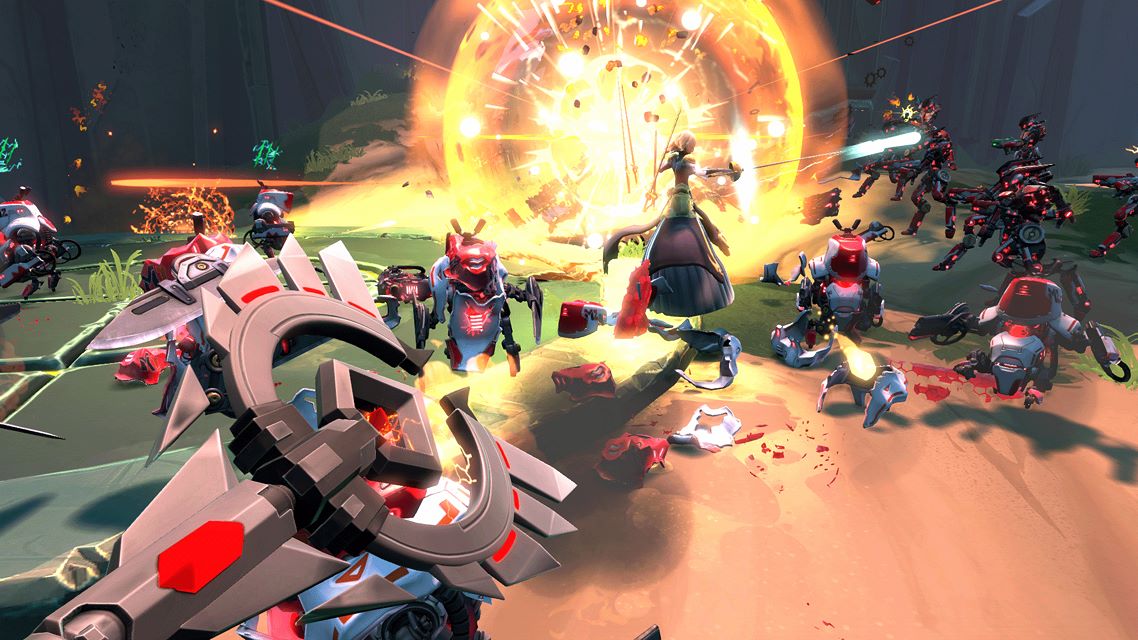
Battleborn is divided up into two portions: story mode and multiplayer. The story mode consists of a prologue and eight missions, each of which pit you up against various goons and allies of Rendain, the game’s main antagonist, who wishes to destroy your universe. The story isn’t deep or profound, and although additional lore can be unlocked as you progress, the universe itself isn’t initially fleshed out enough for the additional material to grasp your attention. NPCs communicate with you during missions and guide you to certain objectives, constantly spouting immature jokes in typical Gearbox fashion, but few hit the mark in the same way that those from Borderlands did. Nevertheless, it seems that Gearbox was not aiming to focus on a meaningful, linear story anyway; if you choose to play with four other people online, as is the best way to experience the game, you must vote for one of three randomly selected mission choices out of the eight total, illustrating just how unimportant it is to play through the story in sequence.
This isn’t necessarily a bad thing–after all, the real fun in Battleborn comes from the gameplay, not the narrative–but it does become a problem when you encounter someone who wants to play one specific mission cooperatively online. For whatever reason, matchmaking does not allow this. Unless playing alone, you can only take part in whatever mission is selected from the three options given. This defect leads to a player joining a game wanting to play “The Experiment,” for example, because he wants to unlock the Boldur character, becoming angry when the only options available are “The Renegade,” “The Void,” and “The Sentinel,” and abandoning his team as soon as the game finishes loading. Not only does this become an issue for the player leaving the match, but also for those who remain. Battleborn does not seem to dynamically adjust the difficulty, so a mission that begins with five players will be impossible to complete if three players disconnect and only two remain. Such flaws could be easily fixed, but at the moment they unnecessarily ruin the matchmaking system and the campaign experience for everyone.
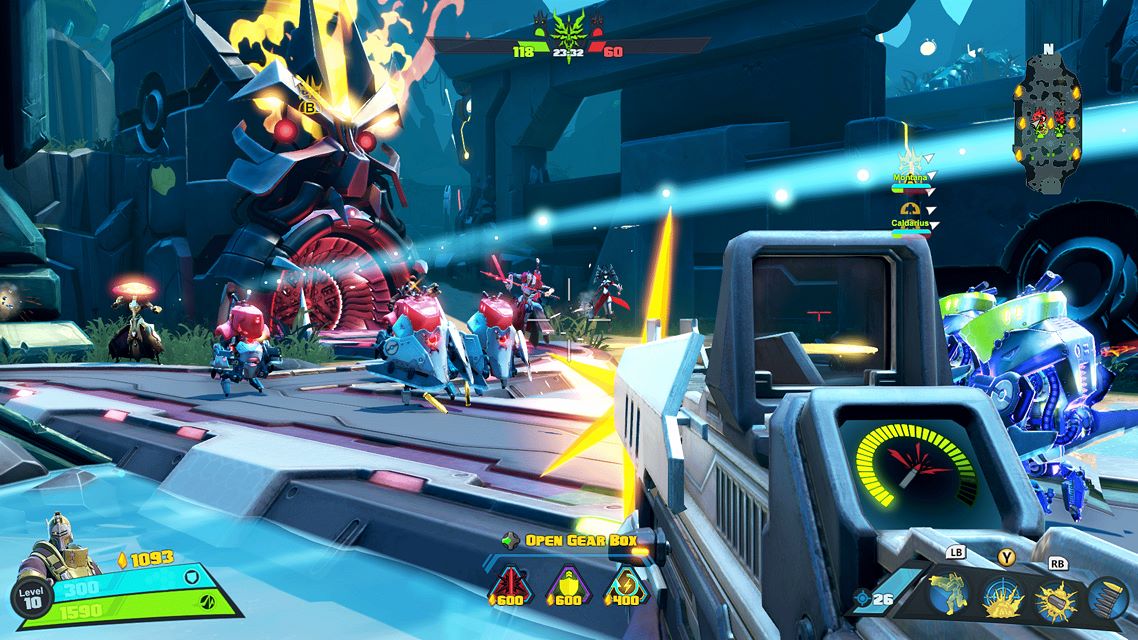
The missions themselves, apart from the lackluster storytelling and the technical errors, can be a lot of fun to progress through with other individuals, either in two-person local split-screen or online. Although there are only eight missions, each one takes at least an hour to complete. Objectives are varied, with some emphasizing offensive attacks and with some demanding seriously well-planned tower defense strategies. During these defensive sections you will spend crystal-like shards collected throughout the level to place turrets and sentries around a central position. Shards can also be spent to activate gear, a type of loot acquired either via an in-game store (no microtransactions, don’t worry) or via loot drops. Gear alters stats, increasing your reload speed or attack damage, for example.
It’s important to go looking for shards and to ration them between turrets and gear accordingly since if you fail to defend an objective, you will fail the current mission instantly, losing up to an hour’s worth of hard-earned progress. Furthermore, if playing online, your entire team will be disbanded and you will be returned to the main menu without even a retry option available to you. While I’m all for challenging game modes, penalizing a player with automatic defeat while also forcing him or her to suffer through the broken matchmaking process again is far too severe a punishment for failure.
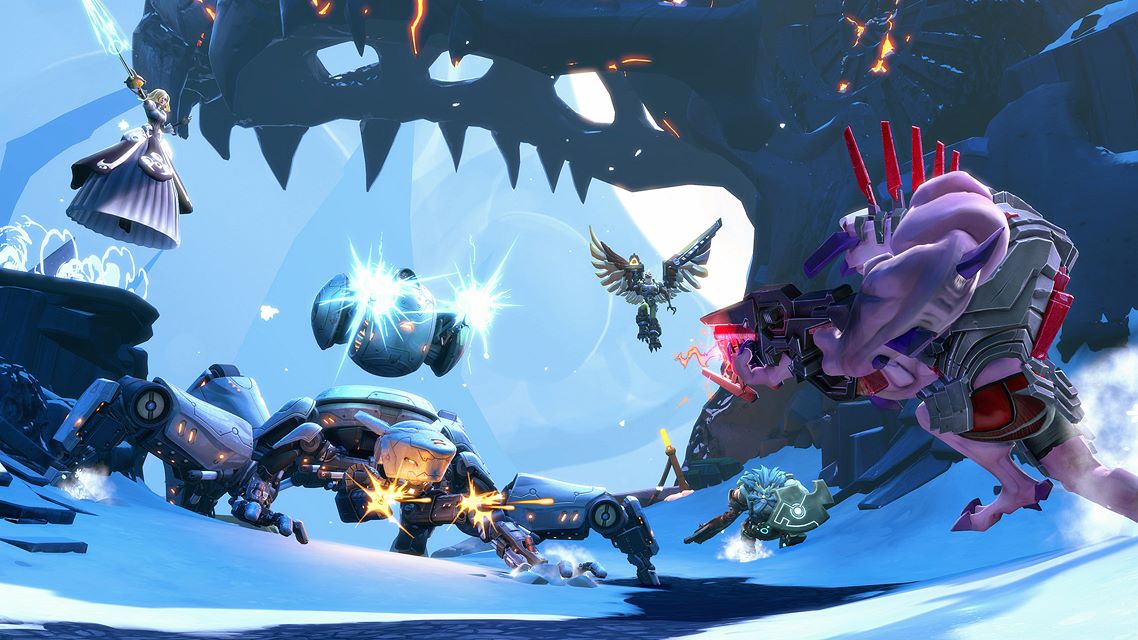
The onslaughts of enemies that you will face in the campaign can become repetitive, but the upbeat electronic music and the excellent level design will keep you interested enough. Most levels contain multiple bosses to shake things up a bit too, each unique in its own right and each challenging to defeat. These boss fights are bittersweet, however, since although the patterns that must be executed and the specific weak spots that must be targeted are reminiscent of epic scenes from, say, The Legend of Zelda series, they mean that certain Battleborn struggle to remain useful in those situations. Certain melee-only characters, for example, are useless against a boss whose head is his only weak spot, and characters whose special abilities only fire in a vertical direction will have trouble targeting a boss who can only be attacked from the side.
Battleborn’s competitive multiplayer pits two teams of five players against each other. Each player chooses one Battleborn to play as for the duration of the match and no two players on the same team can play as the same character. This is where Battleborn truly shines, a fantastic blend of MOBA and shooter. Players must work both with each other and with AI-controlled minions across three separate game modes: Capture, Incursion, and Meltdown. Capture is quite traditional, with the two teams struggling to earn points by keeping ahold of three separate areas. Incursion is the most MOBA-like, with characters defending their own giant minion while also attacking that of their enemies. Finally, Meltdown, my personal favorite, has players escorting minions to an incinerator as a sacrifice; whichever team incinerates the most minions wins the game. In order to thrive in multiplayer you must be perceptive of multiple circumstances all at once; leveling up your own character, keeping an eye on your minions and teammates, and using shards to activate gear, turrets, and accelerators are all together the key to success.
Unfortunately, the inclusion of only three game modes and two maps per mode means that the multiplayer experience begins to feel bleak and repetitive after several hours, even with the diverse roster of characters to choose from. Admittedly, some games that are purely MOBAs can get away with just one map, but Battleborn is still very much a shooter, and while it does have MOBA-inspired elements, it is very accessible and does not require the same amount of strategy that games like League of Legends or Smite do. Because of this, the map deficit seems particularly prominent. Luckily, Gearbox has promised that more maps and modes will be available later on, but I still feel that some simple, mainstream modes such as Team Deathmatch or Capture the Flag should have been implemented at launch, and that there should have been at least ten maps to play on rather than a mere six.
Furthermore, it takes far too long to start a multiplayer game. Even after finding nine other players in matchmaking, each one is granted one hundred seconds to choose a Battleborn to play as, and the game will not begin until everyone has done this. Sometimes the long selection screen causes players to leave matchmaking altogether because one character either forgot to select or is taking too long. Players should not need this much time to select a character; even a fifteen second timer would be much more reasonable. You are also sent back to the main menu after completing a game rather than being automatically put into a playlist for another one. These aren’t major issues, but they slow down what is otherwise a nearly flawless amount of pleasure.
Summary
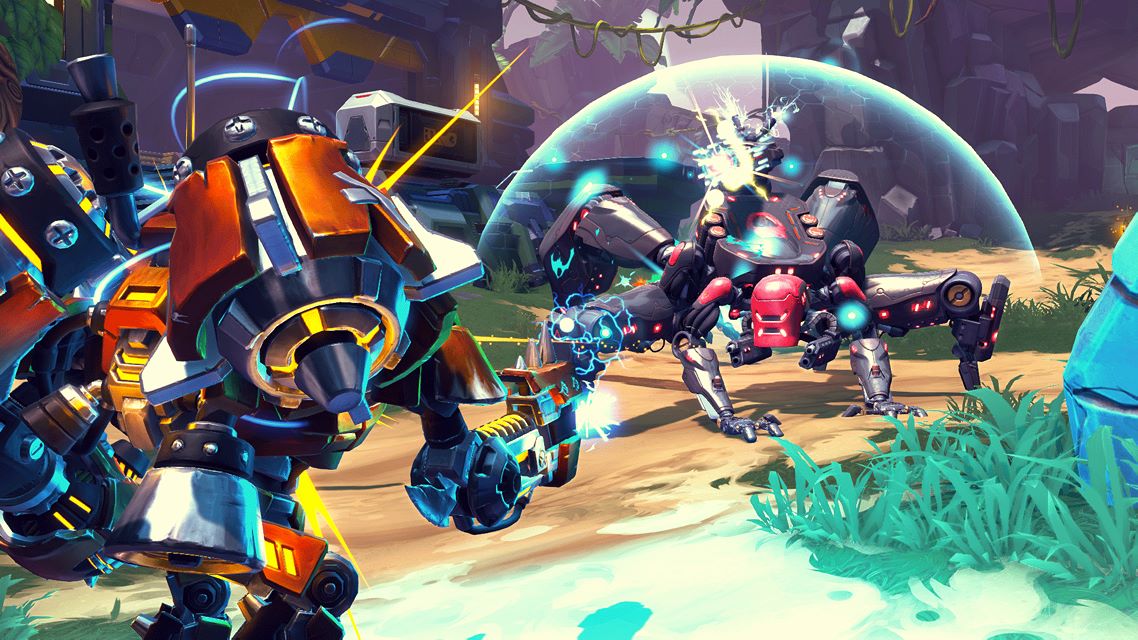
Battleborn is an entertaining game that manages to mix the first-person shooting genre with MOBA elements to create the ultimate gameplay experience for gamers interested in cooperative and competitive multiplayer. The characters, weapons, abilities, art style and voice acting all resonate with booming splendor and come together smoothly to form a game that is great fun at its core. Sadly, Battleborn is plagued with numerous technical issues that make its campaign a vexing experience for the player, and the lack of a satisfying storyline or vibrant NPCs detracts from this experience even more. Although the multiplayer is fundamentally excellent, a dearth of game modes and maps make it repetitive quickly while the customization options end up being extremely limited. Long timers and unnecessary waits further slow down the experience. Battleborn has the potential to be delightful, but right now numerous small problems all added up make for a less enjoyable overall experience.

Tristan was a regular ICXM contributor between 2015–2017, publishing 51 articles across opinion pieces, game reviews, Windows and PC, and Xbox news. Their work focused on hands-on reviews, platform commentary, and breaking-news reporting during the Xbox One X launch year and Microsoft’s wider Play Anywhere / UWP gaming initiative. They post on X as @tbogost.