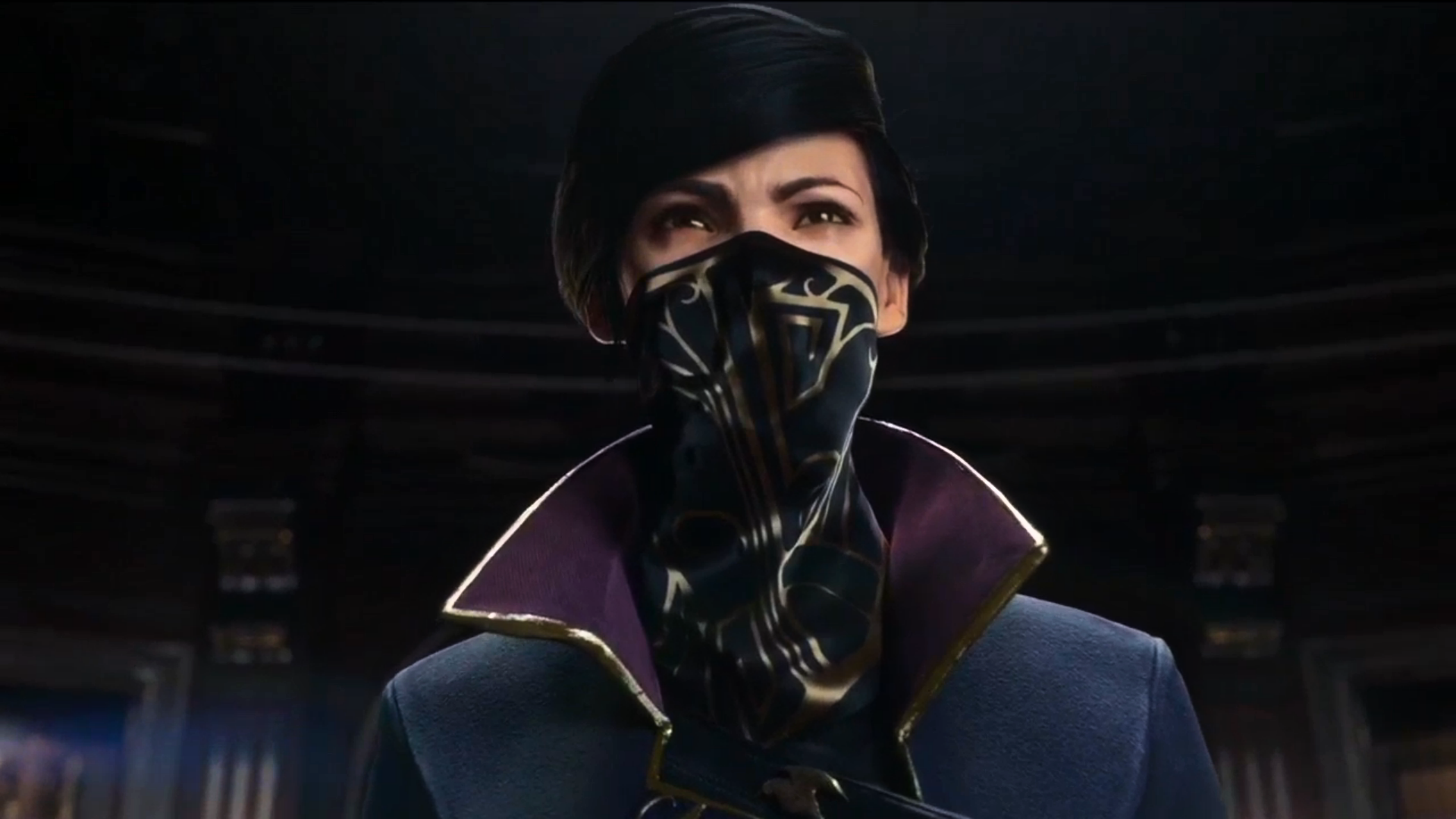
In 2012, Arkane Studios released Dishonored, a stealth-action game with a beautifully crafted world that focused on player choice. Players took on the role of Corvo Attano, Royal Protector to the Empress in Dunwall, who was given supernatural abilities after he was wrongly accused of the Empress’ murder. Fifteen years later in Dishonored 2, Corvo’s daughter Emily is now Empress, and players will once again go on a journey to take back the throne.
Anyone who has played the original Dishonored’s expansion, The Brigmore Witches, will be familiar with the main antagonist, Delilah. She has returned to Dunwall to usurp the throne and now either Emily or Corvo must travel to Karnaca to find out how to stop her. One of the complaints from the first game was that the story was pretty lackluster. That has been rectified to an extent. I definitely think that the story is more interesting and engaging this time, in part due to the decision to voice both protagonists.
The dark, industrial city of Dunwall is now mostly traded for the Mediterranean-inspired city of Karnaca. Because the beginning and end of Dishonored 2 still take place in Dunwall, I could easily feel the differences between the two locations. Both cities are distinct with their own architecture and culture. Dunwall has changed a bit over the years, but it still has this dingy atmosphere to it, whereas Karnaca is vibrant and alive. Karnaca has neutral zones, unlike Dunwall, that players can explore where citizens will shop, play music, and generally just go about their day.

Although parts of Karnaca are infested with Bloodflies, it doesn’t really compare to the plague in the first game, in my opinion. The rat plague in Dishonored was a major part of the story and the city was full of disease-ridden Weepers, who were people that had succumbed to the plague. In contrast, though Karnaca does have buildings in every mission with numerous Bloodfly nests, this infestation is less prominent, and seems to take less of a toll on the city. Even in high chaos, I think I only encountered two or three Nest Keepers, which are the Karnaca equivalent of Weepers.
I think it was good to travel to a new location because so much time was spent in Dunwall during the first game, and I wouldn’t mind if Arkane continues this trend of visiting new cities in subsequent releases.
Corvo retains his powers from Dishonored and now has even more ways to upgrade them. Blink in the first game was a basic teleportation mechanic, but now it can be upgraded to stop time and can even be used as an offensive attack. Having Corvo return as a playable character was a smart decision. His powers are familiar to those who played the original with the added bonus of being refined and improved.
I first played through the game with Emily because I was already fairly familiar with Corvo’s powers from Dishonored. Admittedly, I was worried at the beginning that I wouldn’t like her new abilities as I was so used to Corvo’s, but some of her powers ended up being my favorites, and Emily holds her own as a capable, fun character to play. It doesn’t seem like she has a huge advantage or disadvantage over playing Corvo. Instead, they stand side-by-side as competent characters.

Each character provides their own pros and cons depending on your playstyle, but they balance out nicely. If you choose to play in Flesh and Steel mode without any supernatural powers aiding you, it should not matter which character you pick. Corvo and Emily both have new equipment and gear that players can unlock by finding blueprints around the city, such as the Howler bolts and Stinging darts that can be used with the crossbow.
While they do not share any powers besides Dark Vision, players can access the new Bonecharm crafting mechanic regardless of which character they choose to play as. Bonecharms found during missions can now be broken down into raw whalebone and their specific traits. If you have three particular Bonecharms that you like, you can break them down and combine all of their traits into one Bonecharm that takes up less room since you can only have a certain amount equipped at a given time. If you do choose to use a larger number of Bonecharms to craft, there is a chance it could end up corrupted, and instead of having just three or four positive traits, it will also have a negative trait as well.

The level design is once again outstanding in Dishonored 2. Combined with the amount of supernatural abilities you have, there are so many ways to beat a level. It is never as straightforward as just running to the waypoint to kill your target. If that’s your style, it can be, but actually taking the time to explore and eavesdrop on conversations opens up a wider variety of choices. Player choice and freedom are key pillars of Dishonored 2, and Arkane knows exactly how to complement that.
Two standout missions in Dishonored 2 are most certainly The Clockwork Mansion and A Crack in the Slab. The Clockwork Mansion is essentially a giant puzzle invented by Kirin Jindosh, complete with a mechanical labyrinth. Levers are pulled to rearrange the layout of the rooms, and can even be used to get behind the walls if timed just right. I was blown away when this level was shown in the reveal trailer and I heard it would be playable in-game. I’m amazed at how smoothly the walls and floors move. Walking through the mansion is like taking a trip through Jindosh’s own mind. It’s complex, elegant, and shows a bit of narcissism in its own seeming perfection. That perfection is peeled away when you spend enough time searching his home, with his arrogance making him vulnerable. He’ll taunt you and send his Clockwork Soldiers, never actually thinking that anyone could navigate his grand invention. It was satisfying proving him wrong.
A Crack in the Slab, which was demoed at E3, is in my opinion the most unique mission in the game. Players will receive the timepiece, a device that allows players to jump back and forth in time. The level in its current state is a rundown, seemingly abandoned manor, but when the timepiece is opened up, you are able to see what it was like years prior when it was lavish and occupied. Without being able to utilize your supernatural abilities in this location, you must wisely use the timepiece as your biggest aid. If a doorway is blocked in the present, you can open the timepiece, view how many guards are in the area, if any, and seamlessly transport yourself into the past, making your way one step closer to your goal. This time travel mechanic can also be used to change the present in ways that you may not realize until the end of the mission.

In every mission, I love how there are little notes in dilapidated, abandoned buildings or writings on the wall that add so much life to the world. Every time I came across a hidden trinket or a room tucked away in the corner of an apartment, I felt like I found something that someone else may not have noticed. It reminds me of the show Westworld where one of the characters says, “The guests don’t return for the obvious things we do, the garish things. They come back because of the subtleties. The details. They come back because they discover something they imagine no one noticed before. Something they fall in love with.” Dishonored 2 may be an odd example as it is a video game and not a theme park like the quote is referring to, but that still rings true. Even though I believe it warrants several playthroughs just because of the variety of choices that players have, people also enjoy spending so much time in the game because the developers put a tremendous amount of effort and thought into the small details. Those are what make it special.
While playing it on consoles right now may be recommended until Arkane can fix the broken PC version, I did notice that it still has some technical problems on Xbox One. The resolution, particularly when zooming in with the spyglass, looks blurry if you are trying to view objects or guards far away. There were also times where shadows would flicker and some textures would pop-in after a few seconds. Dishonored 2 on PC surely has much better resolution, but it also runs at a fairly stable 30 FPS on Xbox One—at least during my time with the game—and I think a stable frame rate is a fair trade-off for a slightly unimpressive resolution at times. What works to its advantage is that Dishonored 2 does not aim to have realistic graphics, and the aesthetic in the game helps nullify some of these problems.
Summary
The first Dishonored was one of my favorite games—I must have played it over a dozen times—and I can happily say that Dishonored 2 is a worthy successor. The world that Arkane has created is so rich with stories, both told and untold, that it’s easy to get lost in. The universe’s mysticism is enthralling, with countless ways to enjoy it. Everything that worked so well in the first game—its fantastic level design, supernatural powers, world building, and lore—are all present with even greater impact. It’s evident that Arkane put a lot of time and energy into designing the entire game to create a truly incredible experience.

Jennifer is a games journalist, former games journalist and PR Manager at Gearbox. They contributed 234 articles to ICXM between 2015–2017, focused on opinion pieces, game reviews, Windows and PC, and Xbox news: went on to write for Windows Central and later managed PR for Gearbox Software.