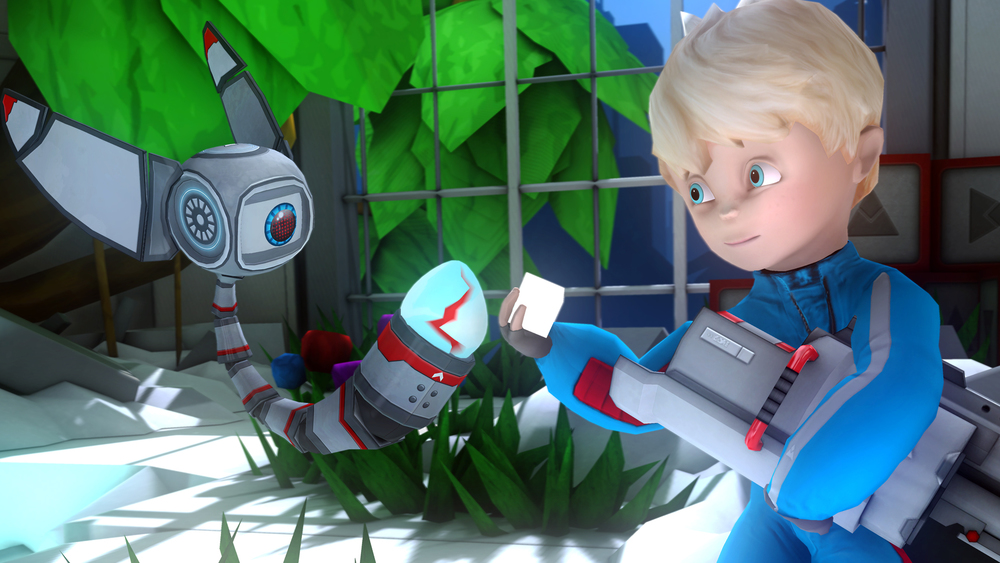
After just five minutes of Kick & Fennick, I could already tell that I rested nowhere near the target demographic for this game. From the very beginning, it’s extremely obvious that Jaywalkers Interactive have created a game specifically for children. It’s not like the Lego series or Pokémon which targets young children but is also extremely enjoyable for adults, Kick & Fennick feels like a game exclusively for a child audience.
That’s not necessarily a bad thing, as long as the game itself is good anyone should be able to find enjoyment in a truly solid title. However, Kick & Fennick spends a lot of its time in an extremely easy, repetitious bubble for the first three to four chapters of its short, five-chapter campaign.

You play as Kick, a small, blonde child of around ten years after waking up on a desolate world ruled by robots that want you quite dead. A few minutes in and you’ll meet Fennick, a flying robot who makes noises extremely similar to that of the turret guns from Portal and aims to be the adorable secondary character in the vain of Kazooie, Captain Price and other such individuals from games that young children play. Fennick is gravely injured though and you two will have to team up to get a new energy core so that Fennick won’t die of sticky, poisonous battery leakage.
To get to the new energy core you’ll have to use Kick’s newfound energy rifle, which is indeed larger than he is, to propel yourself through gaps, across laser beams and through walls. It can also be used to kill enemies. Fennick’s limited ability to teleport you away from danger, which can be refilled by picking up the seemingly always-available energy orbs dotted around the map, makes the game quite easy. It’s difficult to die but if you do you will have to start the entire level over again.
By using the right stick you are able to aim Kick’s energy rifle, showing the arc of your shot. Once you propel yourself in the air you have one more shot before you have to land to recharge. In some levels, you can also find a red charging station to turn your shots into more powerful shots that will propel you further across the level. Until around the end of chapter three, you will be moving in a fairly linear fashion without much deviation from the basic jump-from-platform-to-platform approach and occasional burst through cracked walls.

These few chapters are fun enough but don’t really mix anything up apart from the simplistic boss fight with a huge guard robot. The last two chapters however do mix things up a lot more than the rest of the game. The inclusion of bounce pads, which appear sparsely through levels in chapter three, as well as grind rails, turn Kick & Fennick into an infinitely faster-paced game. Sliding off a long grind rail and then shooting yourself onto a bounce pad that sends you crashing through a wall followed by the swift shooting of three robots above you is a highly satisfying experience that only really happens during the later levels in the game. It’s a shame more of the game isn’t like this.
Nevertheless, Kick & Fennick’s biggest technical problem is apparent when the game starts to speed up. While performance is flawless apart from a couple of short stutters on rare occasions and the visual fidelity is of a passable quality, the camera is one of the most broken aspects of an otherwise solid but standard experience. This is because Kick & Fennick adopts a dynamic camera to attempt a more cinematic look.
The start of the game, just before Kick gets his rifle, sees the camera zooming in on Kick as he shuffles his way through the stage and later on when you’re tackling large, sprawling towers, the camera is supposed to be zoomed out so you can see the level before you. The camera doesn’t work as intended though. At a large number of points during the game, the camera would either fail to follow me during a large distance jump or would decide to choose an angle unsuitable for the situation I was in such as being zoomed in on my character when I needed a wide view to figure out where I was supposed to be aiming. The only way to fix these camera problems is to die, respawn and hope that the game chooses a more suitable angle for when you attempt that section again. Surely the developers would’ve noticed this major problem and fixed it before launch. Apparently not.

Kick & Fennick is also short. As the game was originally developed exclusively for the PlayStation Vita, a handheld device, each level is suitably short for that device with some levels taking under a minute to complete with the longer levels never taking over five minutes. Even when looking out for the special gear collectibles in every level—each level holds a single gear which can unlock an alternate costume—levels can be completed very quickly and within a few hours at the most. It’s one of the shortest games I’ve ever played. A lot of gamers will have issues with its length and not find it a suitable investment. There are longer experiences available for the same price point.
Summary
Kick & Fennick is an alright game. For the most part it works competently and will definitely be enjoyable to a younger audience. Issues with the game’s camera and overall short playtime lead to a jarring experience. Kick & Fennick doesn’t really have enough to stand out amongst other, better platformers on the Xbox One.

Lewis is a games journalist, freelance gaming and consumer-tech journalist. They contributed 344 articles to ICXM between 2015–2017, focused on opinion pieces, game reviews, Windows and PC, and Xbox news: has since served as Editor-in-Chief at StealthOptional and Gaming Editor at MSPoweruser, with bylines at Gfinity Esports and FRVR.