All creators take inspiration from the classics. Whether it is The Lion King rewriting Hamlet with animals, or The Prince and the Pauper being a children’s version of The Man in the Iron Mask; creators have always looked to the masters to help guide them on the path of bringing new properties to the world. The same can be said about videogame creators.
Anode, a 2D puzzle game, is heavily influenced by the classic videogame Tetris. But while Tetris has stood the test of time, continually being remade for each new gaming system available, will Anode be able to stand on its own two feet? I do not believe so.
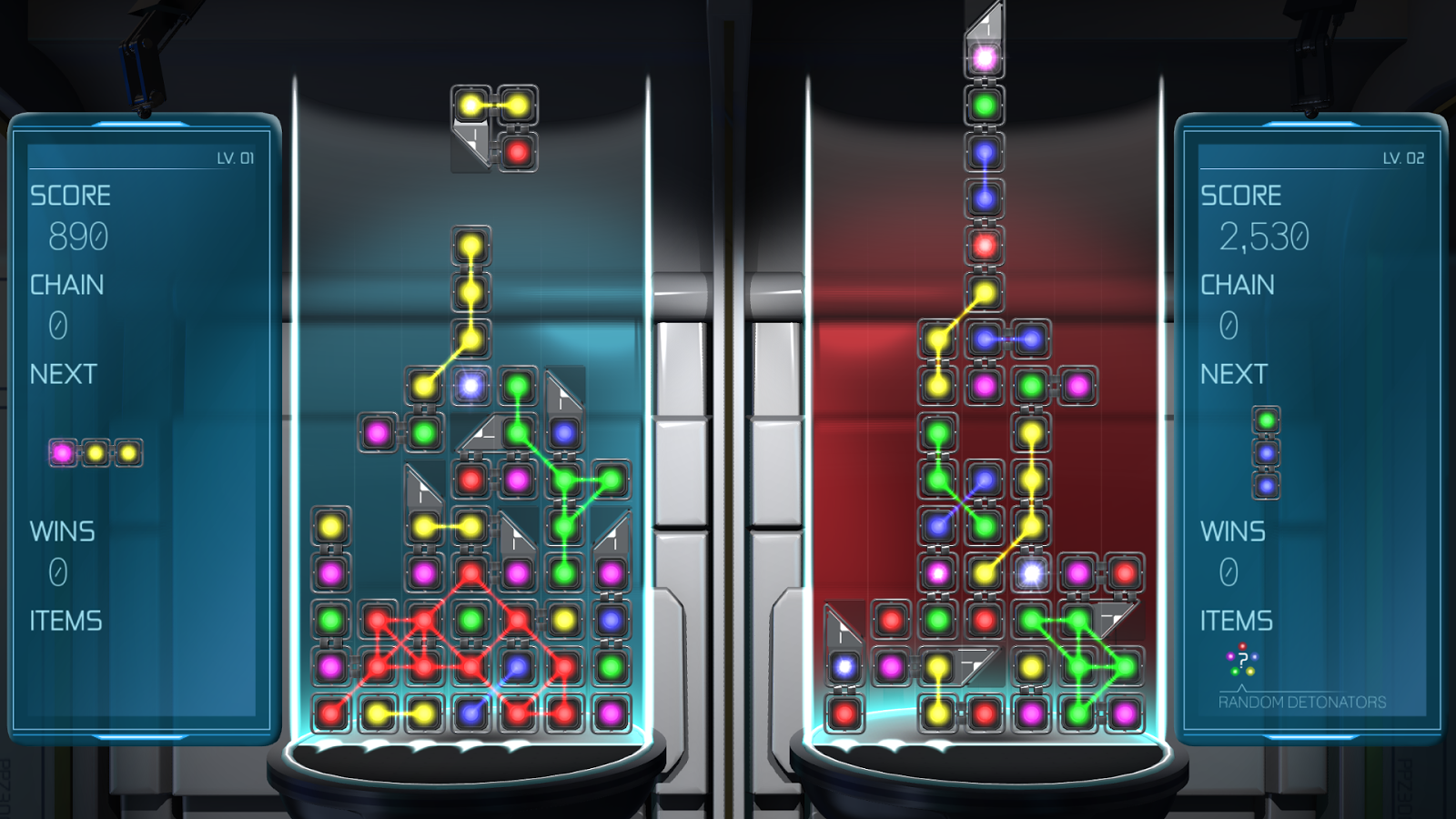
Anode is played by matching similar colored squares to form a chain. Once this chain comes into contact with a power block, the chain explodes. This clears it off of the playing field and grants the player points. The blocks fall from the top of the screen, are rotated by the player, and then dropped in order to create said chains. If chains are destroyed in rapid succession, a multiplier is added that increases the score and progresses the player through the levels. Each level comes with a slightly faster fall-speed for the blocks.
This is where I first recognized a problem. In Tetris, the first levels are incredibly slow, allowing for a pretty robust play time. Eventually the blocks fell so fast that I could not continue, but up until then I always had a great time. In Anode, the levels progress so quickly that the blocks begin falling too fast too quickly. Each game would last only a couple minutes, and after a few hours of play, I wasn’t any better than when I started.
This was because the speed becomes too much for any skill. The balance of speed and difficulty is leaning way too much towards the game being unbeatable around level 20. The power-ups are also unbalanced.
Whenever I would link 7 colored blocks and destroy them, I was awarded with a power-up. These power-ups included destroying half of one color’s blocks, destroying the bottom row, or inserting a random explosive block. I really never found any of these power-ups that useful. In multiplayer, they are a completely different story.
Anode has a multiplayer mode that works exactly like other 2D, puzzle, battle modes. When player 1 destroys a few chains of blocks, player 2 is punished by having extra blocks placed on their side. A player loses when a placed block is stacked high enough to break the top plane. The multiplayer mode adds offensive power-ups that add a line of blocks to an opponent, stops block rotation, and hides the preview of future blocks. I played a dozen matches with my girlfriend, and whoever earned the stop rotation first, always won. This power up caused a delay large enough for the other player to spiral out of control.
The games regularly lasted less than a minute, and they never became exciting or contentious. It always boiled down to collecting a few power-ups, then dominating the other player. I found this mode to be mostly forgettable.
Anode also offers a race, time trial, and mission mode. The race mode tasks the player with reaching a score as quickly as possible. The time trial tasks a player with getting the highest score possible within a chosen time period. The mission mode actually offers some unique gameplay as I tried to beat as many missions as possible until I finally lost the board. Each mission consisted of tasks like “destroy 7 green blocks” or “get a 5x combo.” I did enjoy playing this mode for a few rounds, but it too wore out its welcome.
There is a lot that Anode does right. Visually, the game is very pretty. The use of bright colors and dark backgrounds made each color easily distinguishable while playing. The audio was fitting for the type of game, and the fact that I didn’t notice it during the constant repetition is a good thing. I never noticed any screen tearing, crashes, or extended loading times during my few hours of play, either.
Summary
While Anode is striving to take on the giant that is Tetris, I think it fails to be a game of that caliber. There is magic in the simplicity that is Tetris, and Anode just comes off too brash and in-your-face. While the game is not bad, it just doesn’t do anything special. I find it to have only a small amount of enjoyment that putters out quickly.

Joshua was a regular ICXM contributor between 2016–2017, publishing 42 articles across game reviews, and Xbox news. Their work focused on hands-on reviews, platform commentary, and breaking-news reporting during the Xbox One X launch year and Microsoft’s wider Play Anywhere / UWP gaming initiative.