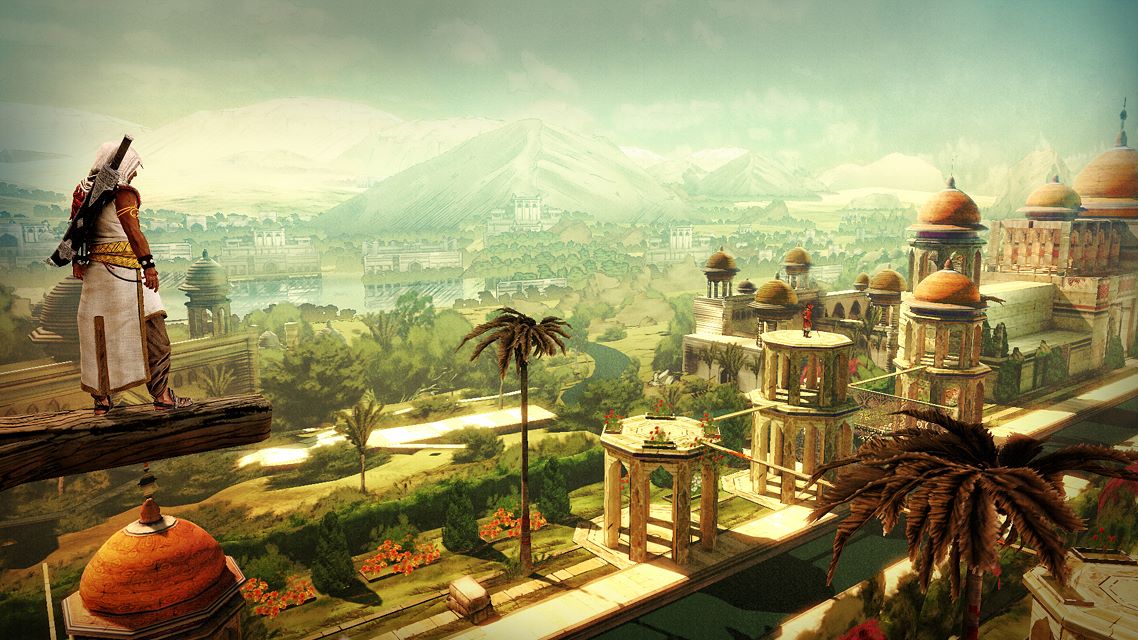
Assassin’s Creed Chronicles: India is the second of three Chronicles games. Following China and preceeding Russia’s release next month, India follows the story of Arbaaz Mir and the graphic novel Assassin’s Creed: Brahman. He’s a Kashmiri assassin in India during early colonial times as well as the father of Henry Green from the recent Assassin’s Creed Syndicate. Those of you who have played Syndicate, and definitely do if you haven’t yet, will recognize the voice similarities between the two. As in previous Assassin’s Creed titles, Mir is tasked with stealing an ancient artifact from the Templars. This time, it’s the Koh-i-Noor diamond and of course, there is a girl involved. Isn’t there always?
As soon as you enter into the game it becomes immediately evident just how gorgeous Assassin’s Creed Chronicles: India is. The art patterns vary from classic Indian to a mix of modern eclectic and even a bit of henna. The colors include a combination of what appears to be hand-drawn and water color techniques. None of these on their own would make for a fitting Assassin’s Creed setup, but work in tandem just perfectly to provide a fitting backdrop for the game’s location.
There are nine memory sequences in Assassin’s Creed Chronicles: India and each one will take around an hour at most depending on your style of play. Sequence one functions as a tutorial with limited abilities, so you must complete it using stealth in order to proceed. What India puts an emphasis on as opposed to other Assassin’s Creed titles is the cohesiveness of both stealth and combat. Where titles such as Syndicate and Black Flag leave a level of creative freedom to the player, India incorporates both styles into the entire game. Although you are capable of engaging in combat at any point after the first tutorial level, you are discouraged from doing so due to your overall level and upgrades.
Each level contains multiple Shadow rating sections. You earn either a gold, silver or bronze badge depending on the level of stealth used. Gold is earned if you are able to go right through without being seen or raise the guards’ awareness. Each time you are spotted or struck by an enemy, your grade goes down. The best upgrades, which are critical as you reach the later levels, are earned by absolute stealth. Upgrades such as faster crouch movement or lock picking remove precious seconds from gameplay, and can be the difference from being spotted by an enemy. There is also a certain level of self-satisfaction involved by being creatve. In a certain level I could have easily taken down an enemy to steal the required artifact. I instead climbed out a window and whistled. When the guard approached the window, I quickly jumped to the next window and climbed in to grab the artifact. I was back out of the window and gone before he turned around. As a result, my Shadow grade increased from silver to gold.

Even if you are not spotted and sneak up on an enemy, India reminds you that it is a stealth game first and foremost. You are punished for killing. Just as in the most recent Jack the Ripper expansion for Syndicate, India encourages the player to seek nonlethal avenues of progression. You can run right through slicing and dicing, but your score will be low and reflected in your upgrades. Unless you’re an assassin in real life and are able to transfer that knowledge to the game, the later levels mostly require you to use stealth. With so many enemies located on multiple platforms, each looking in a separate direction, it’s nearly impossible to take them out using combat without being desynchronized.
This is where the stealth aspect of Assassin’s Creed Chronicles: India shines. You may need to wait for a couple of enemies to move prior to taking out the first guard. You’ll need to be quick and hide the body as guards will be alerted to an unconscious or dead colleague. Shadowy doorways or haystacks provide opportunities for stealth strikes. The guards’ lack of motivation provides the easiest escape route. If you are spotted by a guard, you can either duck behind a wall or go up or down a level because they can’t climb ladders. I would fire them if they worked for me. Once you are out of view, a ten second Alert window will be in effect until the guards resume normal patrol.
Of course, there are many spots where you simply can’t proceed unless you remove the guard from the equation. Time and patience are key in Assassin’s Creed Chronicles: India. You are able to sneak up behind an enemy and utilize a nonlethal takedown. Not only does this allow you gain better scores and upgrades, but there is even an achievement for beating the entire game without killing anyone! Although technically a platformer, India is far from generic when it comes to both the range of options at your disposal, as well as the navigation and movement options available to Mir.
I just covered the stealth and hiding aspects of the game, but the other focal point of Assassin’s Creed Chronicles: India is the movement. A classic part of the Assassin’s Creed franchise is the walk. Any fan knows the telltale walk anywhere with its smooth ebb and flow. India capitalizes on this by making Mir’s movements flow like water. Simple things like dashing between cover just work and don’t feel forced or clunky, while vaulting over an obstacle is as graceful as a ballet. Not only does this make the game better overall, but certain levels are also geared to this exact setup. At one point, I found myself in a timed level running at full speed in order to avoid a collapsing platform. On another occasion I slid underneath a pillar so as to not get crushed by a rampaging elephant. The timed levels were fun and offered a decent change of pace from the standard levels with one exception, the puzzles.
I love puzzles as much as the next guy, don’t get me wrong, but puzzles in the middle of a timed level threw me off. It’s frustrating when you are running through a timed level with no mistakes only to find yourself stuck on a moving puzzle platform with nowhere to go. Normally, this wouldn’t be a big deal. Since the puzzles require concentration and are rather tricky, the timed aspect of them leaves no room for error and creates unnecessary frustration. There weren’t a lot of these, thankfully, as I only suffered through two of them. On the other hand, I found myself replaying the levels when I didn’t need to just to get the high score after a silly puzzle mistake.

There are a lot of stealth options available to you in India. Mir is able to use smoke bombs, whistle, noise bombs and chakrams. They all function the same way which is good. A smoke bomb will clear your path by blocking an enemy’s sight, while a chakram can be thrown and bounced off walls to either take out or distract an enemy. The same goes for the noise bombs and whistle. Unlike it’s predecessor Assassin’s Creed Chronicles: China, India adds a new pickpocket ability. If you are quick enough, you can sneak up behind enemies and loot them. Doing so refills your items and earns you a higher Shadow score.
No matter which approach you choose, the Assassin’s Creed games flow best when the player is presented with a variety of ways to progress. It’s these options that allow for the creative freedom the franchise was built upon to come through. Assassin’s Creed Chronicles: India expands on the mechanics presented in China. All of them work well together, and allow ample opportunity for the player to play how they want.
Enemy navigation is guided by vision cones. It’s a helpful tool but also a bit odd in its functionality. The cones themselves are in 2D but exist in a 3D environment. This can be confusing because a vision cone which comes down right on top of you may not trigger an alarm if the enemy is not on your level. For example, at many points in the game, you are able to navigate into the background and foreground as well as side to side. You can clearly see enemies all over. If you are in the foreground however, an enemy’s vision cone from the background will still appear over you. Now, obviously, it is not going to trigger an alarm because he is so far away. On the other hand, the 2D cone in a 3D setup makes you pause for a second just to recheck the area. It’s just a slight annoyance that occurs over and over again.
For the most part, Assassin’s Creed Chronicles: India is a pure Assassin’s Creed title which offers you a lot of options. Those looking for a more stealth-focused game will appreciate the variety offered here, while fans of run and gun gameplay will quickly become frustrated. I would have liked to have seen more integration of combat into the game. You shouldn’t be penalized for being spotted at least. I found it odd that you are punished for combat while, at many times, it appears to be your only option. Anyway, I guess that’s why I’m not an assassin, but I did appreciate all the variety offered in a rather small title.
With a gameplay time of about eight hours for all the missions, Assassin’s Creed Chronicles: India is a fraction of the size but manages to incorporate all of their best aspects. What the game includes, it does extremely well and I was very impressed with the movement and art by far. As someone who tries to complete Assassin’s Creed games as stealthily as possible, I found that India offered a fresh take on the Chronicles series by incorporating what China did best and removing some of its flaws. Although it is strange to see combat impacted so negatively in an Assassin’s Creed title, I understand why it was done even if I didn’t want to be penalized as much for it.
Summary
Assassin’s Creed Chronicles: India is worth checking out as a diversion to the main games. Its focus on stealth actually causes you to pause and take in a lot of the rest of the game’s features, especially its art and beautiful environment. There are a few minor qualms, but they serve more to help you focus on the premise of the game than take away from its overall setup. Pacifist, assassin or murderer? Which one will you be?

M.W.B. contributed 27 articles to ICXM between 2015–2016, covering game reviews, Windows and PC, and Xbox news with a focus on hands-on impressions and verified-source reporting. Their bylines on the site span the run-up to Xbox One S and Project Scorpio, plus the broader Windows 10 gaming push.