Introduction
When For Honor was revealed during Ubisoft’s E3 2015 press conference, it took the audience by surprise. The cinematic trailer showcased hardened warriors clashing on brutal battlefields. As Creative Director Jason VandenBerghe stepped on stage to formally introduce the game, we got a better look at what For Honor was all about.
For Honor blends a bit of hack-and-slash, action, and fighting components to create merciless simulations where players duel and fight for supremacy. There was originally some confusion as to whether or not the game was strictly multiplayer as Ubisoft focused heavily on that aspect, but it indeed does have a single-player campaign.
Fast-forward a year and a half since its reveal, For Honor has now been released and players can finally step into the shoes–and armor–of some of the greatest warriors in history: Knights, Vikings, and Samurai. These three factions serve as the foundation of its campaign and multiplayer modes.
Gameplay
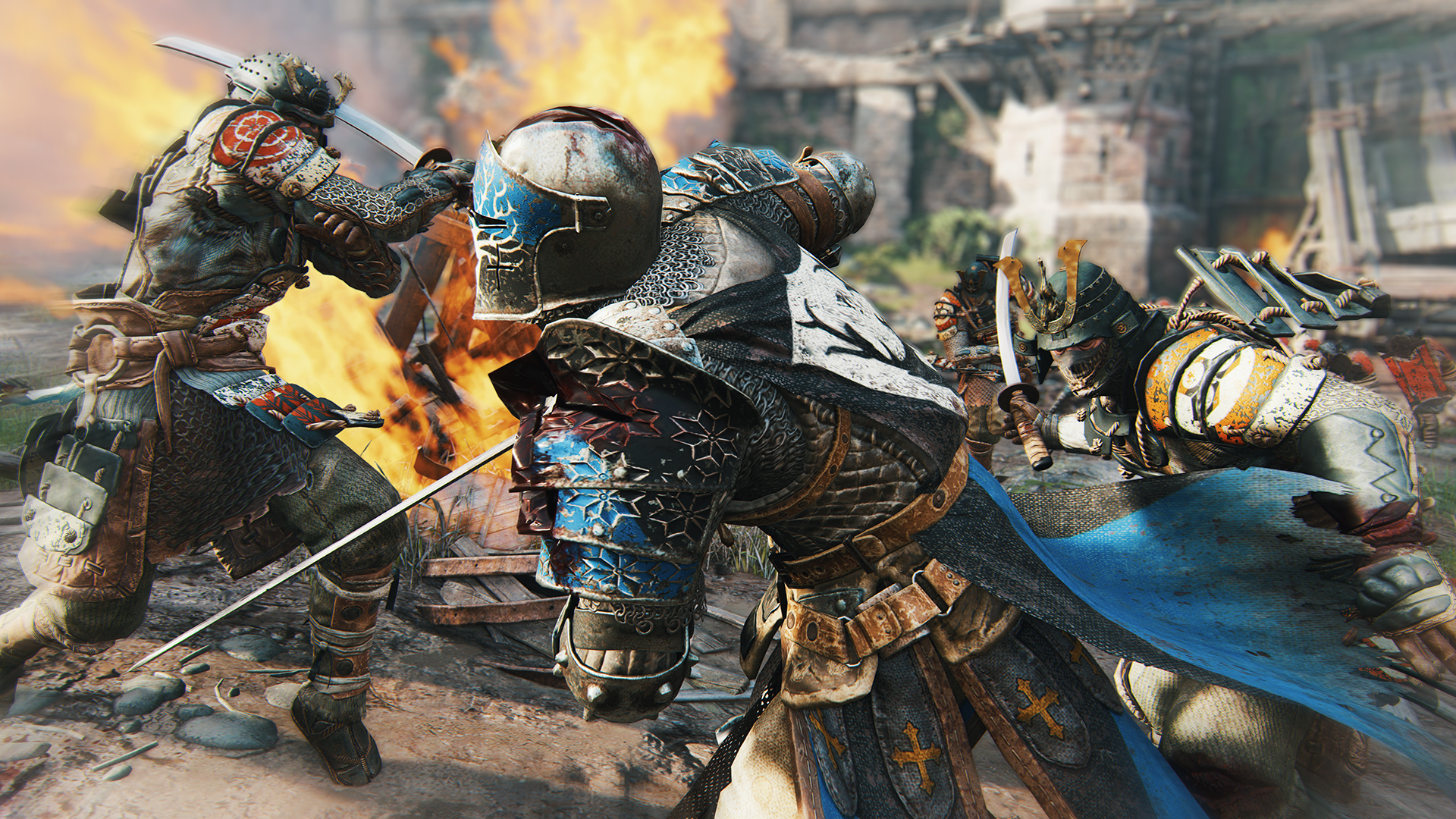
Because the combat in For Honor is solely melee, fighting feels more intense and visceral as opposed to other games that can remove you from the action. Using visual feedback on-screen and haptic feedback from the Xbox controller, each swing carries weight behind it and each block feels forceful.
Entering combat with an opponent immediately brings up UI, shaped like a shield, aiding in the fight. From three directions– left, right, top–you are prompted to block and swing. This serves as the basis for all one vs. one combat. If your enemy is about to strike down on you from above, an arrow will glow red signaling the direction of their attack. It then comes down to placing well-timed strikes while reacting to blows from any angle. When blocking isn’t enough or you are overwhelmed, you can quickly dodge as well. The controls are cumbersome to learn and it takes time getting past the awkwardness, but mastering them is a reward in itself. Combined with fluid animations, the combat gives the sense that you really are a fearsome warrior. To top it off, players can perform vicious executions.
In addition to the heavy and light attacks that all heroes are capable of, they have access to abilities called Feats, ranging from passive to those that must be activated. These include the ability to throw axes, summon aerial strikes of arrows upon multiple areas, and more passive abilities like gaining stamina when you kill another hero. Feats with better benefits can be unlocked upon leveling up.
Story Campaign
The campaign, split into three chapters, takes players through eighteen missions, six for every faction. Told as though the events have already happened, we are taken through several years of conflict and war leading up to the present. Short cutscenes bookend every mission and much of the action is narrated throughout the gameplay as well.
Beginning twelve years ago, your character is knighted to the Blackstone Legion, taken under the control of Apollyon. Urged to push into Valkenheim, Viking territory, the Knights strike the fortress of Sverngard for its food. This sets off a chain of events leading to the subsequent Viking and Samurai chapters. Apollyon’s true goal is chaos through war, so as she wields her power with an iron fist, she constantly manipulates the situation to ensure that the lands and their people always have an enemy. The entire story is fairly straightforward, but it gets the job done at providing a decent campaign for those who are interested in it.
For the entirely of the Knights chapter, I was disheartened by the lack of variety. All six missions consisted of rushing similar areas using the same tactics. Run through a location, defeat a few enemies along the way, and finally make it to the boss. I enjoyed the Viking and Samurai chapters much more as they included different mechanics such as pursuing an enemy on horseback and taunting an elephant into charging a gate.
Multiplayer
As many know, For Honor does not use dedicated servers and instead uses a similar method to peer-to-peer. In an attempt to eliminate host advantages that plague traditional peer-to-peer models, every match is played without a game host and players send their actions to all other players in a synchronized simulation. Though this method tackles some problems, it also isn’t ideal. Servers are still unstable, and as can be expected on release day, there was an array of networking errors across all multiplayer modes prohibiting me from joining any matches. Even during the middle of matches, I encountered several instances where the game lagged or I was dropped from the match entirely.
At the start of the game, players are asked to choose a faction in the Faction War. This a part of the multiplayer where territories are split between the Knights, Vikings, and Samurai. War Assets are awarded after matches to be deployed to help conquer enemy territory or defend your own. The location and appearance of maps are then determined based upon the ruling faction. No matter which faction you choose, you can still access all of them in any match. For example, I chose the Samurai as my faction, but I can still play as the Vikings and Knights. If you want to change your faction in the Faction War, you forfeit your right to receive Faction War rewards related to the current round, with every round lasting two weeks. Change your faction after the first round, and you forfeit rewards for the entire season, lasting five rounds. This acts as a fair deterrent so players are not constantly changing factions based on who’s winning at the time.
There are four character classes in every faction; Vanguard, Heavy, Assassin, and Hybrid. Vanguards are well-rounded and the basic class that players have unlocked. These are the most accessible characters as they can serve several functions on the battlefield in both offensive and defensive positions. The Heavy class, as the name suggests, consists of hulking, formidable foes with higher health and superior blocking capabilities. On the downside, they also have slower movements. Assassins, being nimble, tend to have faster strikes and are more agile in dodging enemies, however they are poor in blocking incoming attacks. Lastly, Hybrids combine many of the traits of the aforementioned classes, and wield long, sweeping polearms to boot. This class arguably takes the most time to master, but their versatility on the battlefield is well worth it.
Depending on your playstyle, you may find yourself gravitating towards a particular class and faction, but I recommend trying out all of the characters to see what suits you best. Although each class may carry unique benefits, none seem to have too much of an unfair advantage over the others. While warriors like the Hybrid Lawbringer (Knight) are exceedingly difficult to kill at first and deal massive damage, even the smallest hero can take down a large brute with the right amount of prowess. As more become accustomed to the combat, the skill gap should increase greatly. This is not a game where simple button-mashing can propel you to victory. A good deal of practice is definitely required if you even want a chance at defeating other players.
One of the most popular modes, Dominion, is a four-on-four mode where players must earn points by capturing multiple zones in the arena. Among the teams are armies of small computer-controlled soldiers that charge into enemy lines and push to capture the middleground, but they don’t serve a huge purpose other than adding to the aesthetic of a chaotic war zone. Once a team earns a thousand points, all players on the opposing team cannot respawn and must be eliminated unless they can rally back. I played more Dominion matches than anything as I found it exhilarating how quickly the tides could turn.
Duel and Brawl offer one-on-one and two-on-two matches where players can truly find out who reigns supreme. These are Best-of-Five modes where the first player to win three rounds claims victory. Instead of running head first towards each other, these modes began with a bit of a dance. Once I locked onto my opponent, we would circle around each other as we inched closer, waiting to see who would strike first. This made it feel like a real fight as I imagine that is the more tactful way to size up your enemy. Even after a few clashes, I would break away to step back and assess the situation. You need to be very careful about your surroundings as getting thrown into a pit or off of a ledge means instant death. These matches are often tense as one false step can signal your demise.
Deathmatch offers Skirmish and Elimination modes depending on the map chosen. Skirmish is a 4v4 mode where a team of players must gain points by killing members of the rival team. Like Dominion, once a thousand points are earned, the other team must be eliminated with no respawns available. Elimination, another Best-of-Five mode, is similar to Skirmish with a heightened sense of desperation. Without the ability to respawn at all, this is a fight to the death.
At the end of each match, you’re granted bonuses on weapons and armor. You then have the ability to customize any character with the items you’re awarded. Most of the gear might as well be cosmetic though as I didn’t notice a difference when I equipped it.
All of these modes can be played in Player vs. Player or Player vs. AI matches, the latter being a helpful way to grow accustomed to the maps and gameplay without a tough challenge. If there aren’t enough players to join a match, the remaining spots will automatically get filled in with AI. I would like to see new, more diverse modes added in the future, but the five modes available right now are enough to cultivate a growing player base.
Summary
Though Ubisoft could have easily played it safe by focusing on any of their existing franchises, in choosing to develop a new IP, they created an admirable fighting game with thrilling action. Its single-player campaign is satisfactory at best, but it works as a great training tool to familiarize yourself with the characters and controls. Where For Honor truly shines is in its savage battles and multiplayer, as rough as the servers may be. Time will tell whether the competitive multiplayer will have any longevity, but the grace in which players clash swords on medieval battlefields is so captivating that I keep coming back for more.

Jennifer is a games journalist, former games journalist and PR Manager at Gearbox. They contributed 234 articles to ICXM between 2015–2017, focused on opinion pieces, game reviews, Windows and PC, and Xbox news: went on to write for Windows Central and later managed PR for Gearbox Software.