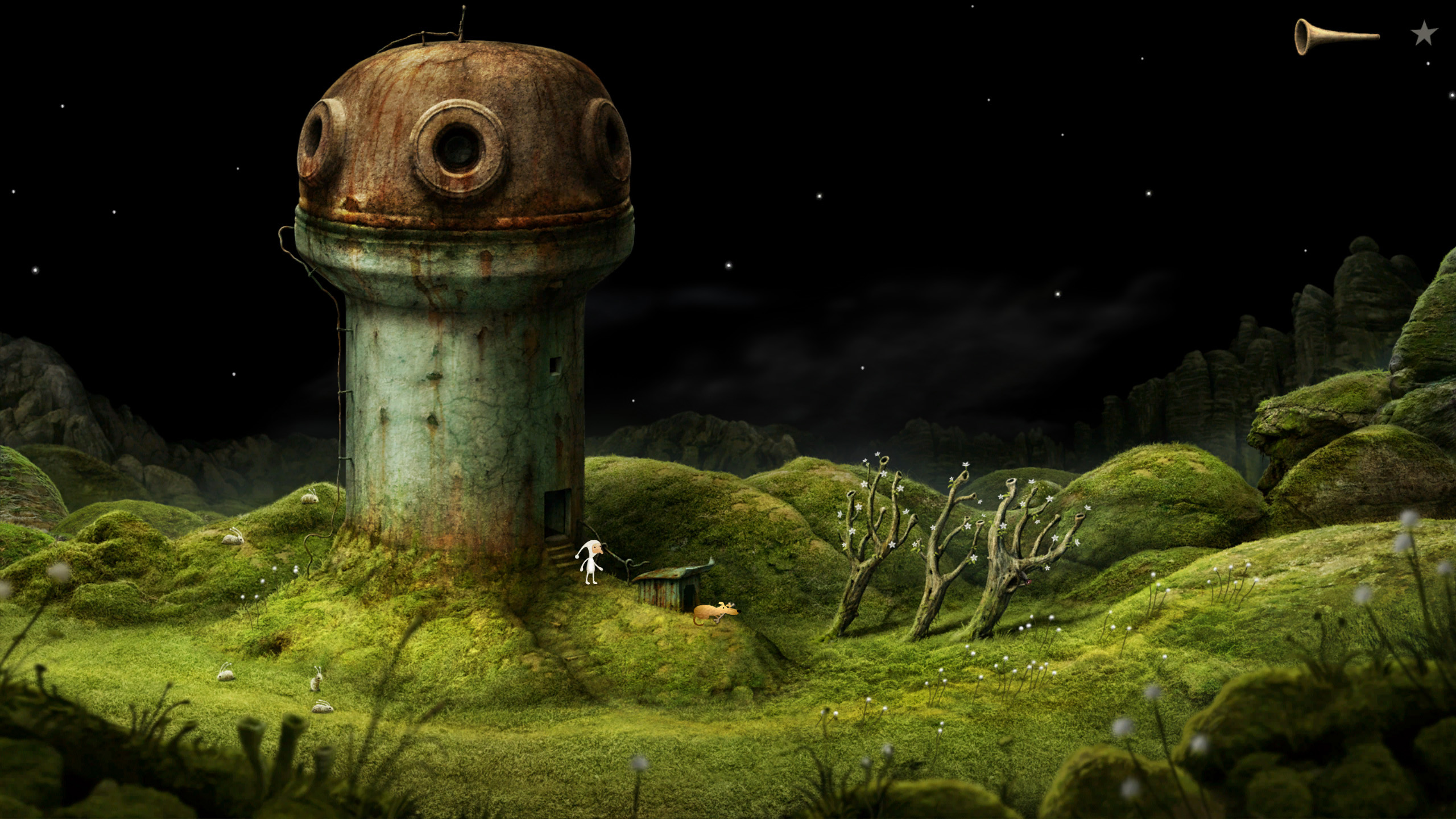
The Czech developing studio Amanita Design has always given to their projects a peculiar personality that started in 2003 with the original Samorost, followed up with its sequel Samorost 2 in 2005. In 2009, Amanita Design released Machinarium and in 2012, they released Botanicula. In 2016, they bring back to life the Samorost series with their latest game called Samorost 3. In any of their games, Amanita Design has always preferred to focus on developing games that would stand out from the regular standards, opting to create beautiful and charming environments for the players to enjoy exploring and uncover the story behind their games than the traditional approach with logical plots and dialogues. Eleven years have passed since Samorost 2 was released and after all that time the little gnome is back to another of his adventures through abundantly organic worlds.
As a bit of a “trademark” from Amanita Design, in all their games the story is always kept simple and told without using any text or voice narration. The little gnome’s adventure starts when a mysterious trumpet falls from the sky and lands on his garden. After discovering that he can use it to listen and sometimes invoke the spirits of nature elements, he embarks on his journey to find out from where the trumpet has come. Although Samorost 3 is a sequel to the previous game, Samorost 2, the story is very straightforward and doesn’t require you to play the previous games in order to understand it.

As I’ve mentioned, the trumpet lets the little gnome listen and communicate with the spirits presented in the various nature elements, such as plants, trees, and animals. Once he communicates with those spirits they will give him hints, puzzle solutions and story elements all in a series of charades. The same happens when he encounters other characters. Whenever he is “talking” to the spirits or any other characters, all of the “conversation” is based on a series of images and animations rather than the traditional text format. The lack of text in Samorost 3 is even extended to the game’s menus, from settings to saving and loading, everything is displayed by symbols, and the only words that can be found in the game are in the credits. This lack of text makes Samorost 3 a game that relies on the universal language of images more than words, which opens it up to everyone regardless of their language.

The puzzles featured in Samorost 3 go from the usual ‘find a specific object to either interact with or to deliver to someone’ to the puzzles where you need to figure out the correct sequence of sounds or objects. Most of them also require a different approach that pushes you to think in a more creative way to solve them, such as manipulating certain objects in a specific way rather than just clicking on them. Hints and solutions to the various puzzles can be found hidden through the various level environments. The main objective of Samorost 3 is for you to explore everything using sounds to listen to animals and plants to interact with. And in case you get stuck without knowing what exactly you need to do to pass a certain puzzle, the developers have included a walkthrough for every level/area of the game that can be accessed from the game menu by solving an easy puzzle in order to unlock it.

One of the aspects that really stands out in Samorost 3 is without any doubt the art style used in the game’s landscapes. The entire game takes places in outer space where the little gnome will travel through a total of five planets and four small satellites. Every planet and satellite has its own ecosystem filled with small details that when combined together presents the player with some stunning and almost photorealistic landscapes that could be easily compared with some of the biggest AAA games out there. Another interesting aspect of Samorost 3 is its subtle and upbeat soundtrack filled with ambient noises and unique sound effects, which most are made using people’s voices, like the dog barking, the gnome spaceship “breathing” and some of the funny nonsense uttered by the little gnome. There are also some occasions where some of the creatures from each planet start to create their own music which leads to the main character dancing.
Summary
Samorost 3 is a short point-and-click game, and it took me five to six hours to fully complete it, with Steam achievements and all. Although it can look short, compared to other exploration games, Samorost 3 complements that with the stunning, detailed and almost photorealistic art style of the various landscape scenarios, which are great just by themselves, but adding the various sound effects and music to them creates a great point-and-click exploration game filled with some interesting puzzles. For those who appreciate the previous games released by Amanita Design, and even if you haven’t played any of them, Samorost 3 is definitely one of their games that I would recommend you play.

João is a games journalist, Senior Editor at XDA Developers. They contributed 156 articles to ICXM between 2015–2017, focused on game reviews, Windows and PC, and Xbox news: previously reported for Neowin before joining XDA Developers in 2021, where he leads coverage of Windows, Microsoft, and hardware.