Back in the days of yore, before the age of video games, there was a time known as the Era of the Tabletop. It was a period where pen & paper was your controller, a crudely drawn map on an old napkin was your level, an overpriced plastic figurine was your character, and your own mind was… well, everything. Dungeons & Dragons, Shadowrun and their ilk were on top of not just the table but the world of games (see what I did there?). It was a true, open-ended roleplaying experience – provided you had a half-decent DM, of course.
While these undisputed kings of roleplaying are arguably as popular as they’ve ever been, this is unquestionably the age of digital games. One of the many to realise this near the beginning, was none other than the inventor of the original Shadowrun tabletop game: Jordan Weisman (an apparently wise man – I’m here all week). In 2011, Weisman founded Harebrained Schemes. Four years on and two Shadowrun computer games later, we find ourselves at the third and latest entry: Shadowrun Hong Kong. So whether you love the tabletop version but are yet to try your hand at the videogames, or you’re a gamer that wants to try the tabletop version but feel a bit out of your depth, you can bet that this is the most authentic Shadowrun experience you’re going to get on a computer. It’s a fantastic gateway drug between the tabletop and the desktop, in other words.
The basic premise of pretty much any Shadowrun adventure, is that you are a Shadowrunner; a mercenary thief for hire, willing to take on any odd – and often violent – job for enough Nuyen (the cold, hard cash of this universe). It’s a dark job in a grim world; a dystopian, cyberpunk future where shady corporations dominate the world, the divide between rich and poor is wider than ever, everyone’s got a gun and/or mechanical augmentation, and a great rift in the fabric of reality has opened – causing magic to once again return to Earth; along with trolls, elves, dwarves, dragons and a variety of other fantastic beasts. This is known as the Sixth World.

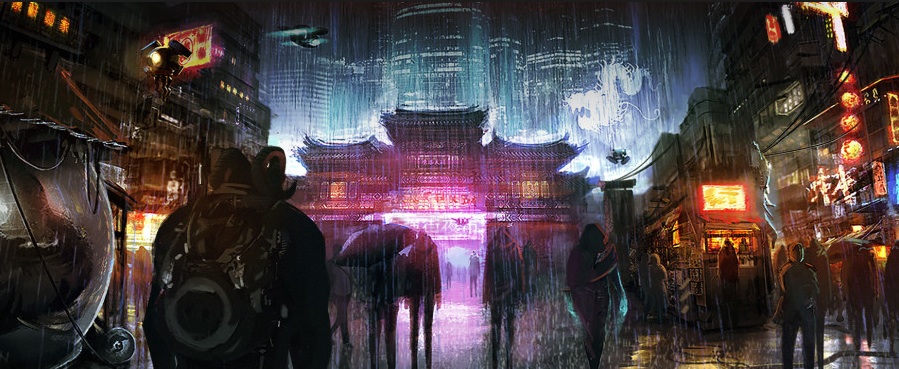
The world itself is beautifully realised in a fixed-perspective or isometric style, with hand-painted environments which are gorgeously detailed. They can feel a bit static at times, as it’s obvious you’re just looking at a drawing. But it’s a very pretty drawing. Still it’s a shame they aren’t more animated, and it’s equally disappointing that you can’t rotate the camera, especially in combat – which I’ll talk much more about later. You certainly buy the world they promise though, and it’s every bit as wonderfully miserable as you’d hoped. The main issue visually however, is that Hong Kong is not vastly different looking or feeling to America or Germany, where the previous two games were respectively set. The maps are mostly all brand new (a couple of minor locations are reused, albeit with slight makeovers), but it’s pretty samey. Aside from a few more colours and a dockland, it’s just the same as always with very little recognisably oriental features. If it wasn’t for the name it could almost be anywhere in the world. Even the characters are mostly white Americans or Europeans. There’s weirdly not many Asians or other ethnicities at all, which is disappointing and confusing. Any Asians that are in the game are usually shopkeepers or incidental characters, with a couple of major exceptions. Everybody just seems to be a foreigner, who all seem to have a flimsy excuse for being there.
Even the player-character, is canonically an American with a dodgy reason to visit. It’s weird that a game like Shadowrun with such a focus on letting players make their own character, forces an identity upon the player. It’s ultimately minor and easy to wave away, but odd nonetheless. Anyway, you’re whisked over from Seattle to HK to have a bit of a chinwag with your father figure, who we quickly discover has gone missing. From there the plot evolves down a semi-open-ended path; the missions are always the same but the order you do them and how you do them can vary greatly. This includes their endings and by extension, the actual proper ending of the game, which has multiple outcomes.

The mission to mission variety comes from the game’s extensive roleplaying options, with a massive skilltree that allows for a stunningly high number of potential character-builds. These don’t just affect combat, but also dialogue options, and can open new paths & possibilities around various levels. For instance, you can choose to be a decker that hacks into computer systems and wreaks havoc, a shaman that summons spirits to fight for you, or an engineer that sends drones through vents to access otherwise inaccessible rooms. These are just a tiny number of the builds you could come up with. Personally I played a full-on combat character through Hong Kong, with cybernetic limbs that made me faster and stronger, as well as being able to effortless catch and throw back projectiles with my magnetic hands. My real favourite thing though, was my razor-sharp whip that could cut a man clean in half – at least in my head. The cyberware is one of the areas that’s been most improved this time round. There’s a lot more parts of the body that can be augmented, along with the much larger variety of gear to stick on it – and most of it’s available much earlier on than before so there’s more time to enjoy it.
Despite the potential to become a one-man-army with knives for your goddamn fingers and eyeballs that shoot lasers, you aren’t taking on this seedy world alone; you’re joined by a cast of colourful characters, each with their own unique abilities and sassy personality. HK is on top form in this department once again, bringing what is probably the most interesting team yet – or at least on par with Dragonfall. Personally the sly Racter & ditsy Gobbet are particular delights, but Duncan is awesome too – primarily because he feels like if this were a movie, he’d be played by Dwayne “The Rock” Johnson. The characters are one of the places where Shadowrun has always really shined; they are brilliantly written, with a ton of dialogue and occasionally moving backstories. Unfortunately, this is always let down massively by the lack of voiceacting. It’s understandable that a small studio like Harebrained can’t afford the massive number of actors needed for what is easily a 30+ hour game with such a large cast. Of course text can be a powerful force too, even preferable in some cases, but the sheer amount of it you have to click through starts to make your eyes glaze over. It’s a real shame, considering the quality of that text.

Another reason for the use of text, is the descriptive dialogue the game throws at you instead of actual things happening. When you’re in a conversation and somebody collapses on the ground, you’re *told* that your friends rush to their aid – performing CPR – while a few people push and shove each other as they look for someone to blame, rather than seeing it for yourself. This flies in exactly two places: books and tabletop games. But this is a videogame; a visual medium, where it’s all about showing rather then telling. This, combined with the lack of voiceacting, causes some scenes to completely fall flat because you’re just reading the script instead of watching the movie. It’s just not compelling despite the image in your head being totally awesome. Again, this is not a book or the tabletop, so it just feels cheap.
Despite the gripes with the method of storytelling, the story itself is pretty good. It’s not particularly unheard of in videogames; guy goes nuts, you have prophetic nightmares, scary man wants to do something evil, the world is going to end unless you- yes YOU, ANDY – stop drinking drinks with aspartame in them right this bloody minute. You know, the usual (don’t worry, Andy’s of the world, I just randomly chose that name to mess with all of ya). It’s a well told story with some very interesting outcomes, both story and gameplay related, based on your actions throughout the game. It’s perhaps not as epic as Dragonfall’s story, but it’s definitely not a stupid as Shadowrun Returns’ ended up becoming about halfway through. Either way, it nails that ominous feeling good Shadowrun campaigns are known for, and delivers a satisfying journey with some fitting conclusions.
Along the way you’ll have to do a bunch of missions in order to earn cash for weapons and find out information to advance the plot. Again, Dragonfall probably had better quests than Hong Kong, and didn’t have any that obviously felt like the game was actively wasting your time. Unfortunately HK does, with a particularly dull one coming quite early one, that has you rearranging the furniture in an office to mess up the Qi energy derived from its swanky feng shui. Yes, that’s seriously a mission, and you can watch me suffer through it after reading this review. Also follow me on Twitter and remember to send me a birthday card, please. Nowhere, however, does the game fell more frustrating and timewastey than in the matrix sections.

The matrix is Shadowrun’s way to make hacking computers feel more futuristic, although like most of the 80s and 90s pop-culture attempts at cyberspace concepts, it actually feels like a dumb relic of a less-technologically rich time – before the internet and actual online worlds like MMOs became a thing. It feels more like the cyberspace from The Lawnmower Man or the old FMV game, Ripper (starring Christopher Walken!), than it does a forward-thinking visualisation of future technology. Say what you want about the Wachowski’s Matrix movies, the virtual world in those felt more forward-thinking, even if it’s not strictly the same thing (and got a lot of “inspiration” from things like Shadowrun). It’s not just the concept that’s the problem, though. These sections are unskippable even if you don’t want to play as a decker, which is really very stupid and goes against the roleplaying promise of the game. No other character class has their particular thing shoved upon the player so it’s ridiculous everyone has to sit through these terrible minigames. The gameplay in these sections is abysmal. Unholy. Accursed. And lots of other mean words. The matrix has been “upgraded” since Dragonfall, with new art and new features. But it’s way, way worse than before. It used to just be a chore, now it’s doubly so and much more likely to frustrate you and waste your time.
The matrix in HK, is now a mixture of horrible stealth gameplay, awful symbol-matching puzzles, and atrocious combat. The stealth sections are now real-time rather than turn-based, and have you watching what are basically guards follow their paths as you look for a route to sneak through. It’s clunky, and you’ll often get caught because the controls are extremely slow and imprecise, you clicked on a piece of the map that won’t trigger movement commands, the enemy suddenly span round unexpectedly, you couldn’t even see an enemy was there because the game obscures everything out your line of sight, or the enemy just sees you behind cover because of course it does. The “puzzles” are every dumb, boring, pointless hacking minigame ever. It’s just number matching. The game shows a sequence of numbers, and you punch them in. Maybe I’d like it better if Parappa the Rapper was my version of Clippy or something.

These bits can be skipped, for a price – that being a huge “system trace” increase (which calls in more enemies and sounds alarms when maxed out). Doing that though, is harshly punished to the point of being untenable, as I’ll explain in a second. My question is though, if the developer’s realised the minigame was bad enough to make people want to skip it, why didn’t they just improve it or cut it entirely? Regardless, it’s not a puzzle. I vastly prefer Deus Ex Human Revolution’s hacking minigame, which actually makes you think about how to solve it sometimes, as you plan the most efficient route to travel round the system – with riskier paths bringing greater rewards. Even if you didn’t like it, at least it was over quickly. The matrix sections drag on for an age and distract you from the actual reason you’re there; the plot.
Finally, the combat is the same as before, and just as bad. It’s got none of the variety that the real-world combat does – which we’ll get to in a minute – and has you simply clicking on enemies until they die. It’s absolutely barebones with no thought required at all. To make it worse, you’re now far more likely to sound an alert in the matrix by maxing out that system trace bar I mentioned. All enemies bump it up when they see you, and a lot of encounters are unavoidable. Let’s just say, you hate the number game thing, so you skip one of them. That puts your trace up to 175 out of 200. Then you walk though a door and boom, five enemies are already there, without warning. They all add +5 trace, and sound the alarm, which basically screws up your entire mission while also being even more of a huge bloody time waste by summoning infinitely respawning enemies. It’s not the player’s fault your minigame sucks so much they want to skip it, and it’s not their fault they got caught when the enemies are completely unavoidable.
Through the course of the game, these awful sections distract from the otherwise enjoyable experience, and add several hours of tedious gameplay onto the already long playtime. The game would be vastly improved by simply giving players an option to make matrix sections completely skippable, and instead just doing a decking skill-check when they click on a jack-point.

Moving on from the matrix, finally, to the meat of the game; the running and the combat. Most missions typically involve a lot of running about, usually undercover or as an infiltrator. You’ll sneak, talk, and hack (urgh) your way through levels – using your character’s or team’s abilities to great effect, so who you bring with you matters a lot, as you’re limited to three companions per mission. Having a high Charisma is super-useful here, and I never roll without it. As well as skill-checks, the game sometimes relies on your own squishy computer up in that handsome head of yours, although not nearly enough. One particular joy was trying to guess a historian’s password (minor spoiler warning: the next paragraph reveals the answer to the puzzle – so if you skip it, know that it’s a really good part of Shadowrun and I praise it a lot).
On the wall were several paintings; the most famous of which was a real-life painting called the Lady of Shalott from 1888. So, I tried various combinations of Shalott, 1888 & Lady, with no success. Then I thought outside the box – outside the information the game would give me. I looked up the painting and discovered it was based on a ballad by Tennyson, so I typed in the good Lord’s name and access was granted. It’s something games just don’t do enough these days as they try to appeal to the lowest common denominator, and something I ridiculously appreciate. It’s so simple to do this kind of thing but even Shadowrun only does it a few times, at least that I’ve noticed. It makes a huge change from just being on autopilot through a game and feels so rewarding to actually fire a few synapses for once. So more of that, please, Harebrained.
No matter how sneaky you are though, there’s a ton of combat in these mean, Hong Kong streets. Shadowrun uses turn-based combat to get the job done, and it works a treat. Along with the cool robot arms and stuff mentioned earlier, there’s a huge variety of guns, swords, grenades, ninja stars, magic spells, spirit summons, and buffs to use. At one point you can get an awesomely powerful laser sniper-rifle. It doesn’t have a lot of shots before you reload the battery, but if you grab the cyberware upgrade that makes your hands be able to reload stuff super-fast, you doing so costs no action points and basically gives you infinite shots. This is just one of the ways that abilities can synergise. You can also do things like have your magic chick stun an enemy and then have your ex-cop guy hogtie them, for the pacifists out there. It’s much more varied a system than something like X-Com: Enemy Unknown’s, but it never feels as satisfying as that game. The lack of camera rotation, voice-overs, and X-Com’s action-cam are huge misses. So too is the general feel of the abilities, which both look and sound like they have no impact. Animations are vague and contactless, and the sound effects are often lacking punch. Everything feels like an abstraction of a fight than an actual battle.

Even so, the fights are still enjoyable and occasionally tactically rewarding, although the latter of those statements is quite rare. Again, X-Com is the more tactical game, with better (multi-level) maps and higher stakes which force smarter decisions to be made. Rarely do you feel like you’re out-thinking your opponents in Shadowrun, and rarely do you have a need nor opportunity to decide whether to hunker down or take a huge risk to turn the tide of battle. There’s nothing like the careful, cover-to-cover approach play you’re encouraged to do in X-Com, and there’s certainly no scouting ahead while your sniper hangs back on overwatch. Most fights in Shadowrun are simply this: open a door, there’s a few enemies behind boxes, you take cover and take turns trading blows until someone wins. Like the game’s other shortcomings – except the matrix – it’s purely a matter of the developers not having a big enough budget rather than a lack of ideas or ability. Despite this, it’s still fun and has enough variety in the abilities that you won’t be bored in combat. If they had more money, this could easily be the next big thing in both turn-based combat and cyberpunk genres.
Summary:
You’ll like this if your idea of fun is running through the filthy streets of a dystopian nightmare city, hopped up on drugs and gleaming with chrome cyberware, as you and your team of charismatic misfits unleash a stream of laser-guided lead and fireballs into your mortal enemies. It delivers on most of those desires, but the execution is often lacking, so be prepared to use your imagination to make up for some underwhelming moments. If this is your first Shadowrun game, I’d recommend Dragonfall instead. If it isn’t, you might be let down by a slight lack of significant enhancements.

Dean was a regular ICXM contributor between 2015–2017, publishing 39 articles across game reviews, Windows and PC, and Xbox news. Their work focused on hands-on reviews, platform commentary, and breaking-news reporting during the Xbox One X launch year and Microsoft’s wider Play Anywhere / UWP gaming initiative. They post on X as @SpookyWomble.