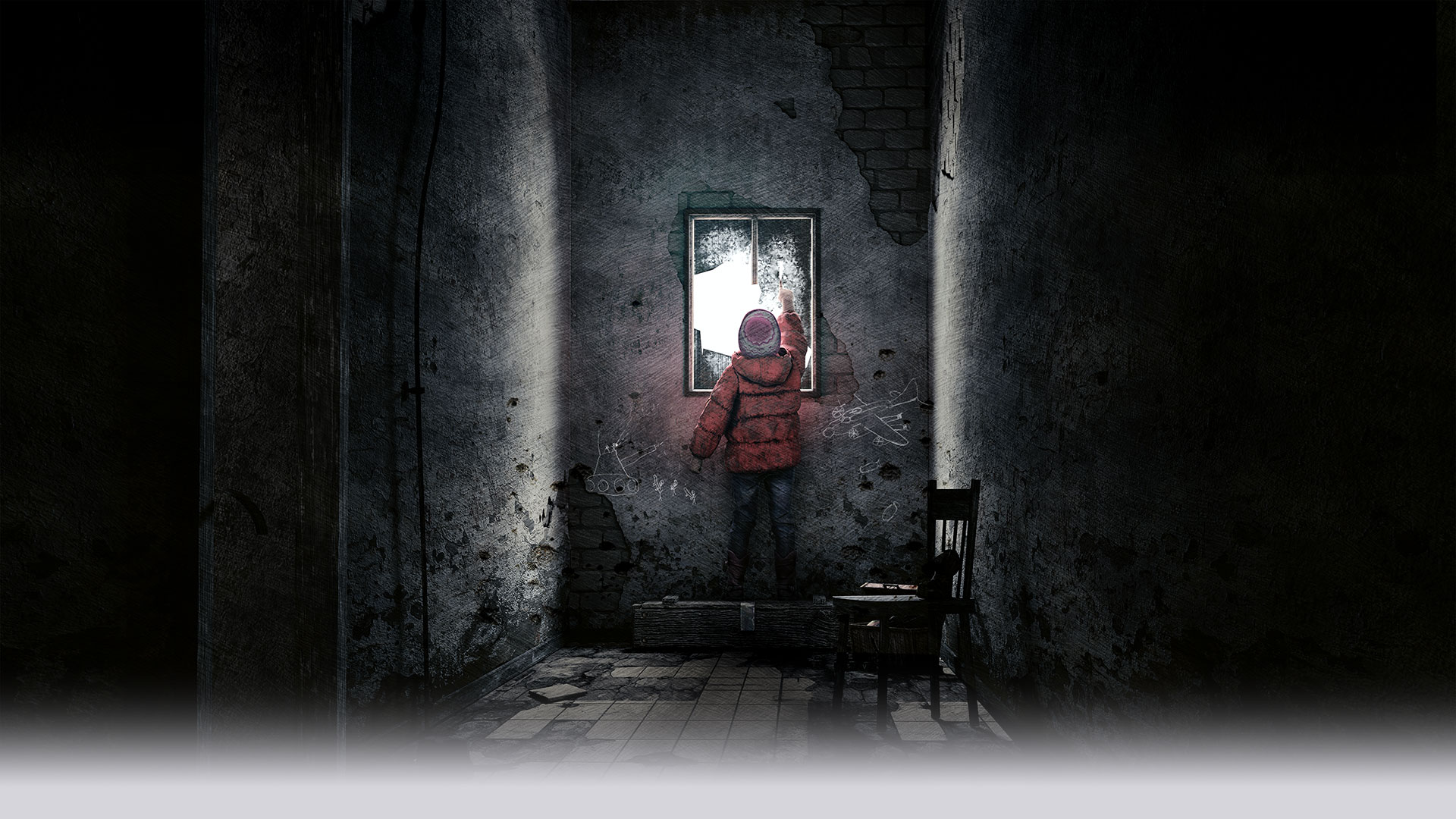
This War of Mine: The Little Ones is a point-and-click simulation game that attempts to evoke pathos in players as they take on the roles of civilians affected by war. A 2.5D background with charcoal sketch lines and dreary gray colors somehow manages to look beautiful, capturing a wasteland desolated by war unlike any other game. At its core, This War of Mine is a solid inventory management game, and it takes some strategic thinking to progress, but the real problem lies in what the game is fundamentally trying to achieve: an emotional response.
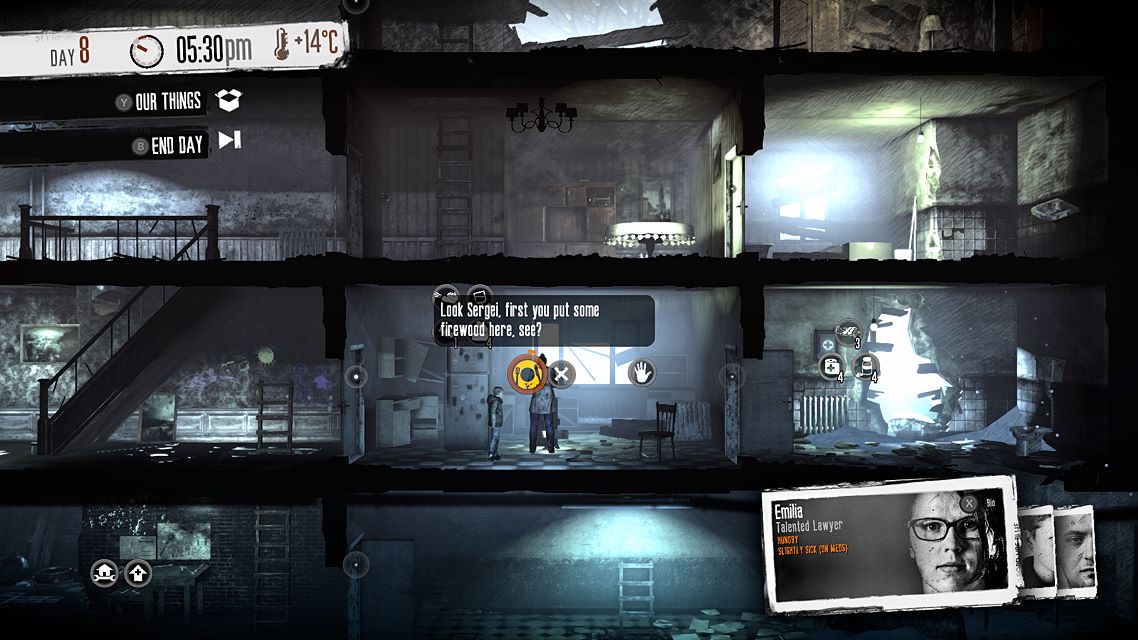
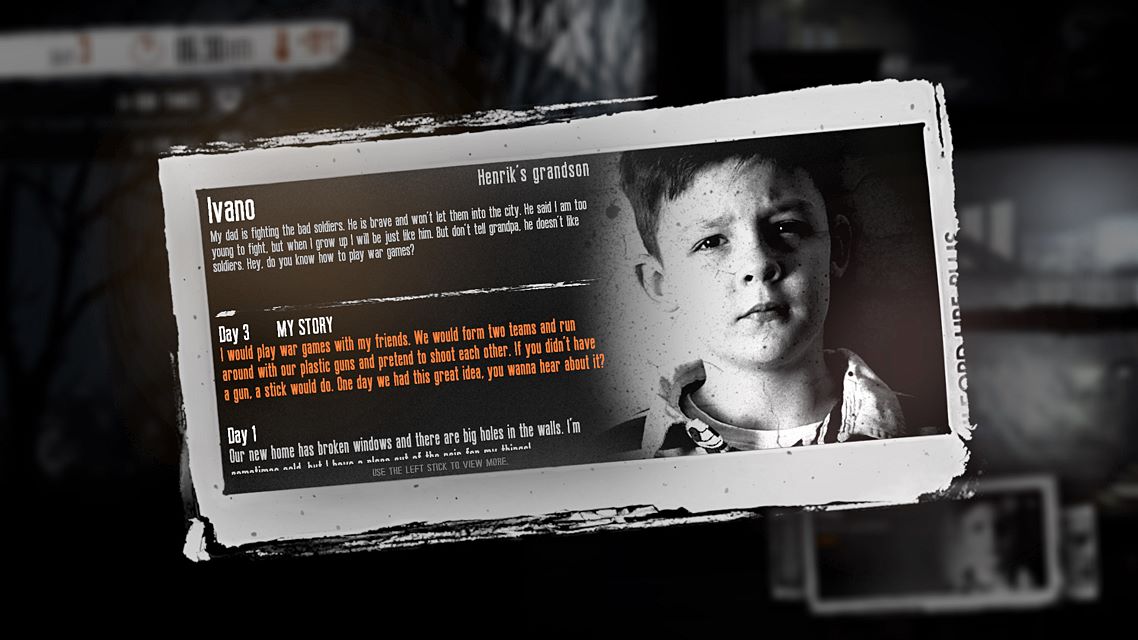
This War of Mine is all about civilians surviving during a terrible war. Rather than fighting on the streets with guns and explosives, you control a small settlement of ordinary people who are simply trying to stay alive. During the day, you switch between multiple characters with the right and left bumpers, assigning mundane tasks to each as necessary. Each character has a photo and a small bio, and depending on pre-war occupations some will have certain skills, such as running extra fast or sneaking quietly. This adds a little bit of extra depth and personalities to the characters you look after. In order to survive you will need to scavenge for parts, wood, food, medicine, and more, crafting valuable items in your deteriorating shelter. Characters will become desperately hungry without food or exhausted without sleep.
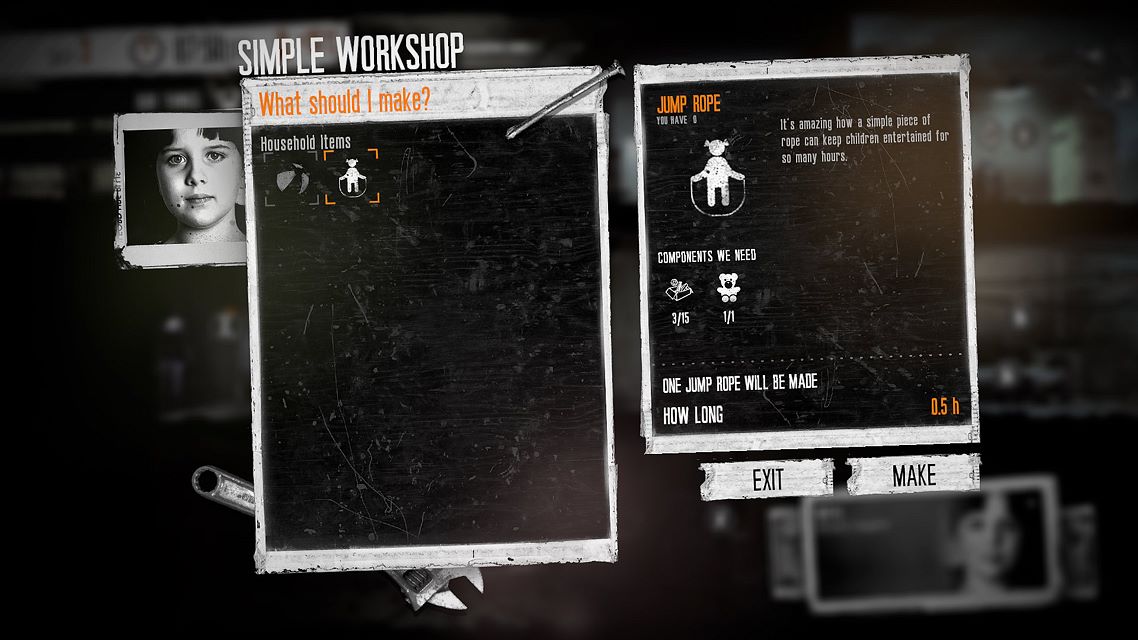
Unfortunately, the faults of playing on console become self-evident quite quickly. As you have to relocate characters manually with the analog stick rather than simply clicking on specific destinations, moving becomes tedious and boring. Walking from the basement of one’s shelter to the attic can be so dull that it is hard to persist. Furthermore, characters not assigned a job will stand idle until you come to them, so your settlement is rarely performing at the maximum potential output. Clunky movement causes characters to run horizontally back and forth endlessly rather than simply walking down some stairs, and indecipherable icons that represent different actions are confusing, leading to countless strategic errors that feel simply unfair. Don’t get me wrong, I like the inventory management system, and I like searching for the resources I need to upgrade my safe house, but it’s hard not to get frustrated when all the minor issues start to add up.
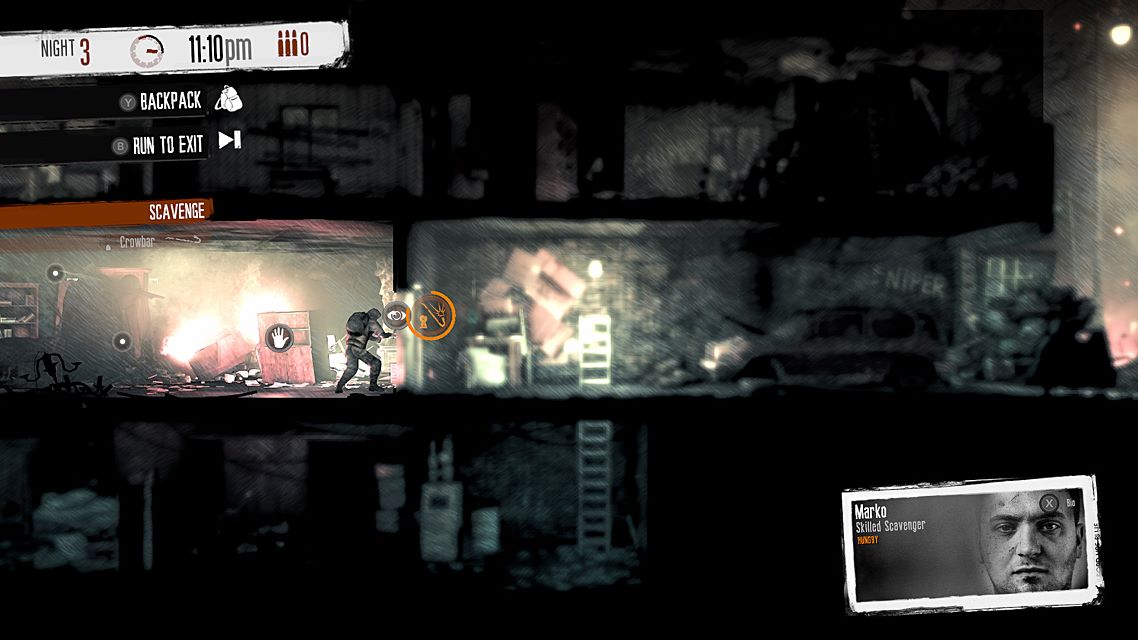
Soon enough you will run out of supplies at home, and must send someone out into the real world to rummage under the cover of night. This night cycle is entirely different from that of the day. You must choose a location to send one scavenger to in order that he or she may find the supplies and resources that you need most. Different locations yield different supplies, and some are more dangerous than others. Sometimes you’ll find yourself in very tense situations. Glowing red circles illustrate sound, and you have to be cautious and careful. Sometimes a sound might just be a rat scrambling across on the floor, but other times you’ll run into fellow survivors just like yourself. Some are friendly, and might offer to trade supplies, but others might be aggressive or paranoid, attacking you. Lighting and sound play a big part in these occurrences, with shadows and even sound waves being realistically displayed so that you can only see or hear around certain corners.
Unfortunately, it is when you meet these NPCs in the night that This War of Mine begins to fall apart. During your scavenging you may find characters sick, starving, lethally wounded, or worse, and you can even aid or attack them, but it’s hard to feel for characters that are portrayed as so not human. On one of my first outings I came across a woman hiding inside an old house. At first staying extra cautious, I soon realized that she was begging for food. Naturally, I approached and tried to hand something over, but alas, I had nothing. Wanting to help this woman, I began to scrounge desperately, looking for something to satisfy her hunger. However, that original feeling of benevolence quickly dissolved as the woman dehumanized right in front of me. Following me wherever I went, the same three lines of dialogue appeared over her head over and over and over again, each begging that I help her with slightly different words. I realized that I knew nothing about this woman. The lack of voice acting brought no emotion to her mechanical lines, her clothes looked the same as my own character’s, and I could barely see even the profile of her face due to the two-dimensional perspective I was seeing from my couch. As there is no way to converse with an NPC apart from trading, my options were extremely limited. This woman felt just as robotic as the mindless AI in shooter games. Rather than feeling guilt and pity for this person who I was denying food, and thus life, I grew more and more frustrated and annoyed with each one of her repeating lines, finally stealing all that I could and leaving the house.
Because of stealing from the woman, my character grew depressed, whereas I felt no emotional trauma at all. Along with hunger and fatigue, depression is an occurrence that must be stopped lest your characters kill themselves, illustrating how This War of Mine attempts to trick the player into feeling regret all for the sake of an additional game mechanic, hence increasing the overall difficulty. I like seeing the consequences of my actions reflected through my own characters, but only to a certain degree. I want to feel sorrow because of my actions, not because of my character’s responses to those actions.
On top of that, characters that have been traumatized or starved will move around your settlement even slower than before during the daytime, trudging along feebly in reaction to the events that they’ve witnessed. This is a great concept that has been executed poorly, as it further destabilizes the movement mechanics, causing even longer wait times.
One feature that the console version of This War of Mine boasts having over the PC version is The Little Ones DLC. The Little Ones implements children into the gritty world of war, offering up a great opportunity for new game mechanics. Alas, that is not at all the case. Children function in the same way as adults in the game, except that they cannot guard your settlement or go out scavenging at night. They are, however, an enormous handicap. Unlike adults, children cannot die, but they can run away or become lost if you do not take good care of them. You must feed them, play with them, and let them sleep. If you do lose a child, then his or her companions will become terribly depressed, which can lead to suicides and then to a game over. Functionally, children serve no purpose. They are not helpful or useful for anything. Again, this feels more like an attempt to implement additional burdens rather than content. Children feel so tacked on and pointless that I would rather play without them entirely.
Summary
The goal of This War of Mine is to keep a group of civilians alive until ceasefire, at which the point the game will end. This can take upwards of about fifty in-game days if you are playing the main game, but custom play allows for shorter or longer games and other specific difficulty settings, which is a nice touch. But, unfortunately, This War of Mine fails to captivate players overall. Inventive visuals and an average management system do nothing to save the game from emotionally bland experiences and frustrating controls, and the implementation of children is an insulting excuse of an expansion. I wish I could recommend This War of Mine. I can see endless potential for a game centered on civilians rather than one centered on the all-too-common soldier stories, but this game just isn’t that one.

Tristan was a regular ICXM contributor between 2015–2017, publishing 51 articles across opinion pieces, game reviews, Windows and PC, and Xbox news. Their work focused on hands-on reviews, platform commentary, and breaking-news reporting during the Xbox One X launch year and Microsoft’s wider Play Anywhere / UWP gaming initiative. They post on X as @tbogost.