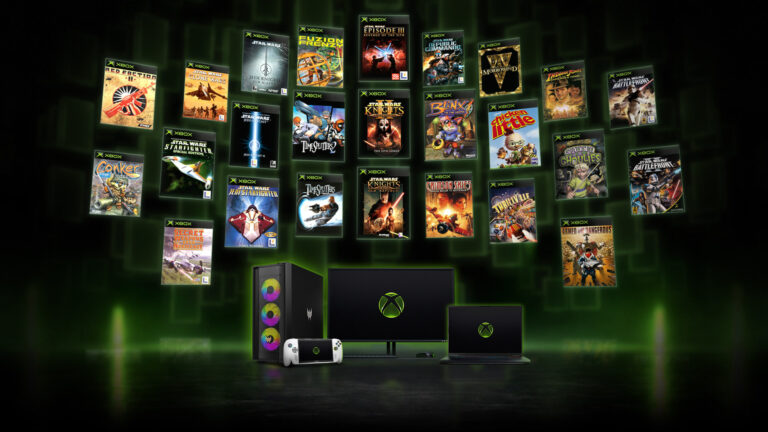
Jason Ronald, Xbox’s vice president of next generation, says Project Helix “is designed to be a console that is also capable of playing games from your PC. It is not a PC that can also play console games”.
On this page
He was asked whether Helix is a console or a PC in Microsoft’s 25th anniversary magazine, which Xbox Wire put online on November 15. A “hardcore gamer or a power user” who wants “that deeper level of customizability across settings and performance options” still “can absolutely go do it”, he adds.
What the Project Helix console is designed to do with PC games
Ronald’s case for a console is that it spares players the upkeep. “I don’t have to worry about updating my operating system, updating drivers, configuring different settings”, he says. “The hardware and the experience is entirely designed around playing games.”
The goal, in his words, is “making it easy, intuitive, and instant to access my games”, on a machine where “we remove the arbitrary constraints between console and PC games”.
That builds on what he told developers in March. Xbox Wire’s summary of his GDC keynote said “Project Helix is designed to play your Xbox console and PC games” and that the hardware is powered by a custom AMD SoC.
The magazine calls Project Helix “the codename for our next-generation family of devices, including the next XBOX console”.
Why Xbox says the next generation isn’t about 8K or 240 hertz
“We don’t think the next generation is defined by 8K, or 240 hertz, or some of the traditional metrics”, Ronald says. He talks instead about “gameplay innovation” and “deeper immersion”.
The technology he names is neural rendering, as a way “to deliver a new level of visual fidelity in more efficient and innovative ways”.
Cost comes into it. The magazine says a “component crisis” is “driving up the cost of almost everything you can plug into the wall”, and Ronald says his team has “to invent entirely new technology” while “continuing to make things accessible and affordable”.
That, he says, is “a big reason why we’re really focused on advancements like neural rendering, because it’s an entirely new way to generate a frame without requiring more computational horsepower, additional memory, and things like that”.
He expects “more innovation over the next three to five years than you’ve seen in the last 10 years”.
How four generations of Xbox games and the ROG Xbox Ally fit in
Ronald talks about being “able to bring four generations of my XBOX library and progression with me and have it available instantly”. The magazine says the backward compatibility program that began on Xbox One in 2015 “will continue into our next generation”.
Xbox CEO Asha Sharma wrote to staff on November 12 that the company has “built four generations of XBOX consoles, with a fifth on the way”.
Progress is supposed to follow the library. Ronald says he expects that “when I’m in the middle of an 80-hour RPG, if I’m 25 hours into that and I want to play it on another device, I should be able to instantly resume from where I was”.
He describes the ROG Xbox Ally as “an opportunity for us to learn alongside our player base” about “being able to play libraries from across multiple different storefronts” and how PC and console games “can show up together in a unified library”.
Feedback from players “has fundamentally informed and altered our plans of how it actually shows up in a future console”, he says. He calls the handheld “a precursor to what we’re doing with Helix”.
Of the Xbox One, he says: “With XBOX One, I think we got so focused on expanding our aperture that we lost sight of what truly is magical, which is players, developers, and the games that they love.”
The date in Xbox’s March post is for developers. It said the company plans “to ship alpha versions of the hardware to developers beginning in 2027”.