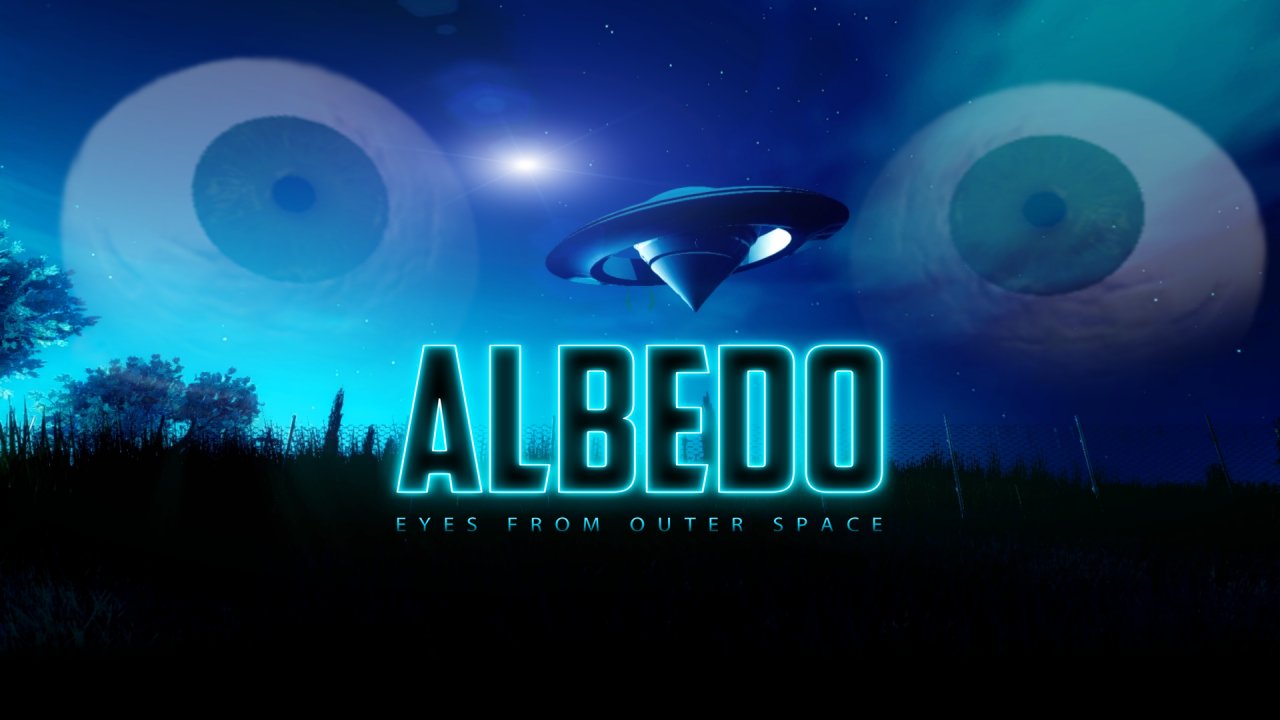
Albedo: Eyes from Outer Space is a hybrid game combining elements of shooter, puzzle and action genres. You play as John T. Longley, a space explorer sleeping aboard his JUPITER ship one night when a massive explosion sends him plummeting into its depths. Once you awaken it becomes your mission to escape the ship while exploring the origin of the aliens that are now on board. The organization John works for, the Olympus Group, is full of corrupt scientists conducting experiments that trifle with space and time. While exploring, you’ll find out why everything happened along with what the Olympus Group really is.
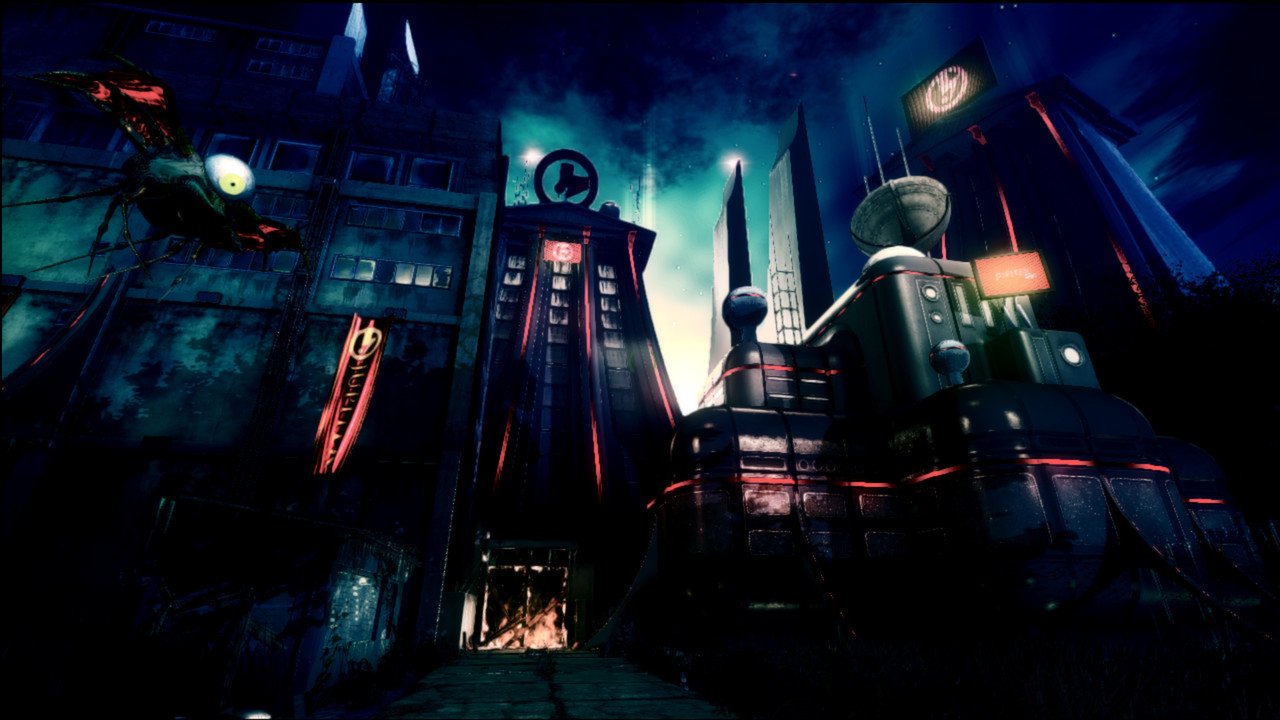
The aliens are big, bug-eyed creatures that look as if they came straight from a 1960s style sci-fi movie. The UFOs wobble in the air as if they are suspended on a rope like something from The Twilight Zone. Puzzles are the predominant feature in Albedo and some are far easier to solve than others. Those others, however, can be quite difficult. While easy ones require some simple maneuvering, harder puzzles often require you to solve multiple sets of problems in order to get the solution to the first one. Fortunately, your Temporal Dilation Tool allows you to look into the future and see a completed version of a puzzle. Since you do not know how you arrived at the solution, you will need to work backwards and then use reverse engineering in order to arrive at the solution.
There are twenty levels in Albedo, each of which took me about thirty minutes to complete. You’ll need to solve a puzzle at the end of each room in order to advance to the next, but that’s not all. A number of first-person shooter elements are situated throughout each level as well. Although the protagonist, John, doesn’t speak that often, all of his statements indicate hints that help to get through situations. For example, after several minutes of difficulty with a particular puzzle, John asked out loud “What’s that smell?” A moment later I was able to find a smelly item that proved useful in solving that particular problem.

Once you enter a room, John has the ability to highlight items necessary to complete the present puzzle. Some items need to be combined in order to form a new object entirely, which will then make other necessary items available. There is almost zero hand-holding in Albedo and it’s refreshing at first, but can be a bit frustrating as well.
The ’60s sci-fi action is far more exciting than I first thought it would be. Rather than looking scratchy and blurry like the ’60s style movies that Albedo draws inspiration from, the graphics are sharp, colorful and frankly quite beautiful. They still manage to maintain that old-school charm. The green alien ooze glows in the light and even reflects upon other items. The water is fluid and the game’s particle effects are pretty enhanced. The manner in which the aliens move is, quite honestly, an impressive sight. They walk and flow like water which is consistent with the overall presentation of the game.
Regrettably, the graphics and presentation in Albedo are victims of their own success. Most of the gameplay decisions and HUD interactions seem to have been based off of presentation and graphical mechanics. Interacting with items takes longer than normal due to the game’s setup. Now, I understand that not all of the items you need can be highlighted to start with because that would remove the “puzzle” aspect of the game. Many of the decisions you will need to make will be based entirely on your own deductive abilities. It can be tricky at first, but you’ll get the hang of it.
There are many aliens you’ll need to defeat before solving certain puzzles, and you can use a wide variety of weapons. With over a hundred weapons ranging from a simple screwdriver to a sawed-off shotgun, goopy alien blood goes flying. Only once you take out the enemies will you be able to solve the puzzle. As noted above, it’s not just one puzzle that needs to be solved. You will need to go through multiple objectives in each room in order to move on. Many times this “need” will not be the key to a puzzle, but rather the key to solving something you then need to solve the puzzle. It can be a chore with the rather clunky UI and HUD setup, but it’s not all bad.

As a fan of puzzle games, I would have liked to see more of the game’s setup triggered by better gameplay mechanics rather than visual benefits. Because of the inferior HUD and how tricky it is to interact with certain objects, solving puzzles becomes problematic even when you know exactly what needs to be done. Also, on the one hand, many of the levels throughout Albedo were incredibly similar to each other, making it hard for me to persevere. On the other hand, Albedo still managed to find a way to include little Easter eggs and hidden areas, which I appreciated.
Summary
Even with the the clunky UI and HUD, I’m impressed with Albedo overall, but can easily find room for some much needed improvement. Every room needs to be 100% explored in order to find the answer to a riddle. Since you are confined to exploring one small area at a time rather than going on one long journey, gameplay can become repetitive very quickly. As a result, I recommend Albedo to any puzzle fan with some patience who is willing to be rewarded for hard work. Although some functions detract from the overall experience, Albedo is an above average puzzle game with many redeeming qualities. Taking into account the elements that could be refined in Albedo, I’m anxious to see what Merge Games develops next.

W.M.B. was a community contributor to ICXM, writing 2 articles in 2016 covering game reviews, and Xbox news. ICXM operated as an independent Xbox and Windows gaming outlet through the run-up to Xbox One S and Project Scorpio, plus the broader Windows 10 gaming push, drawing from a rotating bench of editorial volunteers.